Why every table forgets what "restrained" actually does
Conditions are some of the most-used and least-remembered rules in 5e. Restrained, prone, paralysed, frightened, charmed: every long-running campaign hits a moment where the table pauses, opens the PHB, and re-reads the box of rules text. Sometimes more than once a session. Sometimes more than once a turn.
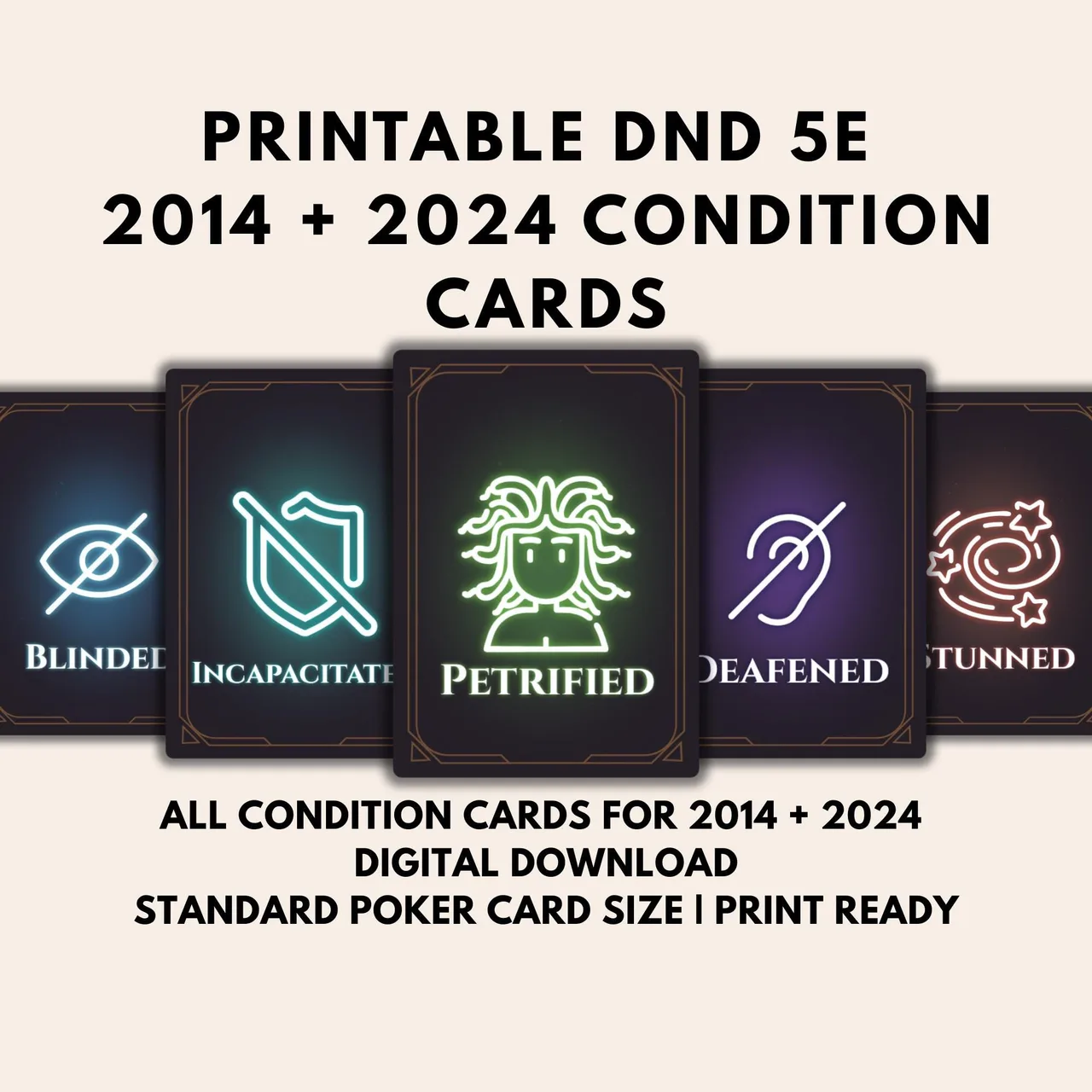
Condition cards solve this by making the rules text live on the table, not in a book. When a goblin grapples a fighter, the DM places the Grappled card on the fighter's mini. The player reads the card. They know their speed is zero, they know they have disadvantage on attacks against anyone other than the grappler, they know what action breaks the grapple. The session does not stop. The combat does not lose pace.
Exhaustion deserves its own card
Exhaustion is the condition that breaks the most. Six tiers, each with stacking penalties, and the player has to remember not just where they are on the track but what every previous tier did. The exhaustion card lays the whole track out vertically with a sliding marker, so the moment the player accumulates a level, they can see exactly what they have lost.
This matters a lot for forced march, sleep deprivation, and hard-mode survival campaigns. If your group runs travel rules seriously, the exhaustion card alone earns its place in the deck. Players actually engage with rest mechanics when the tier is staring at them on the table.
Combining cards with the initiative tracker
The free initiative tracker on this site already supports condition pills, which is great for the DM running the table. The cards are the player-facing version of the same data: the pill is what the DM sees, the card is what the player holds. The two systems pair: the tracker tells the DM whose turn is next and what is on them, the card tells the player what that condition actually means.
For larger combats with multiple stacked conditions, a card per condition keeps everything legible. Three monsters stunned and one player frightened means four cards on the table, each one obvious. No-one has to remember anything. No-one looks anything up. The combat moves.