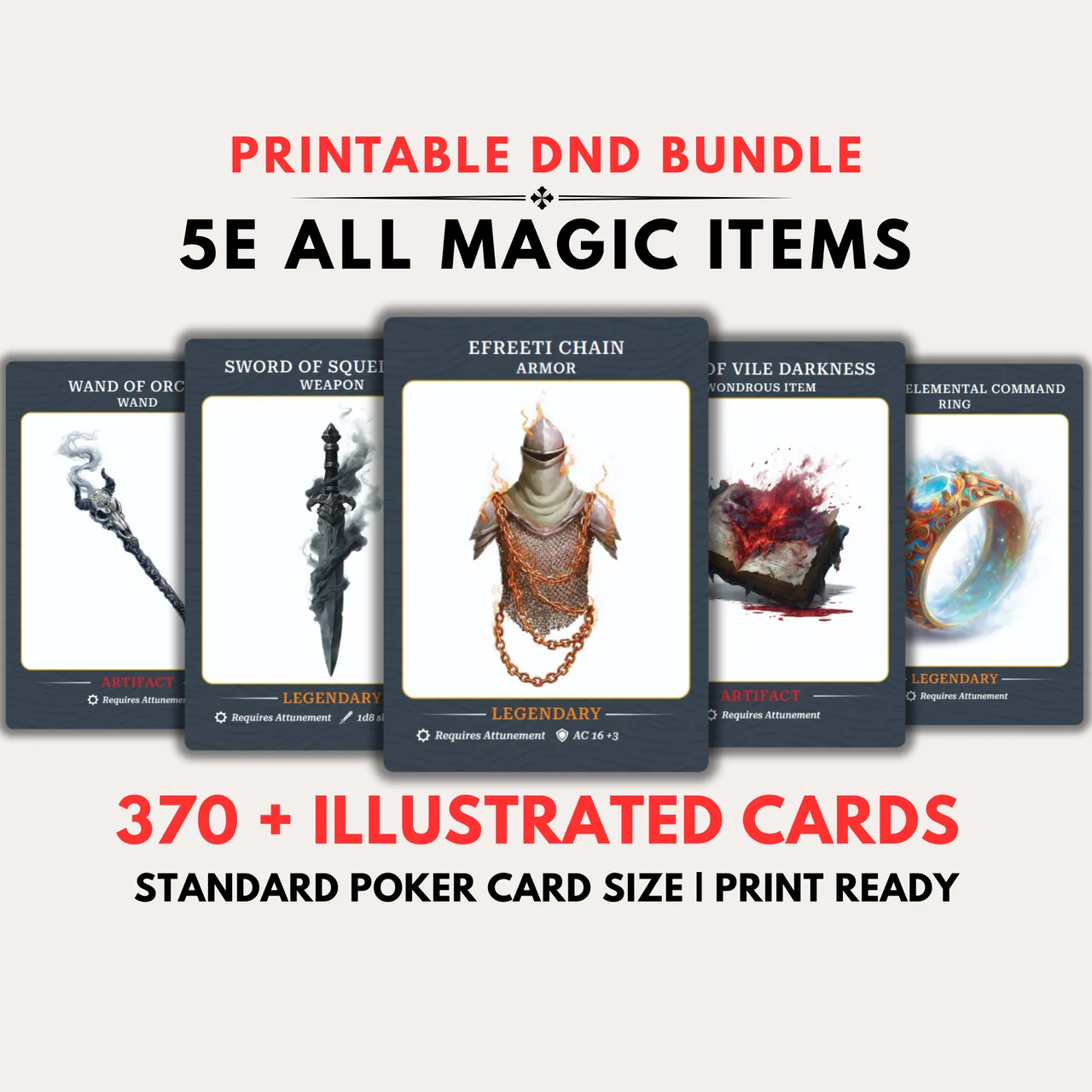
Treasure that lives on the table
Magic items in D&D have a problem: they live in character sheets. A player gets a Bag of Holding and the item exists only as a line of text on a Google Doc, separated from the moment they earned it. Cards fix that. The item is a thing the player picks up, slots into a sleeve, and physically holds for the rest of the campaign.
The sleeve part matters. Most players add notes: how many charges they used today, who attuned to it last, what the item is doing right now. With a wet-erase marker and a card protector, the magic item becomes a small living object instead of an inventory entry. Sessions later, the card is what they remember, not the loot table you rolled it from.
Picking the right card for the rarity tier
The DMG's rarity tiers are calibrated against the assumed power curve. Common items are flavour. Uncommon items shift one combat. Rare items shift one encounter. Very rare and legendary items reshape the whole campaign. The cards are colour-banded so you can grab the right tier at a glance, which matters when you are stocking a hoard mid-session and do not want to break flow.
Pair the cards with the loot generator on this site: roll the hoard tier, see what mix of magical and mundane items the table calls for, then pull the matching cards from your deck. The roll provides the rules-correct outcome, the cards provide the table presence.
Attunement, charges, and tracking
Attunement is one of the most-forgotten 5e rules. Players regularly carry attunement-required items and never attune them, or attune to four things by accident. The cards solve this with a small icon on the face: if it has the icon, the player has to attune. Limit to three. No exceptions. The card itself is the rule reminder.
Charge tracking is the other quiet pain point. A Wand of Magic Missiles has 7 charges, recovers 1d6+1 per dawn, and crumbles to dust on a 1 when the last charge is used. That is a lot of accounting for one item. With a sleeve and a marker, the player ticks off charges directly on the card, sees the recharge note next to the count, and never has to ask "wait, how many do I have?" mid-combat again.