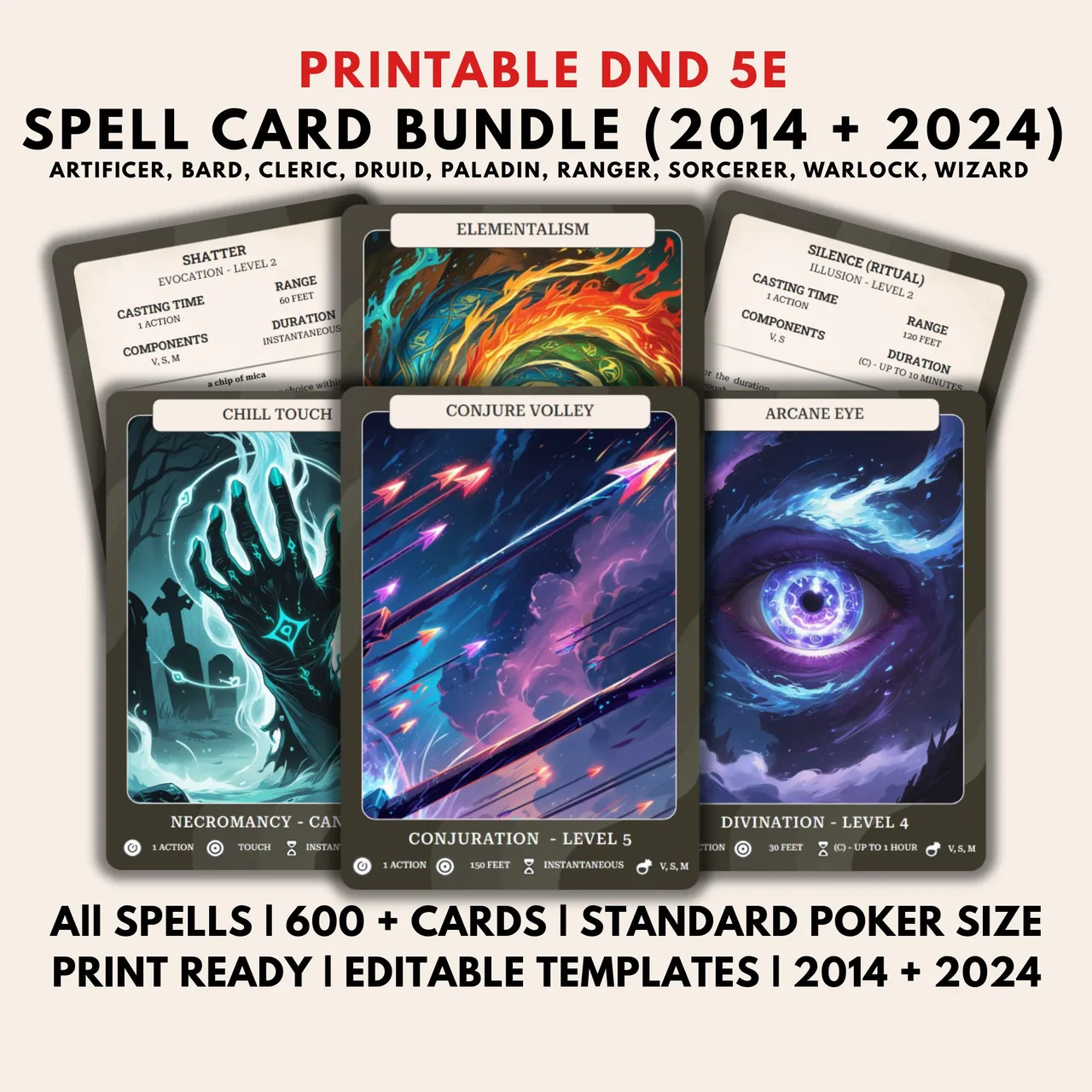
Why physical spell cards change the table
Spell cards solve a problem most casters do not realise they have until they hand one across the table for the first time. Instead of opening the PHB or tabbing through a Beyond character sheet, the player holds the spell. They read the range. They check the duration. They make the decision in seconds.
Faster decisions mean fewer rules pauses, which is the difference between a combat that feels heroic and one that feels like spreadsheet maintenance. Cards also let new players see what they actually own. A wizard with twelve prepared spells fanned out in front of them is a wizard who is engaging with the system, not avoiding it.
Poker vs tarot, illustrated vs text
Poker cards (2.5 × 3.5 in) sleeve cleanly in standard CCG sleeves and stack neatly into deck boxes. They are the right choice for casters with a lot of prepared spells, since you can fit a whole class list in a single deck box.
Tarot cards (2.75 × 4.75 in) read more easily across a table and have room for full-page illustrations. They work better as a hybrid reference + table object, especially for higher-level casters who want one card per signature spell rather than a full deck.
Illustrated decks lean toward immersion. The visuals double as a casting cue, and players who struggle with abstract rules text often understand a spell faster from a single piece of art than from a paragraph. Text-only decks lean toward speed and density. Most tables end up with both.
How DMs use the cards
Spell cards are usually thought of as a player tool, but DMs get just as much use out of them. Hand a player a card mid-session as treasure: they have just learned a new spell, and the prop is already in their hand. Use the cards as a deck NPC casters draw from, so the BBEG's spell rotation feels less predictable. Build a "scroll pile" of physical cards that players can take, sell, or use, without having to bookkeep a spell scroll list on a shared sheet.
The other quiet benefit is post-session feedback. When a player sets a card on the discard pile, you can see at a glance what they cast, what they ignored, and what they wish they had. That is encounter design data you would never get from rolling dice in a chat window.