AI Dungeon Master Tools vs Doing It Yourself (2026)
An honest look at AI Dungeon Master tools in 2026: what they do well, where they fall short, and when free human-run DM tools beat them for your table.
If you’ve searched for DM tools recently, you’ve noticed the flood: AI Dungeon Masters, AI map generators, AI character creators, all promising to run or build your game. The category barely existed three years ago and now competes hard for attention inside a tabletop market projected past $2 billion. So it’s worth a straight answer: what do these tools actually do well, where do they fall down, and when is a free, focused, human-run setup the better choice?
What AI DM tools are good at
Credit where it’s due — there are real strengths.
First-draft prep. Need a tavern name, a quick NPC, a plot hook, or a rough dungeon premise? An AI can spit out a usable starting point in seconds. As a brainstorming partner that never runs dry, it’s genuinely handy for beating the blank page.
Solo and casual play. This is the standout use. Solo and AI-assisted play is one of the fastest-growing slices of the hobby, and an AI DM can give a single player an improvised adventure with no group required. For a casual, low-stakes session, that’s a real unlock.
Tireless improvisation. AI doesn’t get tired of describing the hundredth corridor or voicing a throwaway shopkeeper. For filler content, it’s an endless well.
Where they fall short
The limits are just as real, and they cluster around the things that make tabletop tabletop.
Long-term memory. Campaigns live on continuity — the NPC who reappears, the choice that echoes ten sessions later. AI tools are notoriously shaky here; memory layers help but don’t fully solve it. A human DM remembers that the party spared the bandit because it mattered.
Fair rules adjudication. AI can misapply rules, invent ones that don’t exist, or be argued into a bad ruling. In a game where consistency is fairness, that’s a problem. You end up verifying its calls, which is slower than just knowing the rule.
Reading the table. A human DM senses when players are bored, when to cut a scene, when a quiet player wants the spotlight. That social read is the core of the craft, and it’s exactly what a model sitting outside the room can’t do.
Generic prose and authorship. AI output trends toward the average. The distinctive voice, the running joke, the set-piece that’s yours — those come from a person. And for many DMs, that authorship is the whole point of the hobby.
The honest verdict
AI DM tools are a good assistant and a poor replacement for most groups. They earn their place in prep and in solo play; they struggle to run a living campaign for a real table. The hype frames them as replacing the DM. The reality is they’re another tool in the kit — useful where they’re useful, oversold everywhere else.
A better mix: AI for drafts, focused tools for the table
The setup that actually works is a division of labour. Let AI do messy first drafts if you like it. Then run the game with focused tools that do one job reliably and keep you in control:
- An encounter builder for balanced fights you can trust.
- An initiative tracker to keep rounds flowing.
- An NPC name generator and loot generator for instant, predictable output.
- A condition reference so rules calls are fast and consistent — no model required.
These are free, they don’t hallucinate a rule mid-combat, and they leave the authorship with you. Our full free DM tools roundup covers the set.
The thing no AI replaces: a real table
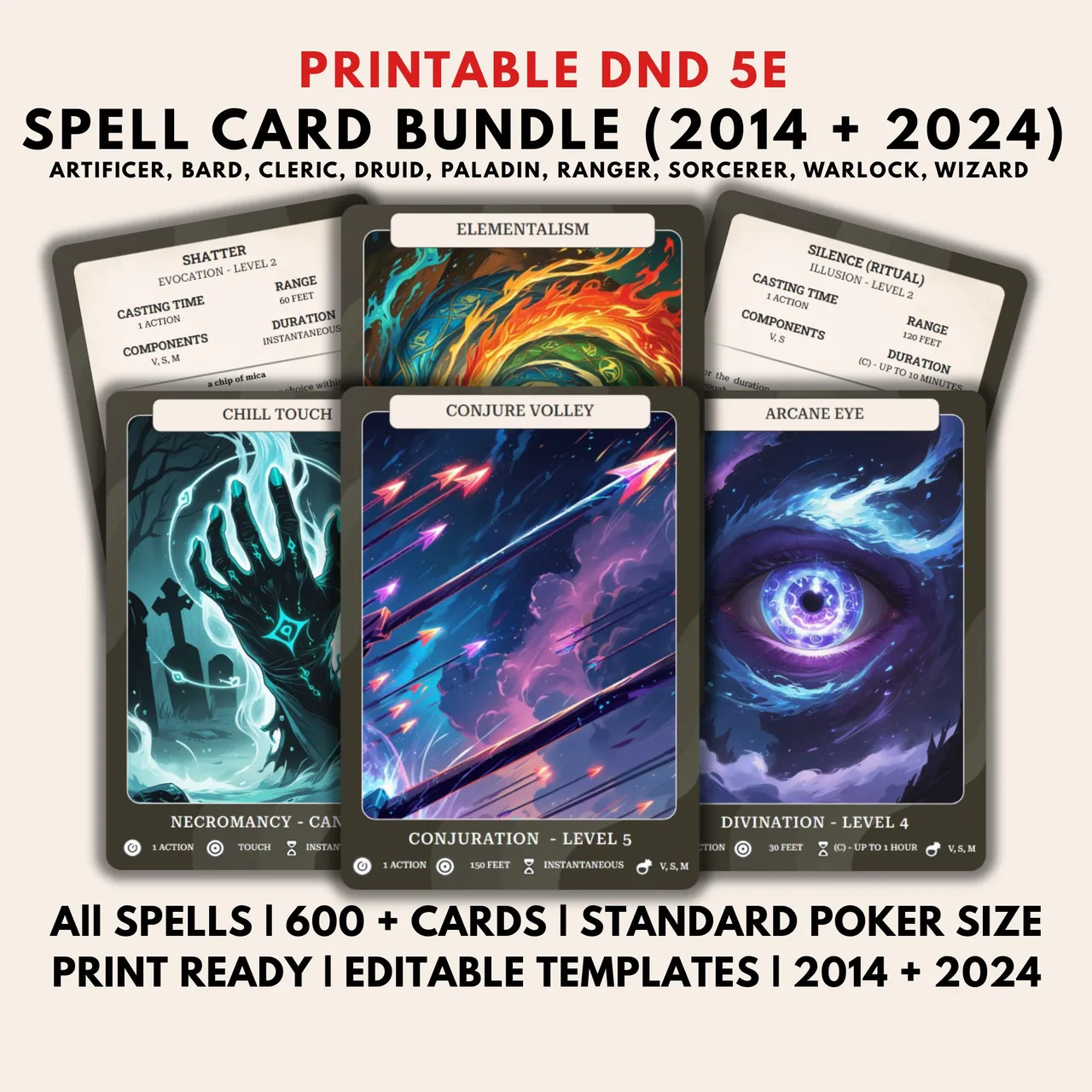
Here’s the deeper point. The appeal of tabletop is people around a table, physical things in their hands — dice, minis, cards, a map they can point at. That tactile, social core is precisely what an AI can’t deliver, and it’s why physical aids still beat a screen for immersion. A spell card in a player’s hand, a printed map under their figures, a deck they draw from — those keep the game human, which is the thing players actually came for.
Use AI where it helps, and not where it doesn’t
Try the AI tools for prep and solo play if they fit how you work — there’s no purity test here. But don’t hand over the parts that make you a good DM: the memory, the fairness, the read of the room, and the authorship. Keep those, back them with reliable free tools, and the result beats any AI DM for a real group.
Frequently asked questions
- What are AI Dungeon Master tools?
- AI Dungeon Master tools are apps that use language models to generate or run tabletop adventures — narrating scenes, voicing NPCs, and adjudicating actions. In 2026 they range from purpose-built D&D 5e assistants to freeform fiction generators and Discord-based group play, plus general chatbots used directly for casual games.
- Can AI replace a human Dungeon Master?
- Not fully for most groups. AI can generate prep, improvise descriptions, and run light solo or casual play, but it struggles with long-term campaign memory, reading a real table's mood, fair rules adjudication, and the social spark a human DM provides. It works best as an assistant rather than a replacement.
- Are AI Dungeon Master tools good for solo play?
- They're one of the better uses for the tech. Solo and AI-assisted play is a fast-growing slice of the hobby, and an AI DM can give a single player an improvised adventure without needing a group. Expectations should stay modest on continuity and rules accuracy.
- Do I need AI tools to run D&D?
- No. You can run an excellent game with free, focused tools — generators, trackers, and maps — that do specific jobs reliably without a language model. Many DMs prefer these because the output is predictable and the DM stays fully in control of the story.
- What are the downsides of AI Dungeon Master tools?
- Common issues include shaky long-term memory, inconsistent rules adjudication, generic or repetitive prose, occasional invented rules, and reliance on a subscription or connection. They also remove some of the craft and authorship many DMs enjoy. Use them where they help and verify what they produce.
- What's the best mix of AI and traditional DM tools?
- A practical approach is to use AI for first-draft brainstorming and prep, then run the actual game with focused, reliable tools — an encounter builder, an initiative tracker, name and loot generators, and physical maps and cards. That keeps the human DM in control while saving prep time.
Keep reading
From the shop
Battlemaps, spell cards, and magic item cards, ready to print.
Browse MakeMythic on Etsy →