Building a D&D battlemap library: one bundle vs buying packs
Should you buy battlemaps one pack at a time or in a mega bundle? The real cost of a DM map library, what you actually need, and why a bundle usually wins.
Every DM hits the same wall eventually: the party goes somewhere you don’t have a map for, and you’re scrambling through browser tabs mid-session. Building a proper battlemap library fixes that for good. The only real question is how to buy one, a pack at a time as you need them, or a single broad bundle up front. Here’s how the maths and the practicality actually shake out.
What a working library looks like
The reason map libraries need to be big is simple: you can’t predict where players will go. They’ll skip the dungeon you prepped and wander into the docks, the sewers, the noble’s garden, the frozen pass. A library that only covers what you expected is a library that fails at the worst moment.
So a working collection covers every common environment, forests, dungeons, caves, cities, taverns, ships, deserts, snow, ruins, planar scenes, and ideally several variants of each. You don’t want your fifth tavern to be the same image as your first. That variety is what makes a world feel real, and it’s why a genuine library is measured in dozens of maps minimum, before you add anything campaign-specific.
The real cost of buying pack by pack
Individual maps and small packs feel cheap in isolation, a few pounds here, a few there. But building real coverage that way adds up fast. If single maps run a few pounds each, even a modest few-hundred-map library climbs into the hundreds of pounds, paid in dozens of separate purchases, each one a little decision and a little friction.
There’s a hidden cost too: the maps you don’t buy. Because piecemeal buying tracks what you expect to need, you consistently under-cover the surprises, which are exactly the moments a map would help most.
Why a bundle usually wins
A mega bundle inverts the economics. Instead of paying per map, you pay once for enormous coverage, which drops the per-map cost close to zero and, more importantly, means you already own the map for wherever the party wanders. The value isn’t just the price, it’s never having the “I don’t have a map for this” moment again.
The practical upside is preparation calm. When your library already spans every biome and location, prep becomes browsing your own folder for the right scene instead of hunting a marketplace with a session about to start. That shift, from acquiring maps to simply choosing them, is the real win.
Get the format right
Whichever way you buy, insist on high-resolution, gridless files. Gridless matters because virtual tabletops like Roll20 and Foundry apply their own grid; a map with a grid baked in causes the doubled-grid misalignment that plagues new DMs. High resolution matters because players zoom, and a soft, pixelated map breaks the immersion a good one creates.
The bonus is that gridless, high-res files serve both table styles. The same library that imports cleanly into Foundry also prints sharp for an in-person game, so you’re not maintaining two collections.
Buy broad, then deep if needed
The sensible strategy for most DMs is: buy broad first, add focused packs only when a specific campaign demands unusual depth. A wide mega bundle handles general play, and if you later run, say, an all-dungeon megadungeon or a seafaring campaign, a dedicated themed pack can top up that one area.
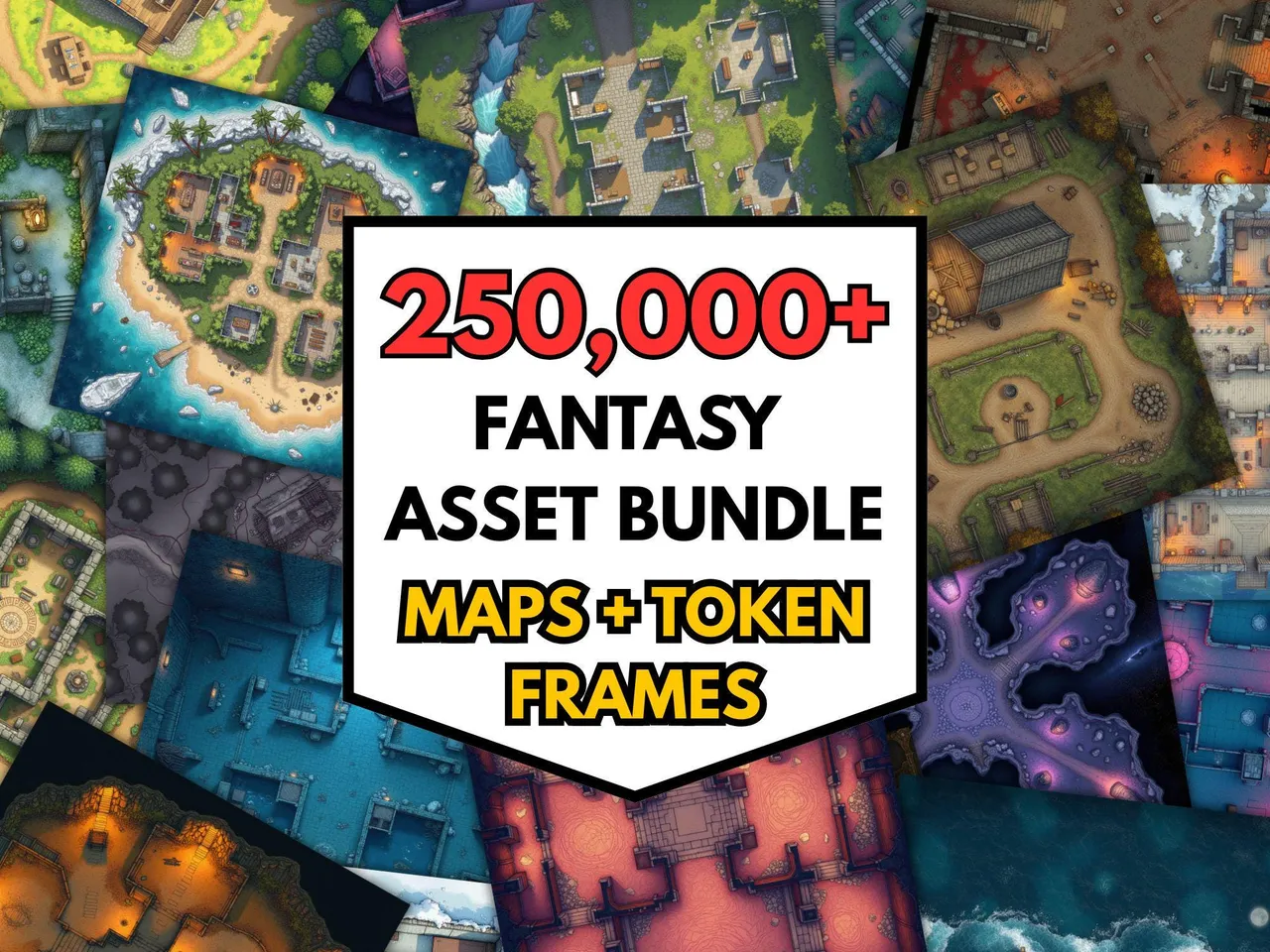
The 250,000+ RPG Battlemaps Mega Bundle ($40 $12.00) is the broad option: every biome and location, high resolution and gridless for Roll20, Foundry or print. For the price of a couple of single maps it builds the whole library at once, so the next time your party goes somewhere you didn’t plan for, you already have the map.
Seed it for free first. A hundred maps is a real starting collection, and the free map pack gives you one before you know which themes you actually reach for. Run a month off it, note what you kept looking for, then buy to fill those gaps rather than guessing up front. The free downloads cover tokens and minis too.
Frequently asked questions
- How many battlemaps does a DM actually need?
- More than you'd think, because you never know where the party will go. A working library covers every common biome and location: forests, dungeons, caves, cities, taverns, ships, deserts, snow, ruins and planar scenes, ideally with several variants of each so your taverns and forests don't all look identical. That's dozens of maps before you account for a specific campaign's needs.
- Is it cheaper to buy battlemaps individually or in a bundle?
- A bundle is almost always cheaper per map by a wide margin. Individual maps typically cost a few pounds or dollars each, so a modest library bought piecemeal runs into the hundreds. A mega bundle delivers the same coverage, and far more, for the price of a few single maps, which is why most DMs building a library start with a bundle.
- What formats do I need for Roll20 and Foundry?
- For virtual tabletops you want high-resolution, gridless image files. Gridless maps let the VTT apply its own grid so you avoid the doubled-grid alignment problem, and high resolution keeps maps sharp when players zoom in. The same files print cleanly for in-person play, so one gridless library covers both table styles.
- Do I need themed packs if I have a mega bundle?
- Usually not, since a good mega bundle already spans every theme. Themed packs are useful when you want a deep, focused set for one specific kind of scene, all dungeons, or all taverns, but for general coverage a single broad bundle removes the need to buy theme by theme.
- Where can I get a complete D&D battlemap library?
- MakeMythic on Etsy sells a 250,000+ RPG battlemap mega bundle covering every biome and location, high resolution and gridless for Roll20, Foundry or print, so a DM can build a complete library in one purchase instead of buying packs piecemeal.
Keep reading
From the shop
Battlemaps, spell cards, and magic item cards, ready to print.
Browse MakeMythic on Etsy →