Conjure Minor Elementals in D&D 2024: The Nerf, Explained
Conjure Minor Elementals was D&D 2024's most broken spell. Here's what it did, what the 2025 errata changed, why it was busted, and how to run it.
Conjure Minor Elementals is the spell that broke D&D 2024’s damage math, and the April 2025 errata is the official fix. The 4th-level spell summons elemental spirits that swirl around you in a 15-foot emanation, and until it ends, any attack you make deals an extra 2d8 damage when you hit a creature inside that space. The base effect was always strong. The problem was the upcast line, which originally scaled that bonus by 2d8 for every spell slot level above 4th. Wizards of the Coast changed that to 1d8 per level. This guide explains what the spell did before, exactly what the errata changed, why it was busted, and how to run it cleanly at your table.
What Conjure Minor Elementals does in D&D 2024
Here is the core text from the 2024 Player’s Handbook. It is a 4th-level conjuration with a casting time of one action, a range of Self (15-foot emanation), and a duration of Concentration, up to 10 minutes.
You conjure spirits from the Elemental Planes that flit around you in a 15-foot Emanation for the duration. Until the spell ends, any attack you make deals an extra 2d8 damage when you hit a creature in the Emanation. This damage is Acid, Cold, Fire, or Lightning (your choice when you make the attack). In addition, the ground in the Emanation is Difficult Terrain for your enemies.
Three things make this strong. First, the bonus applies to any attack you make, not one attack per turn, so every attack roll that lands gets the dice. Second, you pick the damage type per hit, which sidesteps most resistances. Third, the difficult-terrain clause keeps melee enemies stuck in the danger zone. On its own, at a 4th-level slot, the base spell is a fair and powerful pick for any martial-leaning caster.
What the 2025 errata actually changed
The errata changed one line and nothing else. The official 2024 Player’s Handbook errata, released in April 2025, revised the “Using a Higher-Level Spell Slot” entry for Conjure Minor Elementals.
- Before the errata: the extra damage increased by 2d8 for each spell slot level above 4th.
- After the errata: the extra damage increases by 1d8 for each spell slot level above 4th.
The base spell did not change. A 4th-level cast still adds a flat extra 2d8 to each qualifying hit. Only the upcast curve was flattened. The same change was applied to its sibling spells in the conjuration family — Conjure Elemental, Conjure Fey, and Conjure Woodland Beings — which all had the same 2d8-per-level scaling.
You can read the change in the official errata PDF, Player’s Handbook (2024) errata, and in Wizards’ announcement post, Sage Advice and Errata for the New Core Rules is Live. The change is also already live in the D&D Beyond toolset, so anyone using the digital sheet sees the 1d8 scaling by default.
What the scaling looks like now
The difference is small at low slots and enormous at high ones. Per qualifying hit, the bonus damage works out like this:
| Slot used | Old scaling (2d8/level) | New scaling (1d8/level) |
|---|---|---|
| 4th | 2d8 | 2d8 |
| 5th | 4d8 | 3d8 |
| 6th | 6d8 | 4d8 |
| 7th | 8d8 | 5d8 |
| 8th | 10d8 | 6d8 |
| 9th | 12d8 | 7d8 |
At a 9th-level slot the per-hit bonus dropped from 12d8 (averaging 54) to 7d8 (averaging about 31.5). That is the entire fix.
Why Conjure Minor Elementals was broken
The break was not the base spell. It was the interaction between three things: the bonus applying to every attack roll, the 2d8-per-level scaling, and the existence of spells that make many attacks in one turn.
Concentration only lets you run one of these spells at a time, so the trick is to spend your action on a multi-attack spell while Conjure Minor Elementals is already up. Cast it on one turn, then on later turns fire something with a lot of attack rolls. Upcast Scorching Ray gains an extra ray per slot level, and each ray is a separate attack roll. Eldritch Blast gains beams as the warlock levels, and a quickened second cast doubles them. With the old scaling, every one of those many attacks carried up to 12d8 of bonus damage.
Community math showed a 9th-level Conjure Minor Elementals paired with a high-slot Scorching Ray, or with Eldritch Blast plus a quickened Eldritch Blast, pushing a single character past 400 to 600 damage in one round (see Bell of Lost Souls’ write-up and Wargamer’s nerf coverage). The key phrase community reviewers kept using was “broken out of the box” — you did not need a deep optimization chain, just two spells and a few levels. That is exactly the kind of effect that quietly wrecks a campaign’s encounter balance, because the rest of the party and the monster math are not built to keep pace with it.
It is worth being precise about why the action economy mattered here. Most damage buffs in 5e attach to a single attack or a single turn, so even a big number is bounded. Conjure Minor Elementals broke that pattern in two ways at once. The duration is up to 10 minutes, so the cost of the buff is amortised across an entire fight rather than spent each round, and the bonus rides on the attack roll rather than the action, so it stacks freely onto any source of extra attacks. Put those together and the limiting factor stops being your spell slots and becomes the number of d20s you can throw, which is exactly the wrong incentive for a balanced game.
When one spell can swing a fight that hard, it stops being a fun option and starts being the only correct option. That flattens player choice, which is the deeper reason the errata mattered. A spell that is mandatory is, in practice, a tax on every caster who could take it and a wall in front of everyone who cannot.
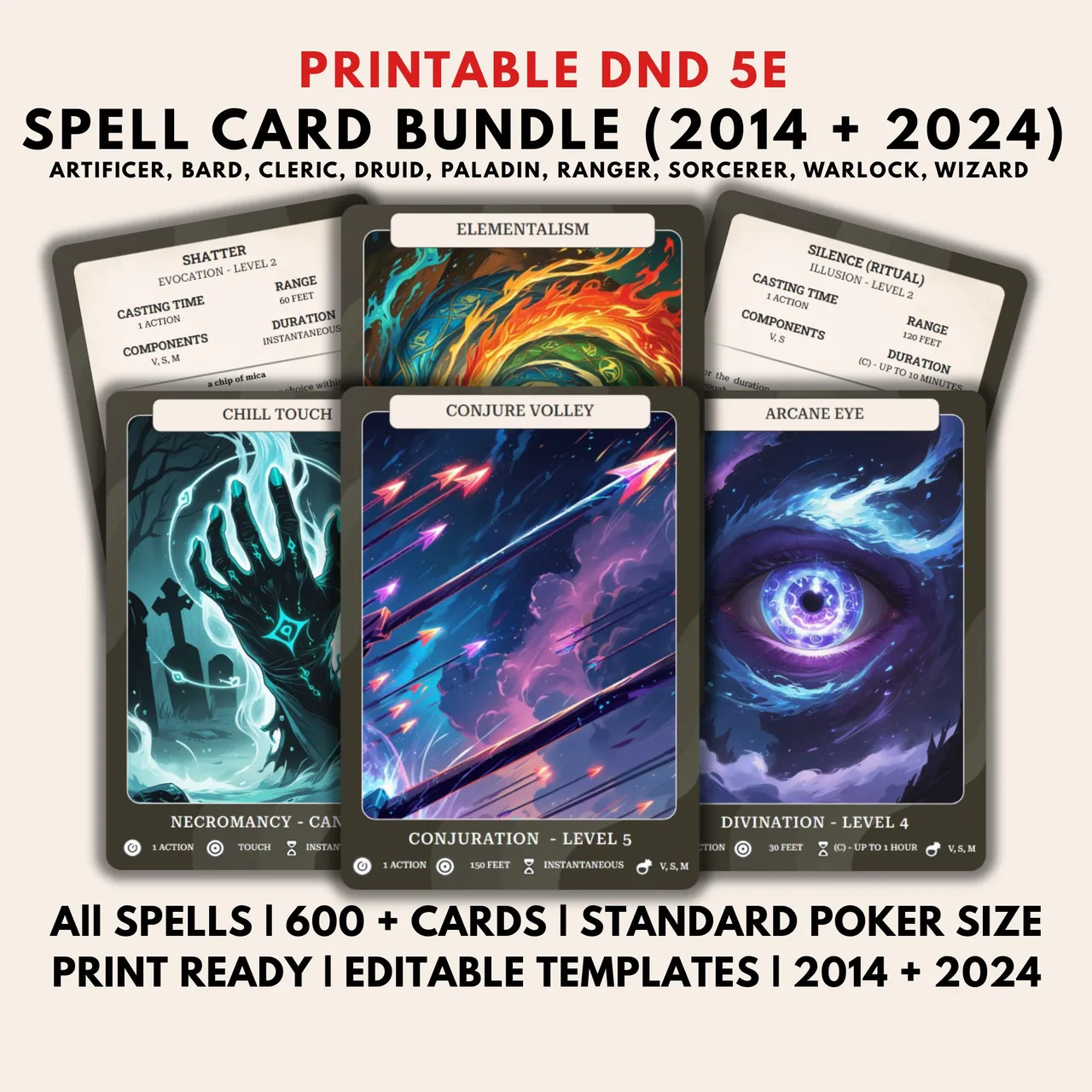
Spell interactions like this are easier to spot and adjudicate when every caster at the table has their spells written out in front of them, not buried three taps deep in an app. If you want fast, accurate references your players can read at a glance — base effect, upcast line, damage type, and all — the D&D 5e Spell Cards Bundle covers every class for 2014 and 2024 spells.
How to run Conjure Minor Elementals at your table
With the errata in place, the spell is in a healthy spot, and most tables should simply use the official 1d8 scaling. Here is how to handle the common situations.
If your group is on the latest rules, you already have the fix. The D&D Beyond toolset, SRD 5.2, and the errata PDF all show 1d8 per slot level above 4th. Nothing else to do — the base 2d8 is meant to stay strong, so do not nerf it further out of reflex.
If a player is using a printed first-printing book, flag the change before the spell first appears. A first-printing Player’s Handbook still reads 2d8 scaling. Tell the player the upcast line is now 1d8, point them to the errata PDF, and update their card or sheet. This avoids an awkward mid-combat correction when they roll forty-eight dice.
If you want to allow the old version, be honest about what it does. The 2d8 scaling is not a small house rule — at high levels it roughly doubles an already-strong spell. If a single player wants it, the rest of the party will feel sidelined, and your encounter design will have to escalate to match, which punishes everyone else. A cleaner middle ground is to keep the official 1d8 scaling and add a soft cap: only weapon attacks gain the bonus, or only the first few attacks each turn benefit. That preserves the spell’s identity without the round-one knockout.
Watch the concentration angle. The spell needs concentration for up to 10 minutes, so it competes with other buffs and is vulnerable to being dropped. A monster that targets the conjurer, or terrain that forces a tough Constitution save, is a fair and flavourful counter that does not require banning anything. Because the effect is an emanation centred on the caster, you can also pressure it through positioning: monsters that retreat out of the 15-foot bubble, or that have reach and strike from outside it, simply do not take the bonus. Building one or two such enemies into a fight is a gentle, in-fiction way to reward smart play on both sides rather than nullifying the spell outright.
Remember it helps the whole party indirectly. The difficult-terrain clause is easy to forget, but it is genuinely useful — it slows enemy advances toward your back line and can funnel melee threats into a kill zone your frontliners control. Even if the conjurer rolls poorly on damage, the spell is still doing tactical work for the group, which is a good thing to point out to a player who feels the nerf stung.
For wider encounter balance once a martial caster has this online, our guide to building balanced D&D encounters covers how to adjust monster HP and action economy so a big nova turn feels exciting rather than anticlimactic. And to keep upcast lines, damage types, and durations straight at the table, a printed spell cards reference beats scrolling on a phone mid-fight.
The short version
Conjure Minor Elementals adds an extra 2d8 to any attack you make against a creature in its 15-foot emanation, and that base never changed. The April 2025 errata cut the upcast scaling from 2d8 to 1d8 per slot level above 4th, which ended the multi-attack combos that let one character deal several hundred damage in a round. Use the official 1d8 version, update any first-printing books, and you have a strong, fair spell instead of a campaign-warping one.
Frequently asked questions
- What did the Conjure Minor Elementals errata change?
- The April 2025 errata changed only the upcasting line. The bonus damage now increases by 1d8 for each spell slot level above 4th, instead of 2d8. The base spell is unchanged: it still adds an extra 2d8 damage to any attack you make against a creature in the 15-foot emanation.
- Is Conjure Minor Elementals still good after the nerf?
- Yes. At its base 4th-level slot the spell is untouched and still adds 2d8 to every attack against creatures in the emanation, which is excellent on a high-attack build. The nerf only slows the runaway scaling when you cast it with a 7th, 8th, or 9th-level slot.
- Why was Conjure Minor Elementals considered broken?
- The bonus damage applied to every attack roll, and it scaled by 2d8 per slot level when upcast. Pairing a 9th-level cast with a multi-attack spell like upcast Scorching Ray or Eldritch Blast let a single character pile huge dice onto each of many attacks, reaching several hundred damage in one round.
- Does the bonus damage apply to spell attacks and weapon attacks?
- Yes. The spell says any attack you make, so it works with weapon attacks, spell attacks like Eldritch Blast, and the rays of Scorching Ray, as long as the target is inside the 15-foot emanation when you hit. Each separate attack roll that hits gets the bonus.
- Can I still allow the original 2d8 scaling at my table?
- You can, but most tables should not. The errata exists because the 2d8 scaling broke high-level damage math. If you want a middle ground, keep the official 1d8 scaling and cap how many attacks can benefit per turn, or rule that only weapon attacks gain the bonus.
Keep reading
From the shop
Battlemaps, spell cards, and magic item cards, ready to print.
Browse MakeMythic on Etsy →