The official Deck of Many Things set vs printing your own
The 2023 Deck of Many Things bundle is $109.99 for 66 cards and two books. Here's what's in it, what you're actually paying for, and when printing makes more sense.
The Deck of Many Things is the most dangerous object in D&D, and it is dangerous in a way no other magic item is: it can end your campaign in a good way or a bad one, and neither you nor the player knows which until the card turns over.
In 2023 it got the full official treatment. The Book of Many Things, a 192-page hardcover, bundled with a 66-card physical deck, an 80-page guidebook covering each card, and a custom deck box. MSRP $109.99, with the card set alone listed around $99.99.
Before deciding whether that is the right purchase, it is worth separating what is actually in the box.
You are buying a sourcebook
The headline is the deck. The bulk of the value is the book.
The Book of Many Things is a proper 192-page sourcebook — adventure hooks, subclasses, items, encounters, all themed around the deck’s chaos. If you want that content, the bundle is a reasonable way to get it and the cards are a bonus.
But if what you wanted was the artefact on your table, you are paying a hundred dollars for a book you did not ask for, wrapped around a deck you did.
That is the whole decision, and it turns on a question worth answering honestly: how many sessions will this item actually be present for?
For most campaigns the answer is one. Possibly two. The deck appears, somebody draws, the campaign changes, and the item is spent or gone. It is a set piece, not a recurring mechanic.
What a printed deck gets you
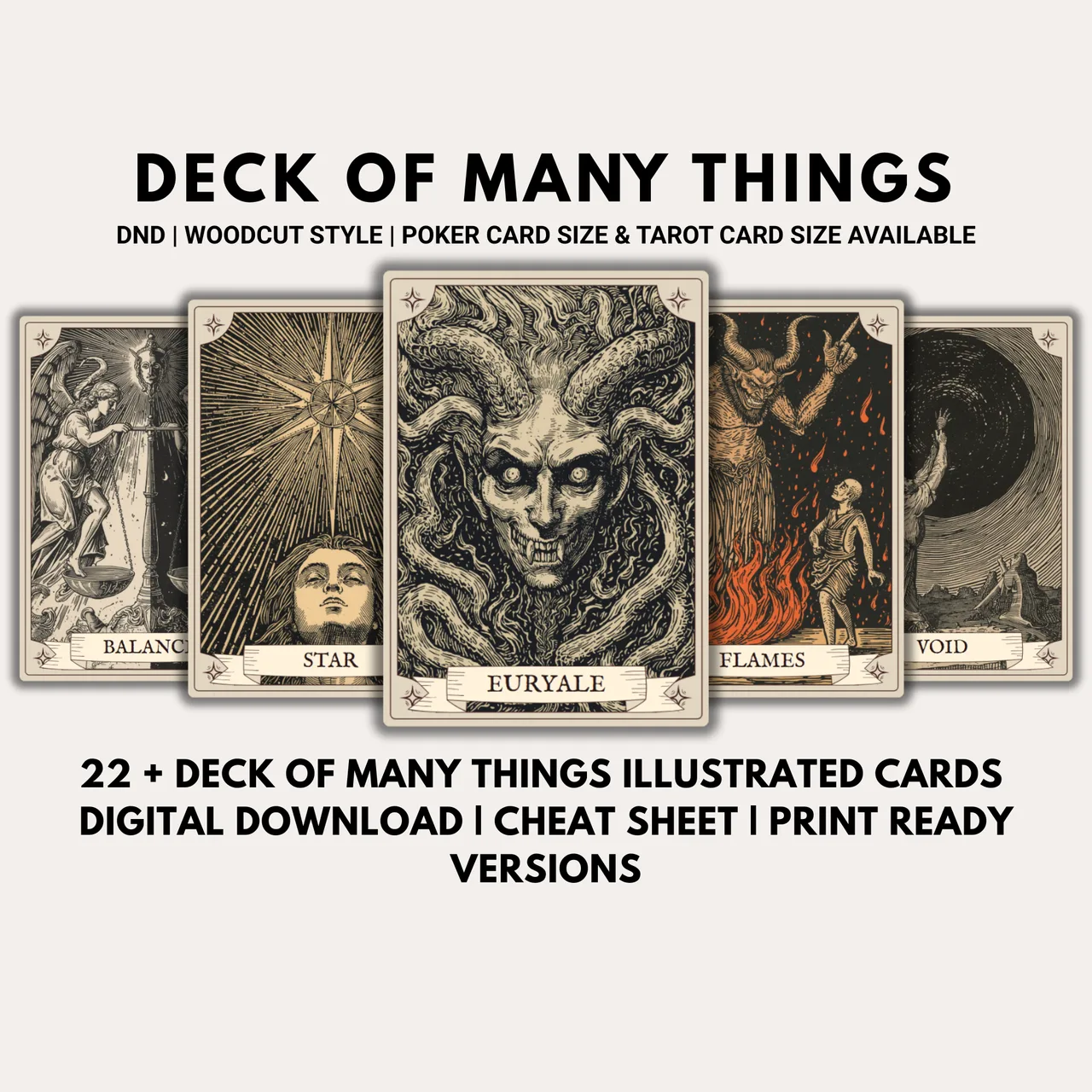
The thing that makes the item land is a player physically drawing from a deck they cannot see into. Everything else — the lore, the guidebook, the deck box — is context around that ten seconds.
A printed deck delivers that ten seconds. It also does two things the official set does not:
You can print it again. The deck is meant to be lost, stolen, scattered or destroyed. A story where the cards end up buried in four different places is easier when reprinting costs paper.
You can hand cards out permanently. A player who drew the Fates card keeps that card. That is a much better souvenir than a note on a character sheet, and you are not dismantling a $100 set to do it.
The trade is straightforward: no sourcebook, and home cardstock rather than professionally printed cards.
When the official set is right
You want the book. If the subclasses, hooks and encounters in The Book of Many Things appeal, buy the bundle. The deck is genuinely nice and you are getting it alongside content you wanted.
You are running a deck-centred campaign. If the artefact is the premise rather than an event, the 66-card version and its guidebook give you far more to work with, and the item earns permanent shelf space.
It is a gift. A boxed deck is a real object. A PDF is not.
When printing is right
The deck appears once. Which is most campaigns. Spending $109.99 on a single session’s prop is a lot, however good the prop.
You want the classic version. The traditional 13 or 22-card deck is a different, tighter item than the 66-card expansion — fewer cards, each one weightier. Plenty of DMs prefer it, and printable versions cover it.
You want cards the players keep.
You play online. Card images work as VTT handouts. A physical deck does not.
Running it well, whichever you buy
The item’s reputation for wrecking campaigns is earned, and mostly avoidable with three habits:
Warn them in fiction, not out of it. Someone in the world should know what this thing is and be afraid of it. Players who draw anyway have chosen their fate; players ambushed by it feel cheated.
Let the player draw. Physically. Do not roll it behind the screen. The whole item is the moment of commitment.
Rule the number of draws before anyone touches it. The single biggest source of arguments is how many cards a character declared they were drawing. Settle it out loud first.
Be ready for the campaign to change. If you are not willing for a character to be imprisoned or a wish to be granted, do not put the deck in the game. Half-honouring the results is worse than not using it.
More on the item itself in the Deck of Many Things explained, and if you like card-based magic items generally, the Deck of Illusions is the far safer cousin. For the rest of your hoard, printable magic item cards applies the same “make it an object” idea at scale.
Frequently asked questions
- What is in the official Deck of Many Things set?
- The 2023 release bundles The Book of Many Things, a 192-page hardcover sourcebook, with a 66-card physical Deck of Many Things, an 80-page guidebook explaining each card, and a custom deck box. MSRP is listed at $109.99, with the card set on its own also listed around $99.99.
- How many cards are in the Deck of Many Things?
- The classic item is 13 or 22 cards depending on which version is drawn from. The 2023 official release expands it to 66 cards, adding a large number of new effects on top of the traditional ones.
- Is the Deck of Many Things worth putting in your campaign?
- It is the most campaign-altering item in D&D and that is the point. Cards can grant wishes, remove levels, imprison a character or summon something that wants to kill them. Use it when you are happy for the campaign to change direction, and not when you need the plot to stay on rails.
- Do you need the official cards to run the Deck of Many Things?
- No. The item works from the table in the rules, and any physical deck representing those cards does the job. What a physical deck adds is the moment of a player actually drawing, which is most of the item's drama.
- Should the DM or the player draw the card?
- The player draws. The entire appeal of the item is the moment of committing to an unknown, and taking that away by having the DM roll behind a screen removes the thing that makes it memorable.
- Can you use a normal deck of playing cards?
- Yes, and plenty of tables do — the classic version maps onto standard ranks and suits. It works mechanically, but it loses the sense that this is a strange and dangerous artefact rather than the pack from your kitchen drawer.
Keep reading
From the shop
Battlemaps, spell cards, and magic item cards, ready to print.
Browse MakeMythic on Etsy →