The Deck of Many Things, Explained (And How to Survive It)
A DM's guide to the Deck of Many Things in D&D 5e: how it works, the card effects that matter, 2024 DMG changes, and how to run it without wrecking your campaign.
The Deck of Many Things is the most chaotic magic item in D&D 5e, and the one most likely to derail a campaign in a single turn. It is a deck of ornate cards, full version 22, reduced version 13, where a player declares how many cards they will draw, then draws blind. Each card fires an immediate effect: gaining a wish, summoning an avatar of death, losing every magic item, or having reality rewrite one past event. The effects are not optional and cannot be undone. This guide explains how the deck works, what the game-changing cards actually do, what the 2024 Dungeon Master’s Guide changed, and how to deploy it without blowing up your table.
How the Deck of Many Things works
The mechanics are simple, which is what makes the deck dangerous. Before drawing, a character announces how many cards they intend to take, from one up. They must then draw exactly that many within one hour, and each draw resolves the instant the card leaves the deck. A drawn card vanishes and reappears in the deck unless it is the Fool or Jester, so the same dangerous outcomes stay in play for the next draw.
Two cards let you keep drawing beyond your declared number, so a “safe” single draw can spiral. The character has no control over which card comes up, and effects apply whether or not anyone wants them. There is no save, no check, no take-backs. That total loss of control is the entire point: the deck is a bargain with chance, and the player chooses only how greedy to be.
Most decks in play use the 13-card version, which keeps seven beneficial cards (Sun, Moon, Star, Throne, Key, Knight, Jester) and six harmful ones (Euryale, Flames, Rogue, Ruin, Skull, the Void). The full 22-card deck adds the truly extreme outcomes — Donjon, the Void, Talons, and others — alongside the biggest rewards. As DM, you decide which version a found deck is, and that single choice sets the ceiling on how much damage the deck can do.
The good cards: what a lucky draw gives you
The upside cards are why players take the risk. The headline rewards in the 5e deck include:
- Sun — a large experience reward plus a random wondrous item. In 2024 terms this became one of the cards rebuilt away from raw XP, since the 2024 rules dropped experience-point effects.
- Moon — you can cast the wish spell 1d3 times. This is the single most powerful draw in the deck and can hand a player the most coveted spell in the game.
- Star — increase one ability score by 2, and it can exceed 20 (up to 24). A permanent stat bump past the normal cap.
- Throne — you gain expertise in Persuasion and ownership of a small keep, a rare card that hands the party a base of operations.
- Key — a rare or rarer magic weapon you are proficient with appears in your hands.
- Knight — you gain the loyal service of a 4th-level fighter who serves you to the death.
- Gem — a pile of treasure: gems and jewellery worth tens of thousands of gold.
These are the cards that make the deck feel like Christmas. The problem is they sit in the same shuffle as the cards below, and a player chasing Moon may pull Skull instead.
The bad cards: what an unlucky draw costs you
The downside cards range from annoying to character-ending. The ones that change a campaign:
- Skull — you summon an avatar of death that attacks you, and you must fight it alone while everyone else is warned off. It can absolutely kill a character.
- The Void — your soul is pulled from your body into an object hidden by the DM, guarded by powerful beings. Your body is incapacitated and wish cannot restore you, only locate you.
- Donjon — you vanish into suspended animation in an extradimensional sphere, gear and all, until someone finds and frees you. You draw no more cards.
- Talons — every magic item you carry is destroyed. Artifacts vanish rather than break.
- Ruin — all non-magical wealth you own is gone.
- Flames — a powerful devil becomes your sworn enemy until one of you dies.
- Euryale — a lasting curse imposes a −2 penalty on all saving throws until a god or the Fates card lifts it.
- Rogue — an NPC you trust becomes secretly hostile, and only wish or divine intervention ends it.
- Idiot — your Intelligence drops by 1d4+1, permanently.
The Void, Donjon, and Skull are the three that can remove a player from the game in one draw. Know which version of the deck you are using, because a 13-card deck still contains the Void and Skull.
The wild-card cards: the ones that rewrite the table
A few cards do not fit “good” or “bad” because they hand power directly to the player:
- The Fates — reality unravels and you can erase one event as if it never happened. Players save this to undo a death or a catastrophe, and it can quietly cancel an entire plot arc.
- Vizier — once within a year you can ask a question in meditation and receive a true, useful answer, wisdom included. It can solve the mystery you spent six sessions building.
- The Fool — you take a penalty and immediately draw again, the extra draw free.
- The Jester — a reward, or two more draws beyond your declared count, tempting a lucky player to keep pushing.
These are the cards that quietly threaten your prep. The Fates can rewind a hard-won consequence, and Vizier can shortcut a mystery. Neither is a problem if you expect it, which is why the deck rewards DMs who plan for it rather than drop it cold.
What changed in the 2024 Dungeon Master’s Guide
The 2024 DMG revised the Deck of Many Things to remove the most disruptive old effects while keeping the intensity. The clearest changes:
- Balance no longer flips your alignment. Instead you raise one ability score by 2 (to a max of 22) while lowering another by 2, a rebalance rather than a personality swap.
- Comet now ties its reward to defeating a chosen foe in your next combat: drop that enemy to 0 hit points and you gain advantage on death saving throws for a year.
- Fool was reworked because 2024 dropped experience-point effects. The old version cost you 10,000 XP; the revised version gives you disadvantage on D20 tests for 72 hours and a free extra draw.
- Experience-based cards in general were rebuilt, since the 2024 game no longer uses XP rewards the way the 2014 cards assumed.
If you run a mixed 2014/2024 table, the safest move is to pick one version of each card and tell players which you are using before anyone draws. The cards’ names and flavour are stable across both rulesets; only specific mechanics shifted.
How to deploy the deck without derailing your campaign
The Deck of Many Things destroys campaigns run carelessly and elevates ones run deliberately. A few hard-won rules from running it:
Save it for the late game. The deck shines as a high-level set piece, a finale moment, or a deliberate reward to a party that earned a reality-bending artifact. It is a terrible random treasure drop at level 4.
Use the 13-card version unless you mean otherwise. Trimming to 13 cards removes Donjon, Talons, the Vizier, and other extremes, keeping a balanced risk profile. Reach for the full 22 only when you want the truly campaign-ending outcomes on the table.
Set the rules out loud, in advance. State that draws are declared, immediate, and final, and that the player accepts the consequences. Half the bad feeling around the deck comes from players who thought they could refuse a card.
Pre-roll the Void and Donjon locations. If a soul gets trapped or a body imprisoned, you want a rescue arc ready, not a player benched with nothing to do. Turn the disaster into the next adventure hook.
When a player pulls a card and the table goes silent, you want the artifact in their hands to feel real. A physical deck does that far better than reading effects off a screen — handing over an illustrated card lands the weight of the moment.
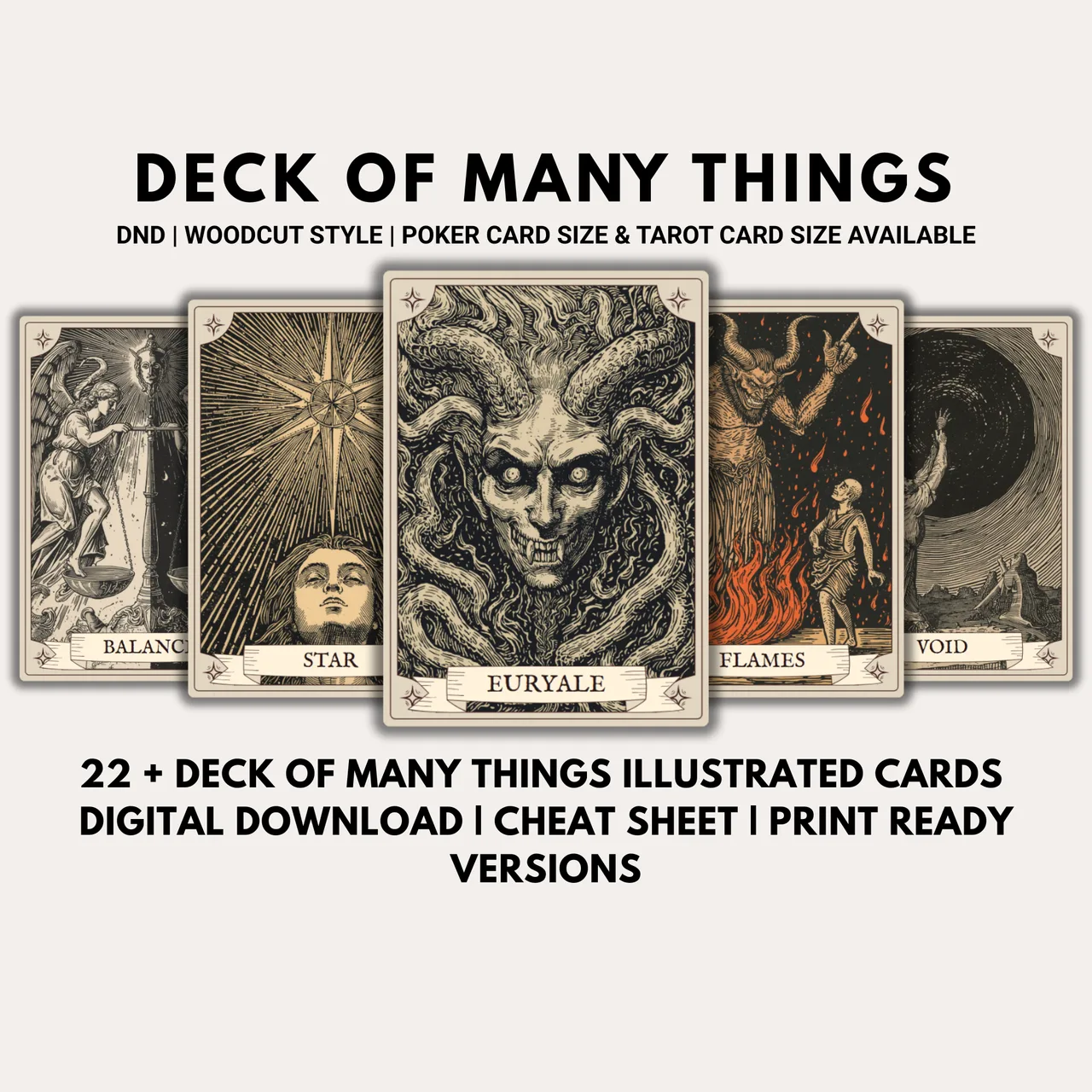
Tools to back up the deck at your table
The deck creates downstream prep work, and a few free tools take the sting out of it. When Sun, Key, or Gem hands a player sudden treasure, a quick loot generator lets you fill in the specifics on the spot instead of stalling the scene. When a card like Key or a wondrous-item reward needs a concrete result, the magic item generator gives you something usable in seconds.
If you want to get comfortable adjudicating chaos before you run the deck, how to improvise as a dungeon master covers the mindset, and our roundup of the best free D&D DM tools points to more prep aids. For handing out the rewards the deck generates, printable magic item cards make the treasure tangible the same way a physical deck does.
The short version
The Deck of Many Things is 22 cards (often 13) of immediate, irreversible chance: wishes and keeps on one side, trapped souls and avatars of death on the other. The 2024 DMG sanded off the worst old effects but kept the danger. Used as a deliberate high-level moment, with the rules set in advance and a rescue plan ready, it produces the most memorable session your table will have. Dropped in carelessly, it ends campaigns. The difference is entirely in how you deploy it.
Frequently asked questions
- How many cards are in the Deck of Many Things?
- The full deck has 22 cards. About three-quarters of decks found in play use a reduced 13-card version, which drops the most extreme cards and keeps a balanced mix of seven good and six bad outcomes. The DM decides which version a found deck is.
- Can the Deck of Many Things kill a character?
- Yes, indirectly. No single card deals damage on its own, but the Skull card summons an avatar of death the character must fight alone, the Void traps their soul, and Donjon imprisons them in suspended animation. Any of these can effectively remove a character from the campaign.
- Did the Deck of Many Things change in the 2024 Dungeon Master's Guide?
- Yes. The 2024 DMG revised several cards to remove swingy effects. Balance now reshuffles ability scores instead of flipping alignment, Comet grants advantage on death saves for a year, and the experience-point cards were rebuilt because 2024 dropped XP-based effects.
- Do you have to draw from the Deck of Many Things?
- No. A character declares how many cards they will draw before touching the deck, from one upward, and must draw exactly that many within an hour. They can declare a single card and stop. Once a card is drawn, its effect happens immediately and cannot be refused.
- Should I put the Deck of Many Things in my campaign?
- Only late in a campaign, with eyes open. The deck can erase plot threads, vault a character to godlike power, or delete them outright. Use it as a deliberate finale moment for a high-level table, not as a random treasure drop.
Keep reading
From the shop
Battlemaps, spell cards, and magic item cards, ready to print.
Browse MakeMythic on Etsy →