How to Improvise as a Dungeon Master (When Players Go Off-Script)
How to improvise as a Dungeon Master when players go off-script: a repeatable in-the-moment framework, reaction rolls, and copy-paste random tables.
Players will always go off-script, and the fix is not “just say yes, and.” That advice keeps a scene moving but leaves you stranded the moment you genuinely do not know what happens next. To improvise well as a Dungeon Master, you need a repeatable in-the-moment loop and a few concrete fallbacks you can reach for without thinking. This guide gives you that: a four-step decision framework, the 2d6 reaction roll for NPC moods, ready-to-use name and motivation lists, a technique for asking questions that drive the scene, and copy-paste random tables you can keep open at the table tonight.
The four-step improv loop
When players do something you did not prepare for, do not freeze and do not invent a whole plot. Run this loop instead. It takes about three seconds once it becomes habit.
- Clarify. Ask what the character is actually trying to do. “You want to bribe the guard, or threaten him?” Half of all off-script moments are just unclear intent, and clarifying often hands you the answer for free.
- Decide if it needs a roll. If success is certain or impossible, narrate it. If it is uncertain and interesting, call for a check with a clear DC. Do not roll for things that do not matter.
- Give any new element a goal. A new NPC, faction, or creature needs exactly one thing: a goal. Once you know what it wants, its behaviour writes itself.
- Narrate the outcome and hand the scene back. Describe what happens, then end on something the players can react to — a question, a threat, an open door.
This loop works because it never asks you to know the future. It only asks you to handle the next ten seconds, which is all improvisation ever is.
Use a 2d6 reaction roll when you do not know how an NPC feels
The single most useful improv tool is the classic 2d6 reaction roll, borrowed from older editions of D&D and still perfect for 5e. When the party meets someone and you have not pre-decided their attitude, roll 2d6 and read the result. It removes the guesswork so you can react instantly.
| 2d6 | NPC reaction |
|---|---|
| 2 | Hostile — attacks or actively works against the party |
| 3–5 | Unfriendly — suspicious, obstructive, wants them gone |
| 6–8 | Neutral — wary, transactional, can be swayed either way |
| 9–11 | Friendly — helpful, willing to talk and deal |
| 12 | Helpful — goes out of its way to assist |
Apply the party’s Charisma or a relevant modifier if you like, but you do not need to. The point is that the dice make the call, so you are reacting to a result instead of agonising over one. A neutral merchant the party charms into an ally feels earned precisely because you did not script it.
Give every improvised NPC exactly one goal
The fastest way to make an unplanned NPC feel real is to give them a single, concrete goal. Not a backstory, not a voice — a goal. When players surprise you, you ask one question: “what does this person want, and how does that shape their next line?” The answer is almost always obvious once the goal exists.
Keep a short list like this open and pull one at random when you need it:
- Wants to be paid and left alone
- Wants to look important in front of others
- Wants information the party might have
- Wants to avoid blame for something already gone wrong
- Wants protection from a threat they will not name
- Wants the party gone before someone notices them talking
A guard who “wants to avoid blame” reacts to a bribe completely differently from one who “wants to look important.” You did not prep that guard, but the goal told you how to play him in half a second.
Ask questions that drive the scene
Improv is not a solo performance. Your players are a free source of content, and good DMs mine them constantly. When you do not know a detail, ask a player to supply it.
“You’ve drunk in this tavern before — what’s the bartender’s name, and why do you owe her a favour?” Now the tavern has a hook you did not write, the player is invested because it is theirs, and you have a name and a relationship for free. Use this whenever the world has a gap: who runs this shop, what does this shrine smell like, what rumour brought you here. Asking questions also doubles as a stalling tactic — every answer buys you several seconds to think while the table does the building.
How to stall gracefully without breaking immersion
Sometimes you need a moment and “uh, give me a second” shatters the mood. Buy time inside the fiction instead. Each of these moves looks like deliberate pacing and quietly hands you five to ten seconds to think:
- Have the NPC pause to size up the party before answering
- Call for an insight or perception check — even if the result barely matters
- Cut briefly to another character’s reaction
- Describe the environment in one extra sentence
- Ask a player what their character is doing right now
Used sparingly, these feel like good direction. Used constantly, players notice — so rotate them.
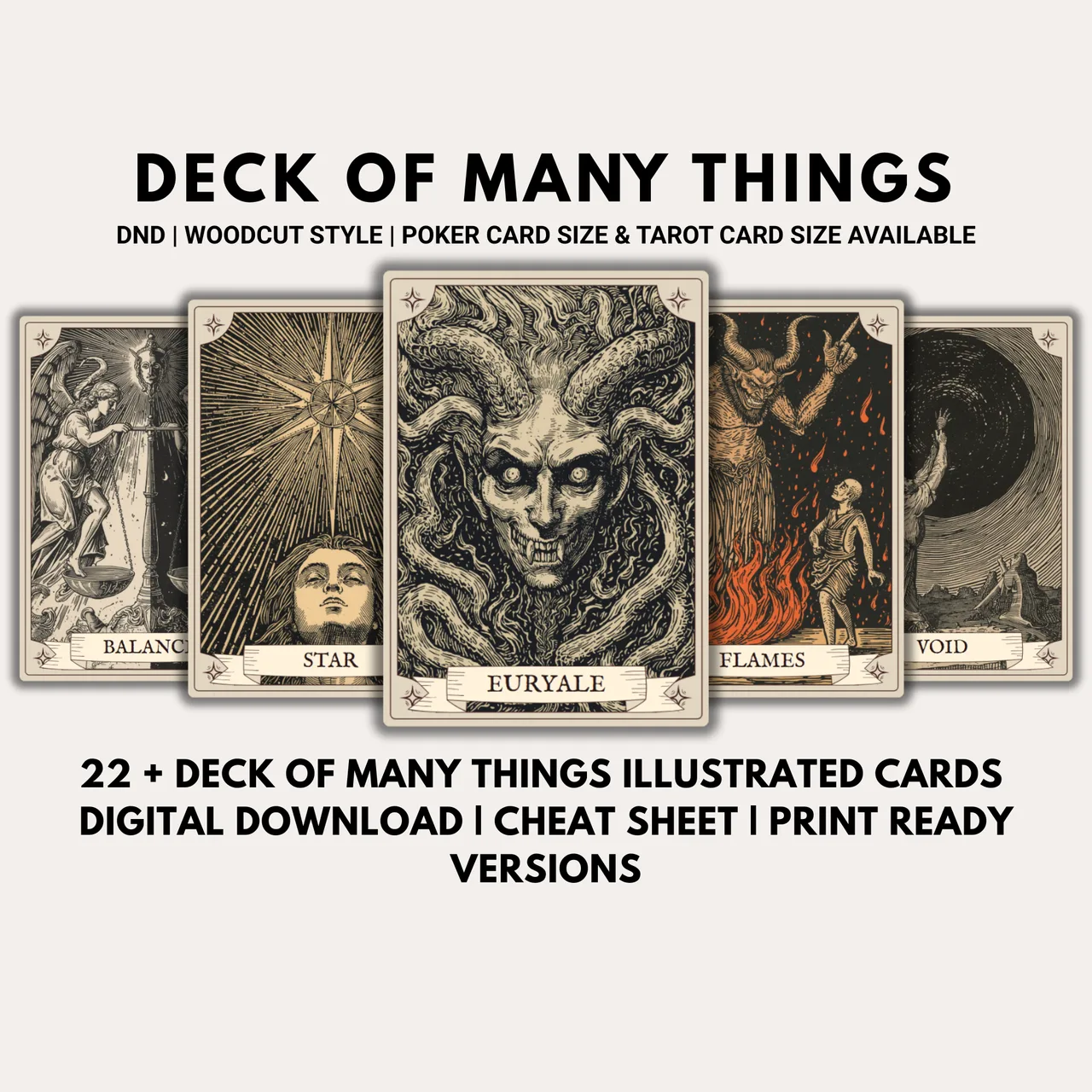
When you want the chaos to be the point rather than a problem to manage, a physical prompt the whole table can see does the work for you. The Deck of Many Things is the classic “I need a random answer now” object: draw a card, and the result reshapes the scene in a way nobody planned, including you. It suits an improv-heavy table because the table tool itself supplies the swerve, and the reactions around it are real.
Copy-paste random tables for the table
Keep these open in a tab or printed beside your screen. When the loop above stalls, roll and read. Randomness beats your own defaults because it pushes you past the same three ideas you always reach for.
d8 — NPC name (mix and match first/last as needed): Bren, Talia, Osric, Mira, Quill, Doran, Selka, Vance.
d6 — What this NPC actually wants: money, safety, status, revenge, a secret kept, someone found.
d6 — A complication the party just walked into: a debt is owed here, someone recognises a PC, the building is about to be raided, the goods are stolen, a rival arrives, a deadline is closing.
d6 — What’s behind the unexpected door: storage, a frightened bystander, a minor guardian (use a reaction roll), loot the party shouldn’t have yet, a shortcut, nothing but a clue.
d6 — Why the rumour is wrong: it’s outdated, it’s a lie to lure them, two events got confused, it’s true but incomplete, someone exaggerated, it’s a trap.
These are deliberately small. The goal is speed, not a sourcebook. If you want them generated for you, the NPC name generator spits out names and hooks instantly, and the random dungeon generator gives you a layout to improvise around when the party heads somewhere you never mapped.
Prep situations, not scripts
The reason players “go off-script” is that there was a script to leave. Stop writing them. Prep situations — a place, the people in it, what each one wants, and what is about to go wrong — and there is nothing to derail because every direction is equally prepared. A situation survives any choice the party makes; a plot survives exactly one.
This is also why a small standing toolkit beats heavy session-by-session prep. A reaction table, a name list, a motivation list, and a handful of reusable encounters cover almost any swerve. The loot generator handles the “they looted something I didn’t plan” moment, and our roundup of the best free D&D DM tools collects the rest. For groups still forming their table habits, setting expectations early in a session 0 makes improvising far easier, because you already know the kind of game everyone wants.
Put it together at your next session
You do not need to be quick-witted to improvise well — you need a loop and a few fallbacks. Clarify intent, roll for what is uncertain, give new NPCs a goal, ask players to fill the gaps, and roll on a small table when you stall. Keep the reaction roll and your name and motivation lists within reach. Do that for three sessions and improvisation stops feeling like a tightrope and starts feeling like the most fun part of running the game.
Frequently asked questions
- How do you improvise as a Dungeon Master when players go off-script?
- Run a quick four-step loop: clarify what the players are actually trying to do, decide if it needs a roll, give any new NPC one clear goal, then narrate the outcome. Lean on a reaction roll or a small random table when you have no answer ready, and ask the players a leading question to buy thinking time.
- What is a reaction roll in D&D?
- A reaction roll is a 2d6 check that tells you how an NPC or monster feels about the party when you have not pre-decided. Low totals mean hostile, middling totals mean wary or neutral, and high totals mean friendly. It removes the guesswork so you can react instantly instead of stalling.
- Is 'yes, and' enough to improvise well as a DM?
- No. 'Yes, and' keeps the scene moving but gives you no answer when you genuinely do not know what happens next. Pair it with concrete tools: reaction rolls, ready NPC and name lists, and the habit of asking players questions that fill in the world for you.
- How do you stall for time as a DM without breaking immersion?
- Buy time inside the fiction rather than outside it. Have an NPC pause to size up the party, call for a perception or insight check, cut to a brief reaction from another character, or ask a player to describe what their character notices. Each move gives you several seconds to think while the scene keeps breathing.
- What should I prep so I can improvise instead of railroad?
- Prep situations, not scripts. Keep a short list of NPC names, a handful of motivations, a reaction table, and a few reusable locations or encounters you can drop in anywhere. Knowing what each major NPC wants lets you improvise their actions without inventing a plot on the spot.
Keep reading
From the shop
Battlemaps, spell cards, and magic item cards, ready to print.
Browse MakeMythic on Etsy →