DnD city battlemaps: running urban street fights
Urban combat plays nothing like a dungeon. A guide to city and street battlemaps, fighting with crowds and rooftops, running town chases, and the maps that make it work.
City and street maps are among the most-searched battlemap categories on Pinterest and the marketplaces, and yet a lot of tables never run a proper urban fight. The party arrives in town, the DM narrates the city in broad strokes, and any combat that breaks out gets resolved on a generic open field. That’s a missed opportunity, because a city is the richest tactical environment in the game, and it plays nothing like the dungeon most encounters default to.
Why urban combat plays differently
A dungeon fight is fundamentally two-dimensional. Corridors and rooms, walls and doors, everyone on the same floor. A city throws that out.
Cities have height. Characters fight from balconies, scramble over rooftops, drop onto enemies from above. They have dense cover, market stalls, carts, crates, fountains and statues breaking every line of sight. And they have people, crowds who get in the way, panic, scatter, and remember who cast the spell that set the bakery alight. The town guard is somewhere nearby and will respond.
All of that makes urban combat more tactical and more consequence-heavy than almost anything else you’ll run. A fireball in a dungeon is a damage roll. A fireball in a crowded market is a damage roll and a problem with the city watch. Players fight differently when the environment can answer back, and a city always can.
The four city maps you need
You don’t need a map of an entire city. You need four kinds of scene, and you can drop the party into the right one as the action calls for it.
The market square. Open ground broken up by stalls, carts and a fountain or statue at the centre. Ideal for a fight that erupts in a public place, with cover everywhere and crowds to complicate it. The single most useful urban map you can own.
The narrow street or alley. Tight, linear, full of chokepoints, with doorways and side passages. This is your ambush map and the spine of any city chase. Verticality comes free here too, because fire escapes and low roofs are within reach.
The rooftops. A layout of connected roofs, gaps to leap, chimneys and skylights for cover. This is where the thieves’ guild fight happens, where the assassin flees, where a clever party takes the high ground. Players love it precisely because most fights never go up.
The city block with interiors. A cross-section that shows both the street and the buildings you can fight your way into. This is what lets a single encounter flow from the road, through a door, up the stairs and out onto the roof without ever leaving the map.
City and street maps are heavily pinned and heavily sold for exactly this reason: they unlock encounters the rest of a DM’s library can’t.
Running a city chase
The urban chase is the encounter the city is built for, and it’s easy to run if you stop thinking of it as one board and start thinking of it as a sequence of zones.
Each round, the quarry moves from one zone to the next, the street, the market, the alley, the rooftops, and the pursuers follow. Every zone has an obstacle that calls for an Athletics or Acrobatics check: shoving through a crowd, vaulting a market stall, scrambling over a fence, leaping a rooftop gap. Success keeps the pace, failure costs ground or a chunk of movement.
The trick that makes it sing is a fresh complication every round. A cart tips across the alley. A guard steps out of a doorway. A washing line forces a duck or a dive. These keep the chase from devolving into a flat comparison of movement speeds, and they give every player something to react to, not just the fastest character. You don’t need the whole route mapped in advance. Two or three street and alley maps in rotation give you all the geography a chase needs.
Crowds, bystanders and consequences
The thing that makes a city feel like a city is that it’s full of people, and people change how a fight runs.
Treat a crowd as difficult terrain that also reacts. Characters can push through it at half speed, lose a fleeing target inside it, or trigger a panic that scatters everyone and reshapes the battlefield mid-fight. Bystanders are also the source of the city’s weight. When the party knows a stray area spell will hurt innocents and bring the guard down on them, they fight with more care, and the encounter gains a moral dimension a dungeon rarely has.
You don’t need to track every commoner. A handful of crowd tokens and one clear rule (push through, scatter, or hide in it) is enough to make the street feel alive.
The MakeMythic city map collection
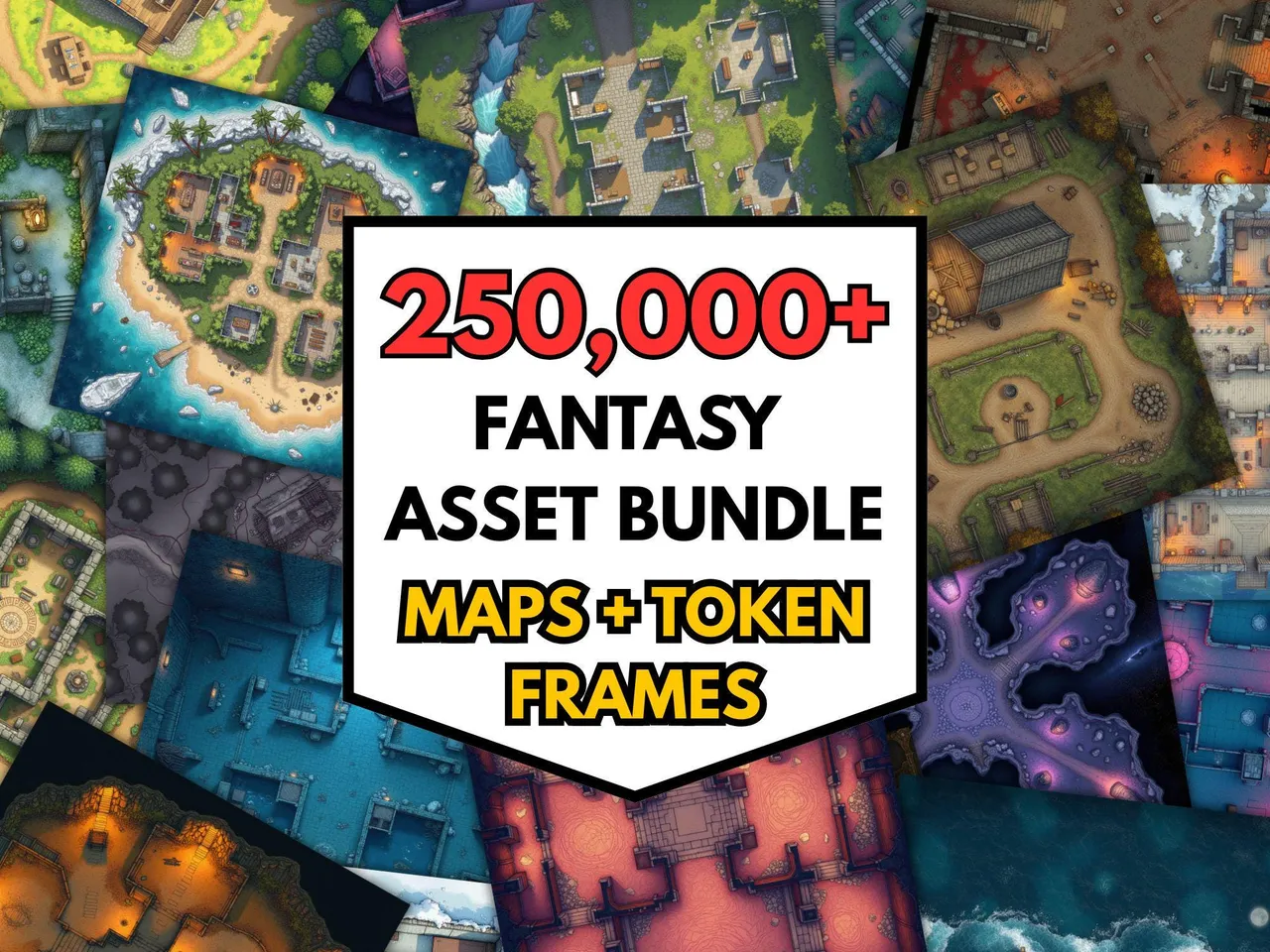
The 250,000+ RPG Battlemaps Mega Bundle ($40 $12.00) covers the full urban range: market squares and town plazas, narrow streets and back alleys, rooftop layouts, docks and waterfronts, and city blocks with interiors you can fight through. Because the bundle is so deep, you can give each district of your city its own look rather than reusing one generic street.
Everything is high resolution and gridless, so it drops straight into Roll20 or Foundry, or prints clean for a table where the players can trace a finger along the alley they’re about to sprint down.
Frequently asked questions
- How is urban combat different in DnD?
- City fights add verticality, crowds and hard cover that dungeons usually lack. Characters fight across rooftops and balconies, use market stalls and carts as cover, and have to deal with bystanders and the town guard. The result is a more tactical, three-dimensional fight where positioning and consequences matter more than raw damage.
- What city battlemaps does a DM need?
- Four formats cover most urban scenes: a market square for open fights with crowds and stalls, a narrow street or alley for ambushes and chases, a rooftop layout for vertical action, and a city block with interiors for fights that move indoors and out. Together they handle almost any town encounter.
- How do you run a chase through a city?
- Use the street and alley maps as a sequence of zones rather than one static board. Each round the quarry and pursuers move between zones, rolling Athletics or Acrobatics to handle obstacles like crowds, market stalls, fences and rooftops. Add complications each round (a cart blocks the way, a guard steps in) so the chase feels alive rather than a straight footrace.
- How do you handle crowds and bystanders in a city fight?
- Treat a crowd as difficult terrain that also reacts. Characters can shove through it, lose a target in it, or cause panic that scatters it. Bystanders raise the stakes: a fireball in a market square has consequences with the guard and the locals, which makes players fight more carefully and gives the city weight.
- Where can I get DnD city and street battlemaps?
- MakeMythic on Etsy includes markets, streets, alleys, rooftops, docks and full city blocks in its 250,000+ battlemap bundle, all high resolution and gridless for VTT or print. One bundle covers a whole city's worth of encounters without buying packs piecemeal.
Keep reading
From the shop
Battlemaps, spell cards, and magic item cards, ready to print.
Browse MakeMythic on Etsy →