How to Run a D&D Magic Shop Players Actually Enjoy
Run a D&D magic shop without tedious price-lookups: how to set stock, price items by rarity, handle haggling, buy loot, and give merchants real personality.
A good D&D magic shop is a scene, not a vending machine. The 2024 Dungeon Master’s Guide gives you a clear framework for pricing and availability, but the fun comes from how you run it at the table. Decide what’s in stock before play starts, set prices by rarity so you’re never flipping pages mid-session, let players haggle within limits, give them a fair way to sell loot, and hand the shopkeeper a personality. Do those five things and a magic shop stops being an interruption and becomes one of the moments players remember.
Pricing magic items without slowing the game
The slowest part of any shop scene is the DM hunting for a number. Solve it before the session. The 2024 DMG ties value to rarity through its Magic Item Rarities and Values table, and the jumps are steep: a common item sits around 100 gp, uncommon around 400 gp, rare around 4,000 gp, very rare around 40,000 gp, and legendary around 200,000 gp. Single-use items such as potions and scrolls are worth roughly half their rarity value, which is why a healing potion stays cheap while a permanent item drains a hoard.
Write the relevant numbers on a card before you sit down. If you know the party is heading to a market town, jot the price of every item that could plausibly be on a shelf there. When a player asks “how much is the +1 dagger,” you answer in two seconds instead of two minutes. That speed is the difference between a shop scene that flows and one that stalls.
For weapons and armour that are already mundane equipment, add the base item’s cost on top. A suit of +1 plate is the rare-item value plus the price of plate armour, not the rare value alone. That one rule keeps your high-end gear from looking suspiciously cheap.
Deciding what’s in stock and why
A shop with everything in it feels fake and hands players too much power over their own rewards. The 2024 DMG suggests availability by settlement: common items can often be bought in a town or city, uncommon and rare items are usually found only in cities, and the rarest items might be sold only in wondrous locations like a city on another plane. Use that as your filter.
Pick a small, fixed inventory before the session, say three to six items, and write down why each one is there. A frontier trading post stocks a healing potion or two and a single uncommon item the owner took in trade. A planar bazaar can stock a rare wand because the seller travels between worlds. The “why” matters because it makes the list feel discovered rather than generated, and it gives you a hook if a player asks where the item came from.
Rotate the stock slowly. If the party returns in a month of game time, swap an item or two and note that the rare piece sold to someone else. A shop that changes feels alive, and “you should have bought it last time” is a clean, fair lesson.
Haggling and shopkeeper attitude
Haggling is where a shop scene earns its place, so give it real but bounded stakes. The simplest method that respects the action economy of a session is a single Charisma check, Persuasion or Deception, against a DC you set from the merchant’s attitude. A friendly seller might shift 10 percent on a good roll; a wary one won’t budge and may take offence at a failed Deception.
Decide the merchant’s attitude before the roll, not after. A shopkeeper who likes the party because they cleared the road bandits starts the negotiation warm. One who’s heard the party left a tavern in ruins starts cold and prices high. Tie attitude to what the players have actually done in your world and the economy starts teaching them that reputation has weight.
Cap the swing so haggling never breaks your pricing. Allow a single check per visit and a maximum discount of 10 to 20 percent. That keeps the game moving, rewards the face of the party, and stops one lucky roll from gutting an encounter’s worth of treasure.
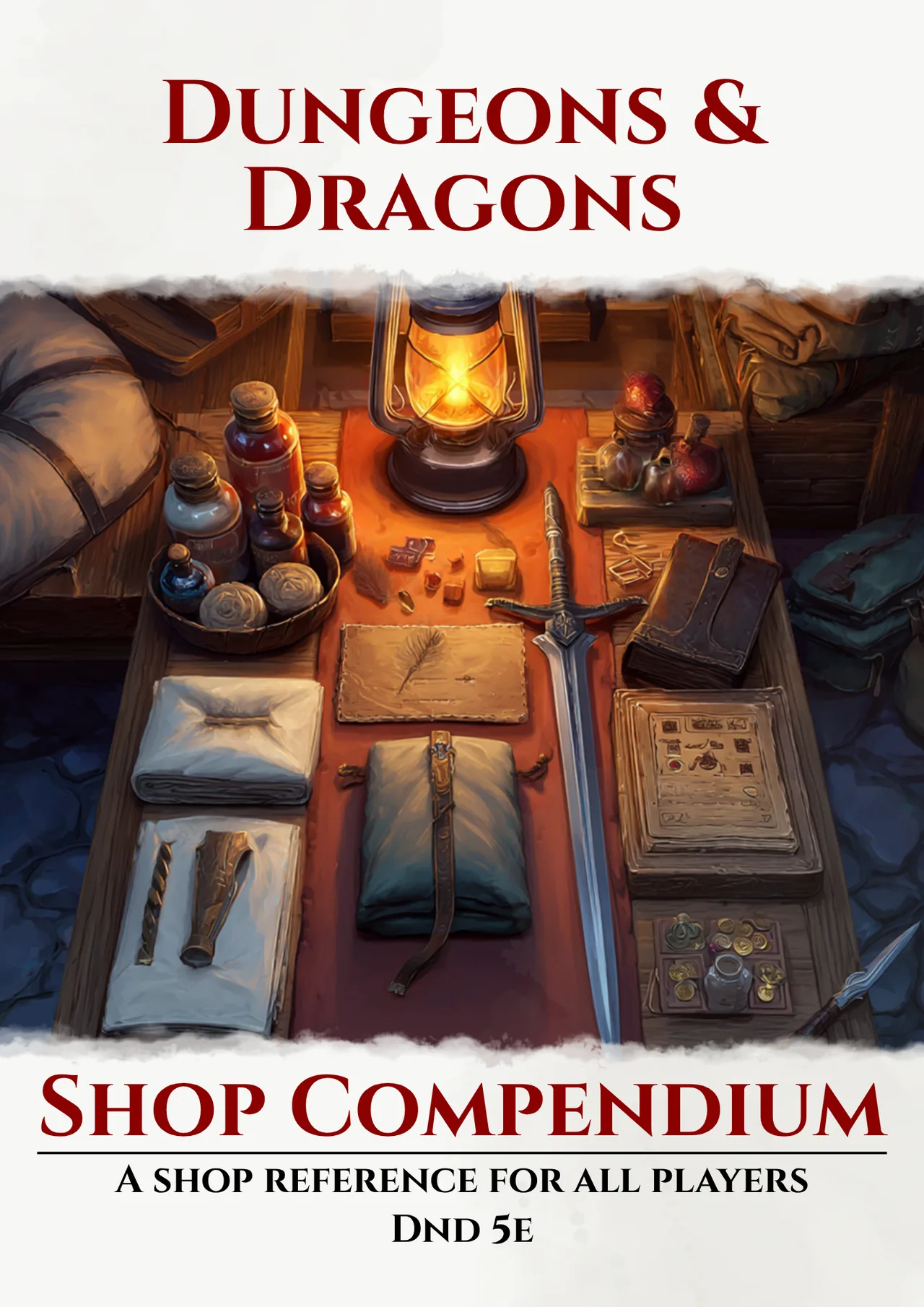
If you’re tired of hand-rolling stock and prices every session, a ready-made shop reference like the DnD Shop Compendium does the prep for you. It’s a printable booklet of stocked shops with set inventories and prices, so you flip to a page instead of building a market from scratch at the table. That’s the whole point of running a shop well: you spend your attention on the scene, not the spreadsheet.
Letting players sell loot fairly
Players accumulate gear they’ll never use, and a magic shop is the natural release valve. The 2024 DMG gives a clean selling procedure: to find a buyer for a single magic item, a character spends one work week and 25 gp spreading the word, then makes a Charisma (Persuasion) check to determine the offer. You can only sell one item at a time, and each work week carries a 10 percent chance of a complication.
Use that downtime structure when selling matters to the story, and a faster version when it doesn’t. In a busy session, let a trusted merchant make a flat lowball offer, often half the rarity value or less, and move on. Save the full work-week procedure for when the party wants top price or the item is famous enough to attract attention they might not want.
The complication clause is a gift. A buyer who turns out to be a cultist, a rival who recognises the stolen sword, or a fence who talks too much all grow naturally from “you spread the word that you’re selling.” Treat selling as a thread you can pull, not just a transaction.
Giving merchants personality
A shopkeeper is a free NPC the players will talk to every time they have gold, so make the seconds count. You don’t need a backstory. You need one want, one quirk, and one opinion of the party. The want gives you a side-quest hook, the quirk makes them memorable, and the opinion turns a price-check into roleplay.
Build it fast. The want might be a rare ingredient they’ll trade a discount for. The quirk might be that they never make eye contact, or that they name every item like a pet. The opinion might be quiet admiration after the party saved their cousin, or open suspicion because the last adventurers robbed them. Three lines on an index card and the merchant is ready.
Names matter here too, because “the shopkeeper” is forgettable and “Brannoch, who polishes coins while he talks” is not. If you blank on a name mid-scene, a quick NPC name generator keeps the cast straight without breaking the flow. For the items themselves, putting a real card in a player’s hand beats reading stats aloud, and our magic item card maker lets you print the shop’s stock so a purchase feels like a reward, not a line in a ledger.
Putting the shop on the table
Once the prices are set and the merchant has a personality, the last step is making the scene visible. A market stall, a cramped curiosity shop, or a planar bazaar all read better with a battlemap under them, especially if a deal turns into a chase or a fight. For that, our 250,000+ RPG Battlemaps Mega Bundle covers town interiors and market squares without you drawing a thing.
To stock the rewards themselves, a loot generator and a magic item generator give you fresh inventory in seconds when players go somewhere you didn’t prep. And if you want the wider toolkit for running a smooth table, our roundup of the best free D&D DM tools and our guide to printable magic item cards cover the pieces that make a shop scene, and the rest of the session, run themselves.
Run a magic shop this way and it stops being the part of the game everyone dreads. Prices are ready, stock makes sense, haggling has stakes, selling opens threads, and the merchant is someone the players actually want to see again.
Frequently asked questions
- Can you buy magic items in D&D 5e?
- Yes, if the DM allows it. The 2024 Dungeon Master's Guide says common magic items can often be bought in a town or city, uncommon and rare items are usually found only in cities, and the rarest items might appear only in wondrous locations. There is no default open market, so each DM decides what's for sale.
- How much do magic items cost in the 2024 DMG?
- The 2024 DMG sets prices using the Magic Item Rarities and Values table, with values rising sharply by rarity: roughly 100 gp for common, around 400 gp for uncommon, 4,000 gp for rare, 40,000 gp for very rare, and 200,000 gp for legendary. Single-use items like potions and scrolls are worth about half their rarity value.
- How do you sell a magic item in 5e?
- Under the 2024 DMG selling rules, you spend one work week and 25 gp to find a buyer for a single item, then make a Charisma (Persuasion) check to determine the offer. You can only sell one item at a time, and each work week carries a 10 percent chance of a complication.
- Should a magic shop have unlimited stock?
- No. A shop with a fixed, rotating inventory of a few items feels real and keeps rewards under your control. Decide what's in stock before the session, tie it to the settlement size, and refresh it slowly so players have a reason to return.
- How do you make a shopkeeper interesting?
- Give the merchant one clear want, one quirk, and one opinion about the party. A want creates side-quests, a quirk makes them memorable, and an opinion turns a transaction into roleplay. You don't need a backstory, just a reason for the scene to be more than a price-check.
Keep reading
From the shop
Battlemaps, spell cards, and magic item cards, ready to print.
Browse MakeMythic on Etsy →