How to Run Your First D&D Game: A New DM's Checklist
How to run your first D&D game: a new DM's checklist for prep, your first combat and roleplay, beginner mistakes to skip, and the 2024 DMG tools.
Running your first D&D game feels harder than it is. The trick to a good first session is doing less, not more: pick a published starter adventure so the world is already built, prep only the parts of the first session you’ll actually reach, and accept that you will not know every rule. A new DM’s real job is keeping the table moving and everyone having fun, not running a flawless simulation. This checklist walks you through what to prep, what to skip, how to handle your first combat and first roleplay scene, the beginner mistakes that trip everyone up, and the 2024 tools that make it easier.
Start with a published adventure, not your own world
The single best decision a first-time DM can make is to run someone else’s adventure first. A published starter set hands you the map, the monsters, the plot, and the pacing, so you can focus on the actual skill of running a table instead of also inventing a world from scratch.
The current D&D starter sets are built for exactly this. Dragons of Stormwreck Isle scales characters from level 1 to 3 and blends combat, exploration, and roleplay in one tidy package, while the newer Heroes of the Borderlands leans into shorter, one-shot-style play. The classic Lost Mine of Phandelver remains a popular first campaign too. Any of them removes the hardest part of being new: the blank page.
Build your own setting later, once you know how a session feels from the DM’s chair. Your first game is for learning the role, not proving you can worldbuild.
What to prep, and what to skip
Over-prepping is the most common new-DM mistake, and it backfires twice: you burn hours, then watch players ignore the dungeon you spent all week on. As the old table saying goes, no plan survives contact with the players. Prep the things you’re certain to use and nothing else.
For your first session, prepare:
- The opening scene — where the players start and what pulls them into the adventure.
- The first location and its goal — one dungeon, one town, or one problem to solve.
- Two or three encounters you’re likely to hit, with the stat blocks printed or bookmarked.
- A short list of names for NPCs the party might talk to.
- A one-line hook that gives the party a reason to act.
Skip, for now: deep NPC backstories you won’t reach, branching side quests, anything in later chapters, and any detail the players can’t see or won’t ask about. If you’re unsure whether to prep something, ask whether it will come up in the next two hours. If not, leave it.
A quick way to keep this lean is to outline the session as a list of scenes rather than a script. Bullet points flex when players go off-plan; a written-out script shatters the moment they turn left instead of right. If you want a head start on assembling that opening, our one-shot adventure tools help you stitch together a strong first session, and the NPC name generator means you’re never caught fumbling for a tavernkeeper’s name mid-scene.
How long prep should take
For a starter adventure, one to two hours of prep is plenty. You’re reading and bookmarking, not creating. The 2024 Dungeon Master’s Guide makes this easier with prep checklists scaled to how much time you have before the game — guidance for one, two, or three hours of prep — so you can match your effort to your evening.
The same book introduces the One-Hour Guideline, which lays out roughly what most groups accomplish in an hour of play. That’s quietly one of the most useful tools for a new DM, because it stops you from prepping ten hours of content for a three-hour session. Estimate your play time, look at what an hour typically covers, and prep to fit.
If your prep is running long, that’s a signal you’re building too much. Cut back to the opening scene and the first couple of encounters. You can always improvise forward, and you’ll be surprised how rarely players reach the end of what you planned.
Running your first combat
Combat is where new DMs freeze, so keep your first fight deliberately simple. Pick a few weak enemies — a handful of goblins, not an ancient dragon — and run the loop cleanly so everyone learns it.
The basic flow is short:
- Roll initiative. Everyone rolls a d20 and adds their modifier; you order the turns high to low.
- Take turns in order. On a turn a creature can move, take one action (usually an attack or a spell), and a bonus action if it has one.
- Resolve attacks. The attacker rolls a d20, adds their bonus, and compares to the target’s armour class. On a hit, roll damage and subtract it from hit points.
- Repeat down the initiative order until one side drops or flees.
That’s the whole engine. Add complications — conditions, resistances, legendary actions — only once the table is comfortable with the basics. Introducing a simple fight first, then layering in tougher concepts session by session, is exactly how the books recommend easing new players in.
Track initiative order and hit points where everyone can see progress. Paper works, but a free initiative tracker keeps turn order and dropping HP straight without you scribbling over crossed-out numbers. If you’re running on a screen or a TV, a grid overlay lets you drop a battle grid onto any map image so movement and range stay clear.
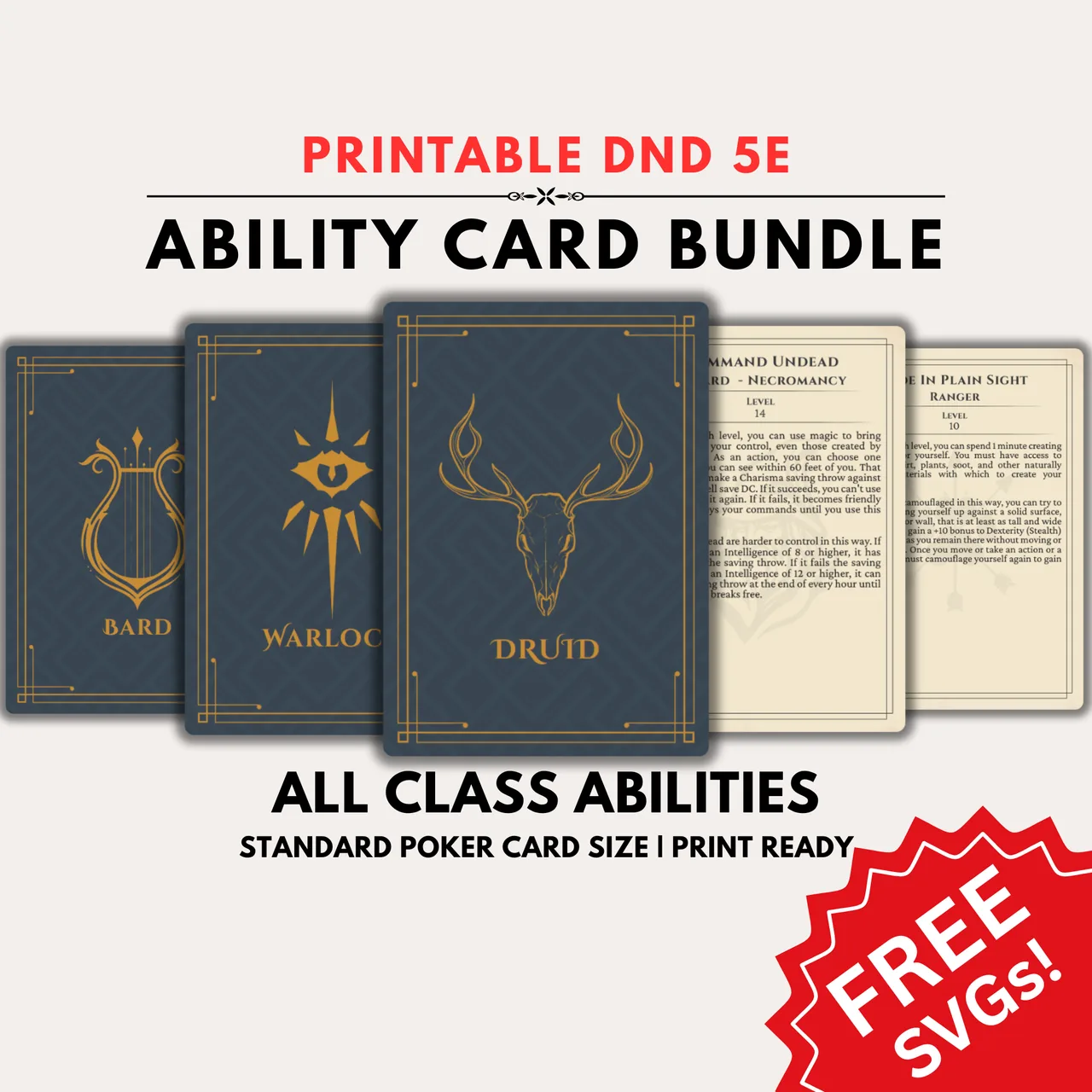
One reason combat stalls for new tables is rules lookups: a player wants to know what their feature does, you both flip pages, and momentum dies. Reference cards fix that faster than anything. A set like the D&D 5e Ability Cards Bundle puts each class’s features on a card the player keeps in front of them, so they answer their own questions and your first combat keeps moving instead of pausing every round.
Running your first roleplay scene
Roleplay scares new DMs as much as combat, and the fix is the same: lower the stakes. You don’t need accents or a one-person theatre show. You need a clear voice for what each NPC wants.
Give every NPC the party meets one goal and one trait. The blacksmith wants the bandits gone and is gruff about it; the noble wants a favour and is slippery about saying so. That’s enough to play them. When a player talks to an NPC, answer as that character would, push the scene toward their goal, and let the players steer the rest.
When you don’t know how an NPC would react, ask the player a question back. “What are you offering?” or “Why should I trust you?” hands the scene to them and buys you a second to think. Roleplay is a conversation, not a monologue — your job is to keep it flowing, not to perform.
Calling for a check is your pacing tool here. Ask for a Charisma (Persuasion) or Wisdom (Insight) roll when the outcome is genuinely uncertain and interesting, not for every sentence. If success or failure wouldn’t change the story, just let it happen and keep talking.
Common beginner mistakes to avoid
A few errors trip up almost every new DM. Knowing them in advance is half the cure:
- Memorising the rulebook. You don’t need to. Make a quick ruling to keep play moving, then look up the official rule after the session. Pace beats accuracy at the table.
- Over-prepping. Covered above — prep the next session, not the whole campaign.
- Treating it as DM versus players. You’re not the players’ opponent. You set challenges, but you’re on their side, rooting for the heroes. It’s collaborative storytelling, not a contest.
- Railroading. When players surprise you, roll with it instead of forcing them back onto your planned path. The detours are usually the best part.
- Forgetting to set expectations first. Misaligned tone and boundaries sink more campaigns than bad dice. A quick conversation up front prevents it — our full session 0 guide walks through exactly what to cover.
If any of these feels familiar from games you’ve played in, good — you already know how it feels from the player’s side, which is your best instinct as a DM.
Lean on the 2024 DMG’s beginner tools
The 2024 Dungeon Master’s Guide was rebuilt with new DMs in mind, and it’s worth reading Chapter 1 before your first game. It opens with the basics of the role — the “hats” a DM wears as referee, storyteller, and worldbuilder — and includes a worked example of play that shows how exploration flows into combat in a real session.
Beyond the One-Hour Guideline and the scaled prep checklists, the book adds nine tracking sheets for things like NPCs, magic items, and ongoing conflicts, plus five short sample adventures for levels 1 to 7 with maps in the appendix you can drop into a pinch. For a first-time DM, those are practical scaffolding: you fill in a sheet instead of inventing a system to track your campaign.
For deeper digital prep without spending a penny, our best free D&D DM tools roundup collects the in-browser tools that pair well with the DMG’s checklists, so your prep stays light and your sessions stay fun.
Your first session checklist
Bring it all together and your first game comes down to a short list:
- Pick a published starter adventure and read it once.
- Run a quick conversation on tone and boundaries before play.
- Prep the opening scene, the first location, two or three encounters, and a few names.
- Set up an initiative tracker and any maps and tokens you’ll need.
- Keep combat simple, give NPCs one goal each, and make rulings on the fly.
- After the game, note what worked and prep only the next session.
Do that, and you’ll run a session everyone enjoys — including you. The first game is never perfect, and it doesn’t need to be. Get the loop going, keep the table laughing, and the craft builds itself one session at a time.
Frequently asked questions
- How do you run your first D&D game as a new DM?
- Start with a published starter adventure so you don't have to build a world, read it through once, and prep only the first session's opening scene, two or three encounters, and a handful of names. Make quick rulings to keep play moving and look up the official rule afterwards. Your job is to keep the table having fun, not to memorise the book.
- What should a new DM prepare before the first session?
- Prep the opening scene, the location and goal of the first adventure, two or three encounters, the stat blocks you'll actually use, and a short list of NPC names. Skip backstory you won't reach, side quests, and anything past the first session. Over-prepping is the most common beginner mistake.
- How long should you prepare for a first D&D session?
- One to two hours is plenty for a starter adventure. The 2024 Dungeon Master's Guide includes prep checklists scaled to how much time you have, and its One-Hour Guideline helps you estimate how much content a session actually covers so you don't over-prepare.
- How do you run your first combat in D&D?
- Roll initiative, go around the table in order, and resolve each turn as move, action, and bonus action if any. Keep the first fight small with a few weak enemies so players can learn the loop. Track initiative and hit points on paper or a free tracker, and add conditions or resistances only once the basics click.
- What is the best D&D adventure for a first-time DM?
- A published starter set such as Dragons of Stormwreck Isle or Heroes of the Borderlands is the easiest start, because the maps, monsters, and plot are written for new DMs. Lost Mine of Phandelver is another popular first campaign. Running someone else's adventure first lets you learn the role before you build your own.
Keep reading
From the shop
Battlemaps, spell cards, and magic item cards, ready to print.
Browse MakeMythic on Etsy →