How to Start a New D&D Campaign
How to start a new D&D campaign: choose a premise, sketch the arc, and prep your first three sessions so the launch lands and the table keeps coming back.
Starting a new D&D campaign comes down to a few decisions made in the right order: a premise tight enough to pitch in two sentences, a session 0 to get everyone aligned, and detailed prep for just the first three sessions rather than the whole story. The most common mistake is the opposite — building a sprawling world and a twenty-session plot before anyone has rolled a die, then watching the players ignore most of it. This guide walks through choosing the premise, sketching the arc, and prepping the launch so the campaign starts strong and keeps the table coming back. For the table-alignment conversation itself, see the complete session 0 guide; this post is about the campaign-level launch around it.
Start with a premise, not a world
A campaign premise is the single problem the whole campaign hangs on. The Angry GM frames it as a campaign problem plus an antagonist, a setting, stakes, and a rough deadline, and that is genuinely all you need to start. “A cult is summoning something beneath the harbour town, and the only people who care are the party” is a premise. A 40-page gazetteer of your continent is not — it is procrastination dressed as prep.
Keep the starting scope small. One town or region, one nearby problem, and one villain behind that problem. This is the same logic published intro adventures use: the 2024 Dungeon Master’s Guide ships with a starter campaign rooted in a single Greyhawk locale rather than the whole setting, and classic learning adventures like Lost Mine of Phandelver keep the action inside one valley. A tight premise is easier to pitch, easier to prep, and easier for players to grab onto in session 1.
Write your premise as two sentences. If you can’t, it isn’t focused enough yet.
Sketch the arc as beats, not a script
Once you have a premise, sketch the shape of the campaign — but only the shape. Think in three acts: the local problem that opens the campaign, the wider threat it turns out to be part of, and the confrontation that ends it. You do not need scenes for any of this yet. You need a handful of beats you can steer toward and happily abandon when the players go sideways.
Decide roughly how long you want the campaign to run, because that changes everything downstream. A first homebrew campaign of 8 to 12 sessions, taking characters from level 1 to around level 6, is far more likely to actually finish than an open-ended level-1-to-20 epic. Published campaigns often run 20 to 60 sessions, but those have a full design team behind them. Pick an ending you find satisfying and work backwards to the beats that lead there.
Hold the arc loosely. The single most reliable feature of D&D campaigns is that players will care about the NPC you invented in passing and ignore the villain you spent a week on. Plan beats, not a script, and let the table’s choices fill in the rest.
Run a session 0 before you launch
Before the first real session, hold a session 0 to align the table on tone, content boundaries, scheduling, and characters. This is non-negotiable for any campaign you expect to run for more than a few weeks. Players arrive with different mental pictures of the game — one wants gritty survival, another wants heroic comedy — and a session 0 surfaces that mismatch before it derails play three sessions in.
The session 0 is also where you turn your premise into character buy-in. Pitch the campaign, then build characters who have an actual reason to engage with it. A party of strangers who “meet in a tavern” starts at a disadvantage; a party with two or three shared connections to each other and to the premise is already invested. The full process — the checklist, the safety tools, the one-page agreement — lives in the session 0 guide, so run that conversation properly, then come back to campaign prep.
Prep the first three sessions in detail
This is where most launches go right or wrong. Prep the first session fully, the next two in outline, and nothing past that in detail. Player choices reshape the story so fast that detailed prep for session six is almost always wasted work.
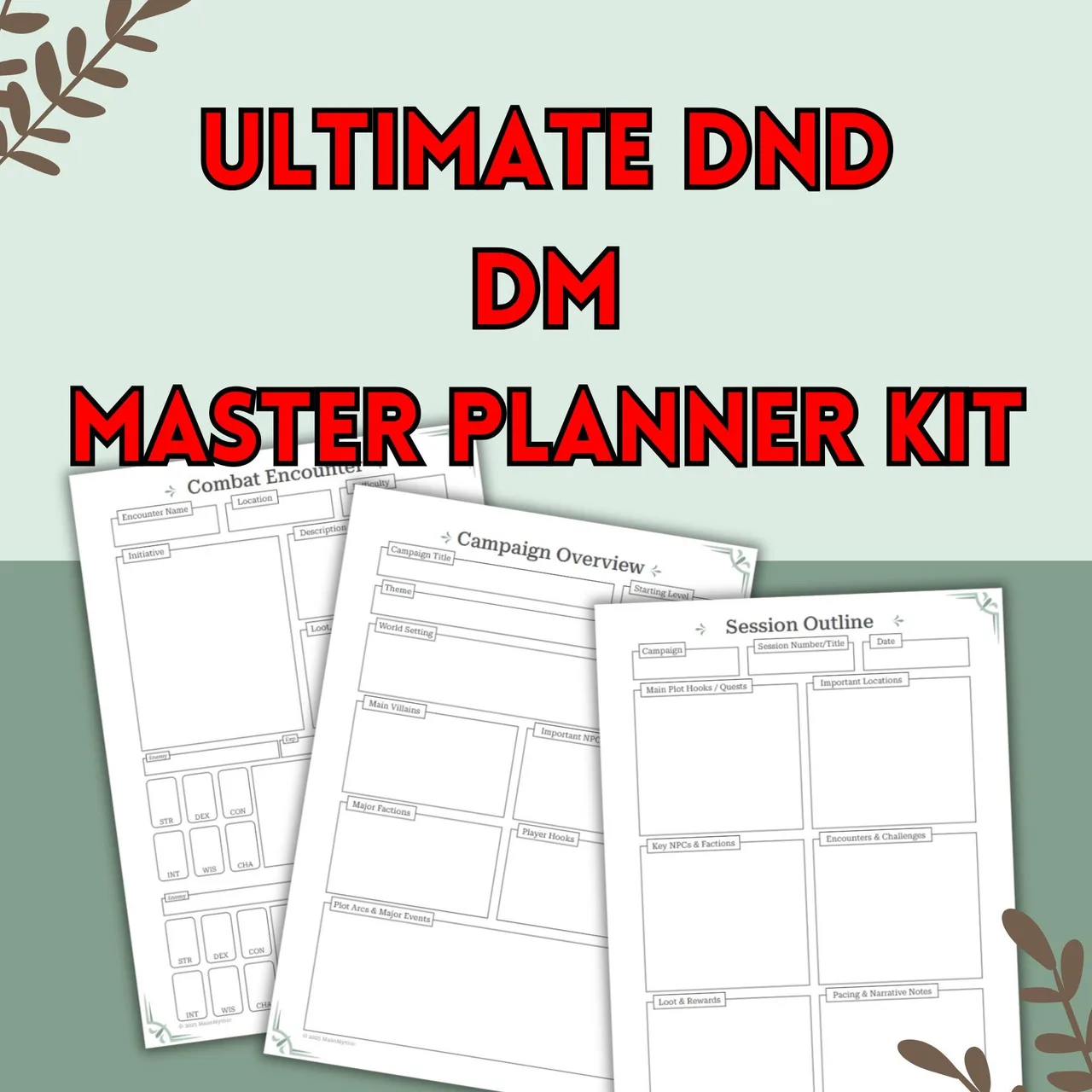
For the opening session, you need a strong first scene, a clear hook, one or two encounters, and the handful of NPCs the party will actually meet. Lock those down. For sessions two and three, a few bullet points each is enough — the locations they’ll probably visit, the obstacles in the way, and the information they need to uncover. Keeping campaign notes, NPC lists, and session outlines in one organised place is the difference between confident prep and rummaging through scattered documents mid-session.
A few free tools cover the parts of prep you’d otherwise grind out by hand. The NPC name generator keeps your cast named and consistent from the first scene, the loot generator builds the reward at the end of session 1, and if your launch involves overland travel between locations, the travel and weather tool sets the conditions for the road. Use them to keep prep fast so your energy goes into the moments that matter.
Build a first session that earns session two
The opening session has one job: convince the table to come back. RJD20 lists the goals of a strong first session as introducing the setting, uniting the characters, kickstarting the story, introducing a threat, and getting the party to second level — a useful checklist to prep against.
Open in motion. Drop the party into a scene that already has a problem in it rather than a tavern where they wait to be hired. Give them an immediate, low-stakes decision so they learn that their choices matter. Run one or two encounters — a fight, a tense negotiation, a hazard — and tie the session’s reward and information back to your premise. If your launch leans on a battlemap for that first fight, our 50,000+ battlemaps bundle covers most opening locations, or you can drop a quick grid over any image with the free grid overlay tool.
End on a question. The party should leave the table wanting to know one specific thing — who sent the assassins, what’s under the chapel, why the mayor lied. That open loop is what books your second session. For more on running encounters that stay tense without grinding to a halt, see our guide to building balanced D&D encounters.
The autumn restart: launching a campaign when an old one ends
A lot of campaigns launch in autumn, when summer holidays end and a wrapped or stalled campaign frees up the slot. If you’re starting fresh after another game ended, two habits make the new launch land harder.
First, do a clean break. Don’t quietly drift from the old campaign into the new one in the same session — give the previous game a real ending, even a quick epilogue, so the table arrives at the new premise with a clear head. Second, treat the session 0 as mandatory even with the same players. The group that loved your last grim survival campaign may want something lighter this time, and the only way to know is to ask. Reuse what worked — the schedule, the table rules, the safety tools — and rebuild the premise from scratch.
A restart is also a good moment to vary the texture. If the last campaign was wilderness survival, a new one centred on a city, a dungeon megastructure, or political intrigue keeps the same group feeling fresh. The random dungeon generator is a fast way to stock a site-based opening if your new premise points underground.
Launch checklist
Before you run session 1, you should have:
- A premise you can state in two sentences (one problem, one villain, one region)
- A three-act arc sketched as beats, with a rough target length and ending
- A completed session 0 with aligned tone, boundaries, schedule, and connected characters
- The first session prepped fully and sessions two and three in outline
- An opening scene with a hook, one or two encounters, a reward, and a closing question
Get those five things in place and you have everything a new D&D campaign needs to start strong. Everything beyond that — the deep lore, the side quests, the recurring villains — is better discovered in play than planned in a vacuum. Launch lean, watch what your table grabs onto, and build the campaign toward that.
Frequently asked questions
- How do you start a new D&D campaign?
- Start by choosing a clear premise — one problem, one villain, one starting region. Hold a session 0 to align the table, then prep only the first three sessions in detail and leave the rest of the arc as loose beats. Launch with a strong opening scene that gives the party a reason to act together.
- How much should you prep before the first session of a campaign?
- Prep the opening session fully and the next two in outline. Detailed planning past session three usually gets wasted, because player choices reshape the story fast. A premise, a starting location, a hook, and a few NPCs are enough to begin a campaign confidently.
- Do you need a session 0 to start a campaign?
- A session 0 is strongly recommended for any campaign you expect to run for more than a few sessions. It aligns tone, content boundaries, scheduling, and characters before play begins, which prevents the misalignments that quietly end campaigns. For a single one-shot a five-minute version is enough.
- How long should a D&D campaign be?
- Most published campaigns run characters from level 1 to somewhere between level 10 and 20 over roughly 20 to 60 sessions. A shorter homebrew arc of 8 to 12 sessions is far easier to finish and a better target for a first campaign. Plan the ending you want, then work backwards.
- What makes a good first session of a campaign?
- A good first session introduces the setting, gives the party a reason to be together, presents a clear hook, includes one or two encounters, and ends on a question the players want answered. Keep stakes local and personal so the table is invested before the larger plot arrives.
Keep reading
From the shop
Battlemaps, spell cards, and magic item cards, ready to print.
Browse MakeMythic on Etsy →