How to Worldbuild a D&D Setting From Scratch (Start Small)
Worldbuild a D&D setting from scratch without the blank-map panic. Start with one town, expand outward, and build only what the next three sessions touch.
Most worldbuilding advice tells you to draw a continent, invent pantheons, and write a thousand years of history before session one. That is exactly why so many new DMs freeze. To worldbuild a D&D setting from scratch without burning out, do the opposite: start with one town, give it three interesting NPCs and three nearby places worth visiting, and build outward only when your players actually move. You do not need a finished world to run a great campaign. You need one well-stocked starting point and the discipline to stop building the moment you have enough for the next few sessions.
Why the blank map makes you freeze
The empty continent is a tempting place to start because it feels like the “real” work of worldbuilding. It is also where most homebrew campaigns die before they begin. Staring at a blank hex map, you have a thousand decisions and no constraints, so every choice feels both arbitrary and permanent. This is the well-known trap that veteran DM Mike Shea calls out in his spiral campaign approach: build a huge world map first and you drain your inspiration filling space the party may never see.
Players never experience your world as a map. They experience it as the inn they are standing in, the person across the table, and the rumour they just overheard. None of that requires a continent. It requires one room and the next door out of it. So the first rule is simple: you are not building a world. You are building a starting point, and the world accretes around it through play.
Build the starting town first
Your whole campaign begins in one settlement, so spend your prep there. A starting town does not need a population figure or a trade-route diagram. It needs enough texture that the first session feels alive and enough hooks that players choose where to go next. Use this region starter template and fill only these fields:
- One name and one notable feature. The town is called Hollowford and the river through it runs the wrong way for one hour each dawn. That single oddity does more worldbuilding than three paragraphs of history.
- Three NPCs the party will meet in session one. A nervous innkeeper, a guard captain who owes someone money, and a child who keeps a dangerous secret. Give each a want and a problem, nothing more.
- Three nearby places worth visiting. A flooded mill, a watchtower with no garrison, a cave the locals avoid. These are your first adventure sites, and they are close enough to walk to.
- One faction with one goal. A merchant guild quietly buying up farmland. You will discover what they are really after as you play.
That is the entire prep load for your opening arc. It mirrors the structure recommended in beginner guides like Black Citadel’s starter-town walkthrough and The Angry GM’s homebrew campaign series: a few NPCs, a few sites, one tension, and nothing else until the party gives you a reason to add more.
If naming all those innkeepers, guards, and shopkeepers is the part that slows you down, lean on a generator and keep moving. Our free NPC name generator gives you a usable name in a click so you can spend your energy on what each person wants, not on staring at a blank line where a name should go.
Use a rumour table to reveal the world
Once your town exists, you need a way to feed the wider setting to players without writing an encyclopaedia. A rumour table does exactly that. It is, as Roleplaying Tips puts it, simply a bullet list of hooks and details that NPCs can drop into conversation. Each entry points outward to something the party could chase.
Write six to ten short rumours and tie them to the things you have already built. “A guide went into the avoided cave last winter and came back changed.” “The merchant guild paid triple for the old mill, nobody knows why.” “The river ran backward for two hours on the solstice, not one.” Notice that every rumour is a thread leading to one of your three sites or your one faction. You are not adding lore. You are pointing at lore you will write only if the players bite.
The clever move, borrowed from the Tribality living-world technique, is to vary the truth. Take one fact, then create a partial truth, a half-lie, and a flat falsehood about it. Now three NPCs can disagree about the same event, and your setting feels deep because it contradicts itself the way real places do. When a rumour gets resolved in play, cross it off and add a new one. The table is a renewable engine, not a fixed list.
Expand only outward, only just in time
Here is the rule that keeps the whole method sustainable: build only what the next two or three sessions will touch, and expand only outward from where the party already stands. When players decide to leave Hollowford for the city downriver, that is your signal to build the city, and not a session sooner.
This is the spiral in practice. The party’s choices draw the map, not your imagination in a vacuum. If they head into the avoided cave, you flesh out the cave and whatever the cave connects to. If they ignore it and chase the merchant guild, the cave can wait, possibly forever, and nothing is lost because you never built it. Every hour of prep lands on something the players will actually see.
When the party does leave town and crosses real distance, a couple of free tools carry the load so you can keep prep light. Our travel and weather tool handles overland pace, rations, and conditions on the road, and the hex coordinates tool gives you a clean way to lay out the wider region one hex at a time as the party reveals it. You are still only building the next chunk, just with the bookkeeping handled.
A worked example: three weeks of prep
To make the pace concrete, here is how Hollowford grows across three sessions.
Before session one, you build only the town: the dawn river, the three NPCs, the three sites, the merchant-guild faction, and a six-line rumour table. Maybe two hours of work total.
Session one happens. The party befriends the guard captain, ignores the cave, and gets very interested in why the guild bought the mill. Before session two, you build only the mill and the guild’s local agent. You do not touch the cave. The party’s attention told you what to make.
Session two ends with the party deciding to follow the guild’s shipments downriver to the city. Before session three, you build the city, but only its docks district and the guild warehouse, because that is all the party can reach in one session. The rest of the city stays a name on a rumour. Three weeks in, you have a town, a mill, and one district of a city, every piece of it load-bearing, and not one wasted hour of lore about a continent nobody has visited.
You still need maps for the places they reach
The catch in just-in-time worldbuilding is that the party arrives somewhere new every couple of sessions, and each new place wants a battlemap. Drawing a flooded mill, a watchtower, a cave, and a warehouse from scratch is the one part of this method that eats real time, and it always lands the week you have the least.
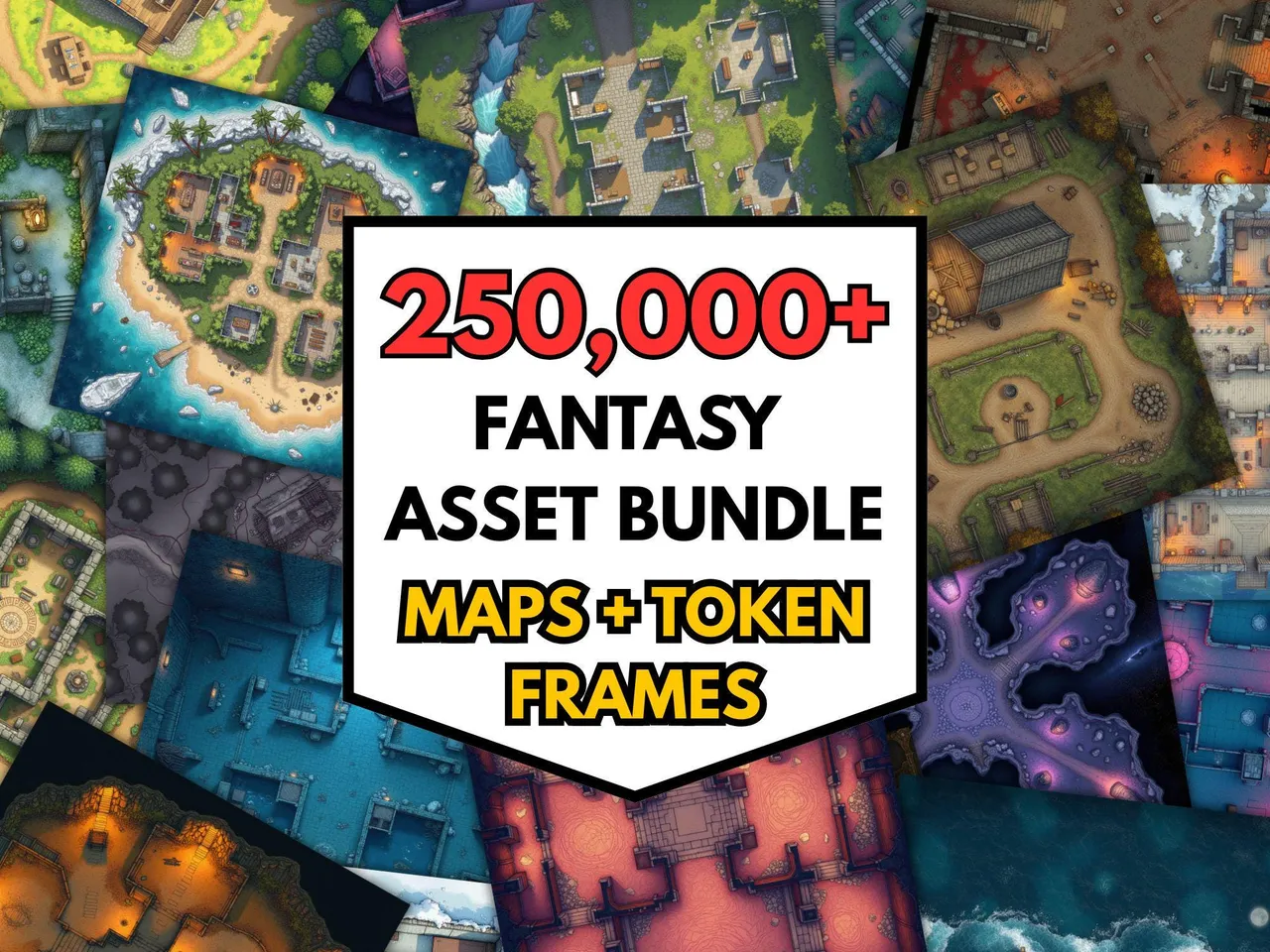
This is the gap I built a library to close. The 250,000+ RPG Battlemaps Mega Bundle covers exactly the locations a spiral campaign generates, taverns, mills, towers, caves, docks, dungeons, so when the party heads somewhere you only just invented, you drop a map in and keep prepping the part that actually matters: who wants what, and why.
If you prefer to stay in the browser, our maps and grid tools let you prep and scale your own images for the table without leaving the site.
The discipline is the method
Worldbuilding from scratch is not hard because invention is hard. It is hard because the format invites you to build infinitely and reward yourself never. The fix is a constraint: one town, three sites, three NPCs, a rumour table, and a firm rule that the next thing you build is whatever the party walks toward next. Hold that line and the world assembles itself, session by session, always exactly as big as it needs to be and never larger.
If you are setting up a brand-new game around this method, it pairs naturally with a solid session zero to agree tone and table expectations, and a glance through the best free DM tools will cover the generators, trackers, and maps that keep your just-in-time prep down to an hour a week.
Frequently asked questions
- How do I start worldbuilding a D&D setting from scratch?
- Start with one town, not a world. Name it, give it one notable feature, three NPCs, and three nearby places worth visiting. That single settlement plus its surroundings is enough to run a whole opening arc, and you expand outward only when the party moves.
- How much of my D&D world should I build before session one?
- Build only what the next two or three sessions will actually touch. That usually means one town, two or three adventure sites, a handful of NPCs, and a short rumour table. Anything beyond what the party can reach soon is wasted prep.
- Do I need a world map before I start a campaign?
- No. A map of one town and its immediate region is plenty. A full continent map tempts you to fill empty space the players may never visit. Draw the wider map later, once play has shown you which direction the campaign is actually heading.
- What is a rumour table and why is it useful for worldbuilding?
- A rumour table is a short list of hooks and gossip NPCs can drop into conversation. It reveals your setting piece by piece, points players toward adventure sites, and makes the world feel alive without forcing you to write pages of lore upfront.
- How do I expand my D&D world without it becoming overwhelming?
- Expand only outward from where the party already is, and only just before they arrive. When players head for the next town, build that town the week before. The world grows one session-sized chunk at a time, never faster than play demands.
Keep reading
From the shop
Battlemaps, spell cards, and magic item cards, ready to print.
Browse MakeMythic on Etsy →