The Best D&D 2024 Subclasses (A DM's Perspective)
A DM's look at the best D&D 2024 subclasses, which got buffed or nerfed, and what each change means for your encounter math at the table.
Most subclass rankings are written for players chasing the highest damage. This one is written from the other side of the screen. The 2024 Player’s Handbook revised all 48 subclasses, and the changes that matter to a DM aren’t always the ones that top a player tier list. What matters at your table is how a subclass affects encounter math: burst damage, action economy, control effects, and how predictable a turn is. Below, grouped by class, are the 2024 subclasses worth knowing about, what got stronger or reined in, and a “what to watch for” note on each standout so you can build encounters that hold up.
The change that affects every subclass: level 3
Before the class-by-class breakdown, one rule reshapes early encounter design. In 2024, every class picks its subclass at level 3. In 2014, that varied: clerics and sorcerers chose at level 1, others at level 2 or 3. Now levels 1 and 2 are a clean baseline within each class, and the subclass identity only switches on at level 3.
For a DM running low-level play, this means your first two sessions are easier to balance, because a fighter is just a fighter until level 3. It also means the big subclass power spikes arrive on a predictable schedule, which makes the level 3 to 5 stretch the moment encounters start needing real thought.
Fighter: Eldritch Knight pulls ahead
The Eldritch Knight is the clear fighter standout in 2024. The headline change is that it can now learn spells from any school of magic, not just abjuration and evocation. That removes the old trap of a martial player accidentally building a weak caster, and it opens up utility like Misty Step and Shield on a durable frontline body.
What to watch for: an Eldritch Knight with Shield and Absorb Elements is far harder to burst down than a 2014 one. If your encounter relied on a big alpha strike to threaten the front line, expect that reaction-based defence to blunt it. Lean on action economy and multiple attackers instead of one large hit.
Barbarian: Berserker is finally usable
Path of the Berserker was a famous 2014 trap because its Frenzy feature handed out levels of exhaustion. The 2024 version fixes this. Frenzy now adds extra dice of damage on your first hit each turn while you’re raging and using Reckless Attack, and it no longer causes exhaustion. Across the class, barbarians also gained weapon mastery properties and the new Brutal Strike options, which trade the advantage from Reckless Attack for effects like knocking a target back or cutting its speed.
What to watch for: the Berserker’s damage is now steady and exhaustion-free, so a barbarian player will commit to Reckless Attack far more often. That advantage cuts both ways. Your monsters hit them more easily too, so a Berserker is a reliable target for save-or-suffer effects and grapples while they’re swinging recklessly.
Paladin: Vengeance shines, but smite is capped
Paladins are the most important class for encounter math in 2024, because of one change. Divine Smite is now a spell, cast as a bonus action, which means a paladin can smite only once per turn rather than on every successful hit. The subclasses themselves are solid, with Vengeance offering the most focused damage and Devotion the most protective toolkit, but the smite cap is the rule that reshapes your boss fights.
What to watch for: the paladin’s nova round is now smaller and more predictable. In 2014, a paladin could dump several spell slots into a single turn and delete a boss. In 2024 that’s gone, because smite takes a bonus action and locks out other bonus-action attacks. Your big single-target threats survive longer, which is good for dramatic fights but means you should recheck the hit-point totals on solo monsters you ported from older math.
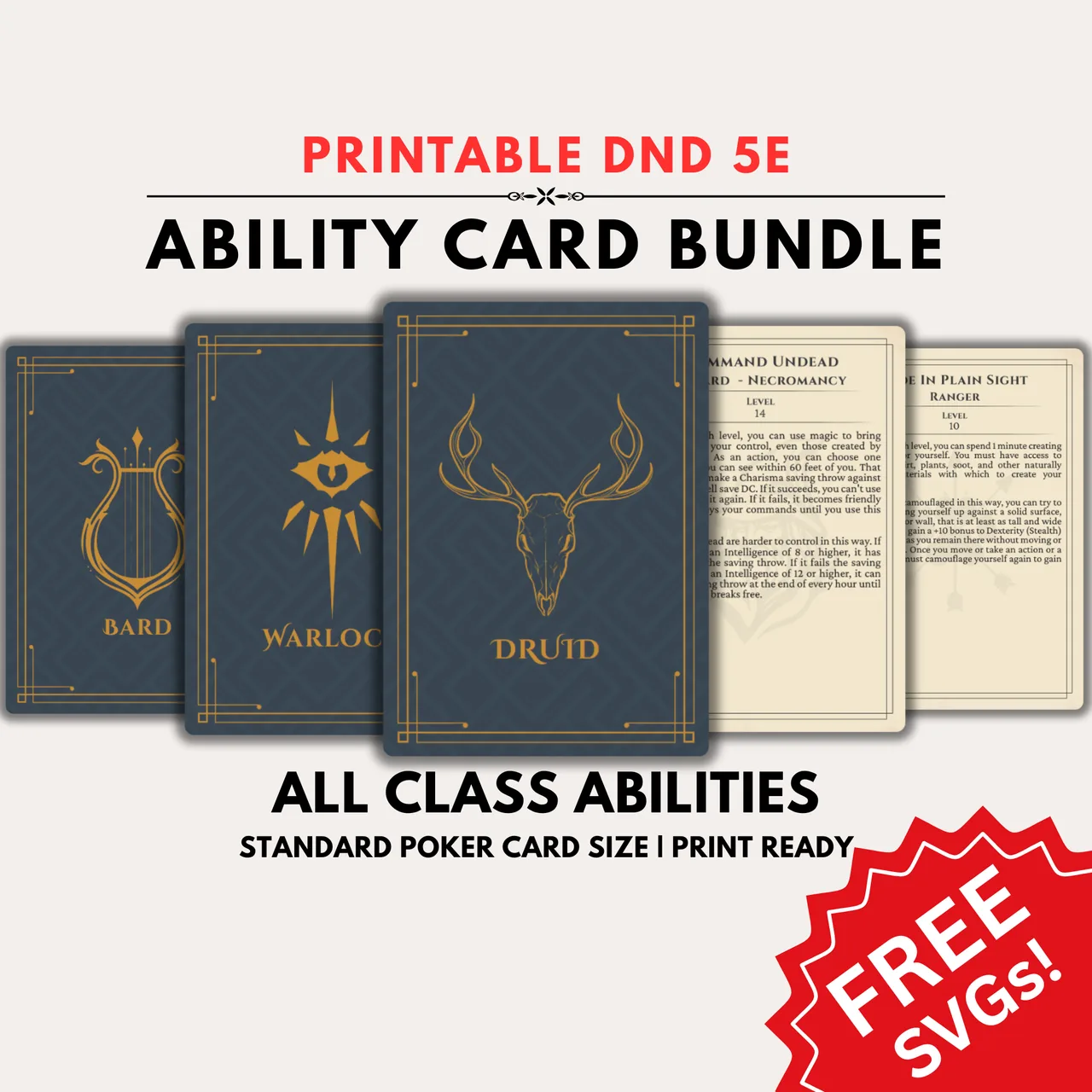
Players comparing these revised features side by side will want every subclass ability in front of them rather than flipping through a book mid-turn. A printed reference of class features is one of the cleanest ways to keep that comparison at the table without slowing combat.
Ranger: Gloom Stalker stays strong, Hunter’s Mark gets better
The ranger as a whole got a quiet glow-up, and Hunter’s Mark is the reason. The spell now deals 1d10 force damage on a hit, up from 1d6, and a ranger can cast it twice per long rest without spending a slot, with it always prepared. Gloom Stalker remains the popular pick, though its Dread Ambusher changed: instead of a guaranteed extra attack on round one, it now grants bonus damage a few times per day. Beast Master also improved, with the companion’s AC now scaling off the ranger’s Wisdom.
What to watch for: rangers now bring consistent single-target damage to nearly every fight, because Hunter’s Mark is almost always up. When you build a multi-round fight, assume the ranger’s marked target takes steady extra damage each turn. Spreading threats across several enemies dilutes that focus far better than one big bruiser does.
Sorcerer: Draconic and Wild Magic both got real spell lists
Sorcerers were one of the biggest winners, mostly at the base-class level: they now prepare far more spells, closing the old gap with the wizard. On the subclass side, every sorcerer subclass gained its own bonus spell list. Draconic Sorcery picked up ten extra spells as it levels, including Fear and Charm Monster, plus an AC calculation that now adds Charisma. Wild Magic was retuned so surges trigger on a roll of 20 rather than 1, and Bend Luck got cheaper.
What to watch for: the Draconic sorcerer is now a durable blaster with built-in control options like Fear, so it can both shape the battlefield and soak a hit. If your encounter funnels enemies into a tight space, a sorcerer with a wider spell list will punish that grouping hard. Give your monsters room to spread out, or accept that a single fireball-shaped turn can end the fight.
Warlock: Great Old One reworked, Hexblade left behind
The 2024 warlock changes are structural. Invocations and Pact Boons now arrive at level 1, and Pact of the Blade is itself an invocation, so any warlock can become a weapon attacker. The Great Old One got a full rework into a stronger control and mind-magic subclass. The notable absence is Hexblade, which is not in the 2024 Player’s Handbook at all. Its iconic Charisma-to-attack trick is largely covered by Pact of the Blade now.
What to watch for: warlocks are more flexible from level 1, and many tables will let a 2024 warlock pick up Pact of the Blade instead of the old Hexblade. The result is a durable, repeatable Eldritch Blast or weapon attacker rather than a slot-heavy nova. Plan for consistent chip damage every round rather than one explosive turn, and don’t count on the warlock running dry on spell slots the way a wizard might.
How to actually use this at your table
The pattern across the 2024 subclasses is consistency. Several of the old “nova” tricks, especially the paladin’s, were reined in, while steady per-round options got better. For a DM, that means burst-damage spike rounds are rarer and more predictable, while sustained damage across a fight went up. Solo boss monsters survive paladin turns better but get ground down more reliably over several rounds.
If you’re rebalancing encounters for a 2024 party, two practical moves help. First, recheck the hit points on any solo boss you built around 2014 nova math, because the paladin cap means it needs less padding. Second, lean into multi-round, multi-target fights, where the new steady-damage subclasses shine and where your monsters can spread the party’s focus. To rebuild your encounter baseline from scratch, our guide to building balanced D&D encounters in 2024 walks through the CR and budget math.
Once the fight is live, the subclass features matter most in the moment a player asks “wait, what does my level 6 thing do again.” Keeping that lookup off the critical path is what keeps combat moving. A free initiative tracker handles turn order, and a printed feature reference handles the rest. For spellcaster-heavy parties, a spell card set does the same job for prepared spells, and our breakdown of how the frightened condition works in 2024 covers one control effect several of these subclasses now hand out.
The short version
The best D&D 2024 subclasses, from a DM’s seat, are the ones that made player turns more reliable: the Eldritch Knight, the fixed Berserker, the Gloom Stalker, and the Draconic sorcerer. The single change you most need to absorb is the paladin’s once-per-turn smite, which shrinks burst damage and reshapes boss design. Plan for steady damage over several rounds rather than one explosive turn, and your 2024 encounters will land right.
Frequently asked questions
- What are the best D&D 2024 subclasses for a balanced table?
- There's no single best, but the standouts in the 2024 Player's Handbook are the Eldritch Knight fighter, Gloom Stalker ranger, Draconic sorcerer, and Vengeance paladin. Each got cleaner, more reliable features. From a DM's chair, the more useful question is what changed, because that's what shifts your encounter math.
- Did paladins get nerfed in D&D 2024?
- In one specific way, yes. Divine Smite is now a spell cast as a bonus action, so a paladin can only smite once per turn instead of on every hit. This caps their burst damage and makes their spike rounds easier to plan around as a DM.
- When do you choose a subclass in D&D 2024?
- Every class now picks its subclass at level 3, instead of level 1, 2, or 3 depending on the class. This standardises early play and means levels 1 to 2 are mechanically similar within a class before the subclass identity kicks in.
- Is Hexblade in the 2024 Player's Handbook?
- No. Hexblade is not in the 2024 Player's Handbook. Its signature trick, a Charisma-based weapon attacker, is largely folded into Pact of the Blade, which is now an invocation any warlock can take. The named Hexblade subclass still lives in the 2014 books.
- How many subclasses are in the 2024 Player's Handbook?
- There are 48 subclasses, four for each of the 12 classes. That's up from 40 in the 2014 book. Most are revised versions of familiar subclasses rather than brand-new ones, with a handful of significant reworks.
Keep reading
From the shop
Battlemaps, spell cards, and magic item cards, ready to print.
Browse MakeMythic on Etsy →