D&D 2024 Conditions Cheat Sheet: All 15 Conditions Explained
A plain-English D&D 2024 conditions cheat sheet covering all 15 conditions, with the exact rules and what changed for exhaustion, grappled, and prone.
This D&D 2024 conditions cheat sheet covers all 15 conditions in plain English, with the exact rules you need mid-combat and clear notes on the three that actually changed. The 2024 Player’s Handbook gathers every condition into one tidy appendix, so each spell, monster ability, and class feature now points at the same definitions. Most conditions behave the way veteran players remember, but exhaustion, grappled, and incapacitated got real mechanical updates. Below you’ll find each condition, what it does, and where it differs from 2014, so you can rule fast at the table instead of flipping pages.
The 15 D&D 2024 conditions at a glance
Here is the full list with the one-line core of each. Read the detailed sections below for the conditions you’ll adjudicate most.
- Blinded — can’t see, auto-fails sight checks, disadvantage on attacks, attackers have advantage.
- Charmed — can’t attack the charmer or target it with harmful effects; the charmer has advantage on social checks.
- Deafened — can’t hear and auto-fails hearing checks.
- Exhaustion — stacking -2 per level on every d20 test, -5 feet speed per level, death at level 6.
- Frightened — disadvantage on attacks and ability checks while the source is in sight; can’t willingly move closer.
- Grappled — speed 0, disadvantage on attacks against anyone but the grappler.
- Incapacitated — no actions, bonus actions, or reactions; concentration breaks; can’t speak.
- Invisible — can’t be seen without special senses; surprises easily; attacks against it have disadvantage, its attacks have advantage.
- Paralyzed — incapacitated, can’t move or speak, auto-fails Strength and Dexterity saves, melee hits are crits.
- Petrified — turned to solid substance, incapacitated, resistant to all damage, immune to poison and disease.
- Poisoned — disadvantage on attack rolls and ability checks.
- Prone — can only crawl, disadvantage on its attacks, melee attackers get advantage, ranged attackers get disadvantage.
- Restrained — speed 0, disadvantage on attacks and Dexterity saves, attackers have advantage.
- Stunned — incapacitated, can’t move, auto-fails Strength and Dexterity saves, attackers have advantage.
- Unconscious — incapacitated, prone, drops what it holds, auto-fails Strength and Dexterity saves, melee hits are crits.
Exhaustion in D&D 2024 (the biggest change)
Exhaustion is the condition that changed the most. The old 2014 version had six escalating tiers, each adding a different penalty, and most players needed the table in front of them to remember which level did what. The 2024 rules replace all of that with a single, clean math rule.
Each level of exhaustion gives you two stacking effects:
- A -2 penalty to every d20 test per level. A d20 test means attack rolls, ability checks, and saving throws. At exhaustion level 3, that’s a flat -6 to all three.
- A -5 feet speed reduction per level. At level 3, your speed drops by 15 feet.
You remove one level of exhaustion at the end of each long rest, and the condition only clears once you hit level 0. Reaching exhaustion level 6 still kills the character. This version is easier to run and harder to forget, because it’s the same rule scaled up rather than six separate penalties. It also hits casters and martials evenly, since saving throws are now part of the d20-test penalty.
Grappled in D&D 2024 (now a fixed DC)
Grappled is the second condition with a meaningful rules update, and it’s the one most likely to trip up a table mixing editions. In 2014, grappling used a contested check: the grappler rolled Athletics against the target’s Athletics or Acrobatics. In 2024, grappling instead uses a fixed save-or-escape DC, which makes it faster and removes the swingy opposed roll.
The grappled condition itself does three things:
- Your speed is 0 and can’t increase.
- You have disadvantage on attack rolls against any target other than the grappler.
- The grappler can drag you when it moves, though every foot costs it an extra foot unless you’re much smaller.
To escape, a grappled creature uses its action to make a Strength (Athletics) or Dexterity (Acrobatics) check against the grapple’s escape DC. That DC equals 8 + the grappler’s Strength modifier + its proficiency bonus. The same fixed DC is what a target rolls against when a monster first tries to grapple it. If you track a lot of grapplers and shoves on a busy map, our free initiative tracker keeps each combatant’s conditions visible so a speed-0 target doesn’t accidentally move on its turn.
Prone in D&D 2024
Prone is mostly unchanged, but it’s worth nailing down because it comes up every fight and the advantage/disadvantage split confuses people. A prone creature can’t walk or run; it can only crawl, which costs extra movement, or spend half its total movement to stand up and end the condition.
While prone, a creature has disadvantage on its own attack rolls. Attacks against it depend on range:
- Melee attacks within 5 feet have advantage — being on the floor is dangerous up close.
- Ranged attacks have disadvantage — a prone target is a smaller, harder shot from distance.
The practical read for players: going prone is a decent way to blunt incoming ranged fire, but it hands nearby melee attackers an edge and slows you down. Tracking which tokens are prone, grappled, or restrained is much easier with a clean grid; our grid overlay tool drops a printable grid on any map so positions and reach stay unambiguous.
When conditions pile up at the table, the constant lookups are what kill momentum. Having a quick reference for each one in hand means you rule and move on instead of pausing the fight.
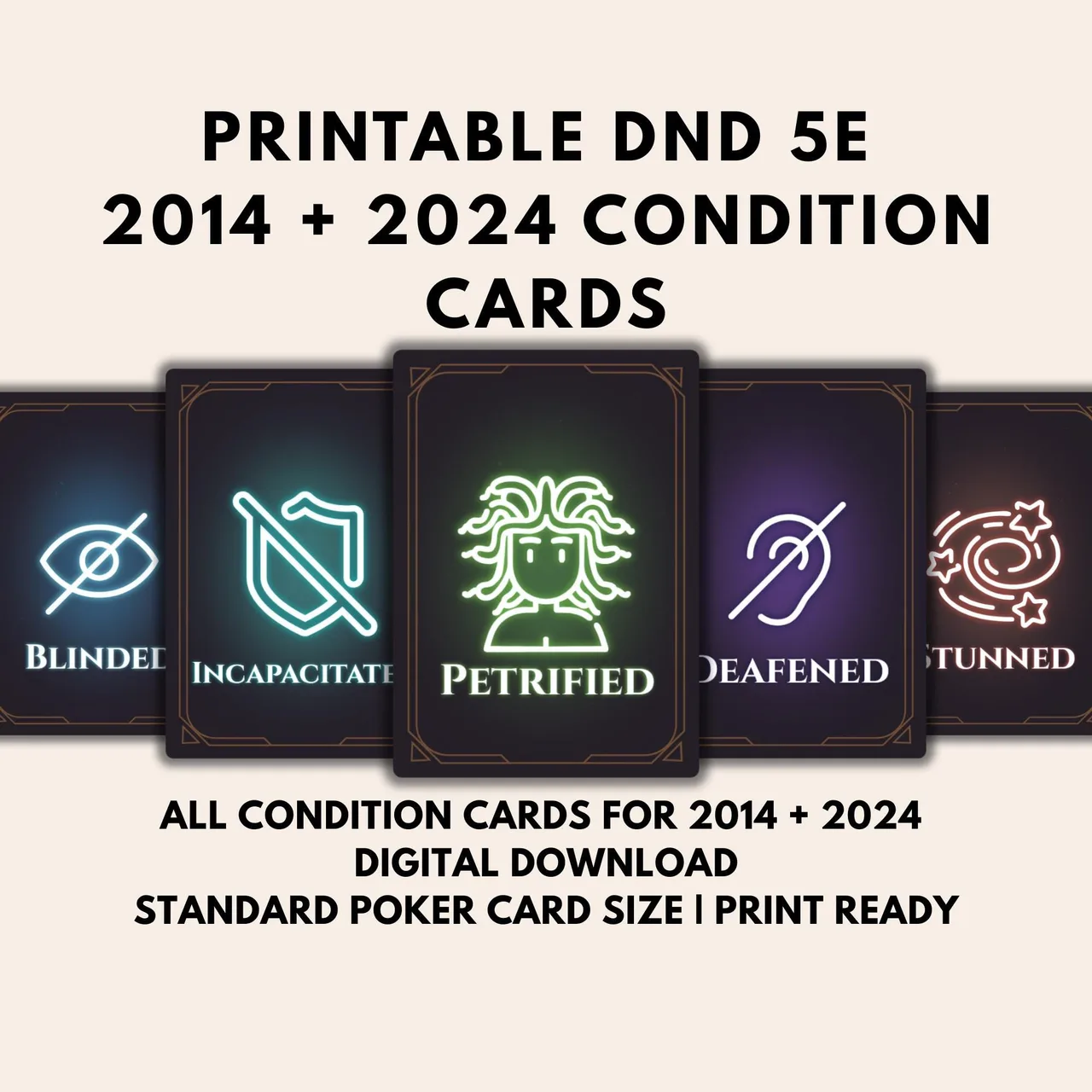
Incapacitated and the conditions built on it
Several of the harshest conditions stack on top of incapacitated, so knowing it precisely saves you from re-reading three others. In 2024, an incapacitated creature can’t take actions, bonus actions, or reactions, has its concentration broken, and can’t speak. The concentration-break and no-speech clauses are new compared to 2014, where incapacitated only stopped actions and reactions.
That base feeds the lockdown conditions:
- Paralyzed — incapacitated, plus can’t move or speak, auto-fails Strength and Dexterity saves, and any attack that hits from within 5 feet is a critical hit.
- Stunned — incapacitated, can’t move, can speak only falteringly, auto-fails Strength and Dexterity saves, and attackers have advantage.
- Unconscious — incapacitated, prone, drops whatever it’s holding, unaware of its surroundings, auto-fails Strength and Dexterity saves, and melee hits within 5 feet are crits.
- Petrified — incapacitated, transformed into a solid substance, resistant to all damage, and immune to poison and disease.
Because incapacitated now also breaks concentration, a single stun or paralysis instantly drops a caster’s ongoing spell. That’s a sharper tactical lever than 2014, and worth flagging to your spellcasters so they position carefully.
The senses and control conditions
The remaining conditions cluster into two groups: those that block a sense and those that bend a creature’s choices.
Sense conditions are blinded and deafened. A blinded creature can’t see, auto-fails any check requiring sight, attacks with disadvantage, and is attacked with advantage. A deafened creature can’t hear and auto-fails any hearing check — a small effect alone, but a real problem for spells with verbal triggers or warnings.
Control and impairment conditions are charmed, frightened, poisoned, restrained, and invisible. Charmed stops a creature from attacking its charmer and gives the charmer advantage on social checks. Frightened imposes disadvantage on attacks and ability checks while the fear source is visible and bars willing movement toward it — covered in full in our guide to the frightened condition in D&D 2024. Poisoned is the simplest combat debuff: disadvantage on attack rolls and ability checks. Restrained sets speed to 0, gives disadvantage on attacks and Dexterity saves, and hands attackers advantage. Invisible, despite living in the same appendix, is largely a benefit: the creature can’t be seen without special senses, its attacks have advantage, and attacks against it have disadvantage.
Run conditions without stalling the fight
Conditions are where tense scenes grind to a halt, because someone has to remember the exact wording. Three habits keep play moving. First, state the end-trigger out loud the moment you apply one — “repeat the save at the end of your turns” stops the condition feeling arbitrary. Second, mark conditions on the map so a speed-0 or prone token can’t quietly act wrong; a labelled token does more than a sticky note. Our free token maker builds clean, labelled tokens for exactly this. Third, keep a reference within reach so you rule in seconds, not minutes.
If you want the encounters that put these conditions to work to actually be balanced, our walkthrough on how to build balanced D&D encounters pairs naturally with this sheet — the right CR and action economy are what make a well-timed stun or grapple matter.
The short version
D&D 2024 keeps 15 conditions and tidies them into one appendix. Most behave like 2014, so your instincts still hold. The three to relearn are exhaustion (a flat -2 per level on every d20 test, death at 6), grappled (a fixed 8 + Strength + proficiency escape DC instead of a contested roll), and incapacitated (now also breaks concentration and speech, which cascades into paralyzed, stunned, and unconscious). Learn those three, keep a reference handy for the rest, and conditions stop being a rules debate and start being a tactical lever.
Frequently asked questions
- How many conditions are there in D&D 2024?
- There are 15 conditions in D&D 2024: blinded, charmed, deafened, exhaustion, frightened, grappled, incapacitated, invisible, paralyzed, petrified, poisoned, prone, restrained, stunned, and unconscious. They are gathered in a single appendix so every effect references the same definitions.
- How does exhaustion work in D&D 2024?
- Each level of exhaustion subtracts 2 from every d20 test (attack rolls, ability checks, and saving throws) and reduces your speed by 5 feet. The penalties stack with each level, you lose one level per long rest, and reaching exhaustion level 6 kills the character.
- What is the grappled escape DC in D&D 2024?
- A grappled creature can spend its action to make a Strength (Athletics) or Dexterity (Acrobatics) check against the grapple's escape DC. That DC is 8 plus the grappler's Strength modifier plus its proficiency bonus, instead of the 2014 contested check.
- What does prone do in D&D 2024?
- A prone creature can only crawl unless it stands, has disadvantage on its own attack rolls, gives melee attackers advantage against it, and gives ranged attackers disadvantage. Standing up costs half its movement for the turn.
- Did the conditions change between 2014 and 2024 D&D?
- Most conditions kept the same effects, but a few changed. Exhaustion switched to a flat -2-per-level system, grappled now uses a fixed save or escape DC, and incapacitated now also breaks concentration and stops speech. The rest are mostly reworded, not rebuilt.
Keep reading
From the shop
Battlemaps, spell cards, and magic item cards, ready to print.
Browse MakeMythic on Etsy →