DM Note-Taking That Survives the Session
A practical DM note-taking system for D&D: prep categories before, phonetic shorthand during, and a 24-hour recap after — plus a reusable note structure.
DM note-taking fails for one reason: most DMs try to do it all at once, during play, when their attention is already spent running the game. The fix is to split the work across three phases. Before the session you set up categories and a handful of scene beats. During the session you capture the bare minimum in shorthand, or you delegate it. After the session you spend ten minutes turning that shorthand into a recap while it’s fresh. Do this and your notes stop being a graveyard of half-remembered names — they become a working tool you actually reach for between sessions.
Why most DM notes fall apart
The common failure is treating notes as a single task that happens at the table. You sit down to run a four-hour session, try to narrate combat, voice three NPCs, adjudicate rules, and write legible sentences at the same time. Something has to give, and it’s usually the notes — they become an unreadable scrawl, or they stop entirely an hour in.
Experienced DMs who track this consistently land on the same split: do almost nothing during play, then write the real record straight after. The session itself is for running the game. The writing happens on either side of it. Once you accept that, the whole problem becomes manageable, because each phase asks for a different, lighter kind of effort.
The other half of the fix is structure. Loose notes with no home turn into a pile you never reread. A few fixed categories give every detail a place to live, so finding it later takes seconds instead of a scroll through three sessions of mixed scribbles.
Before the session: categories and scene beats
Set up your note structure once, at the start of the campaign, and reuse it every session. Four standing categories cover almost everything that matters at a D&D table:
- NPCs — name, one-line description, voice or quirk, what they want, where the party last met them.
- Locations — the place, who controls it, what’s notable, any unresolved hooks tied to it.
- Quests — the goal, who gave it, the current state, and the next obvious step.
- Factions — the group, its goal, its current standing with the party, and who speaks for it.
When something new comes up in play, you already know which bucket it goes in — or whether it’s worth writing at all. That single decision, made in advance, removes most of the friction of in-session notes.
Then prep the session itself as a short list of scene beats. Pick the three to five scenes you expect to run and write each as a tight block: the location, the NPCs present with their names spelled out, the relevant stat blocks or CR, any key DC, and a line or two of dialogue to set the tone. Scene beats are not a script — the party will wander off it — but they mean that when a scene starts you have the names, numbers, and hooks in front of you instead of buried in a sourcebook. You stay present because you’re not flipping pages.
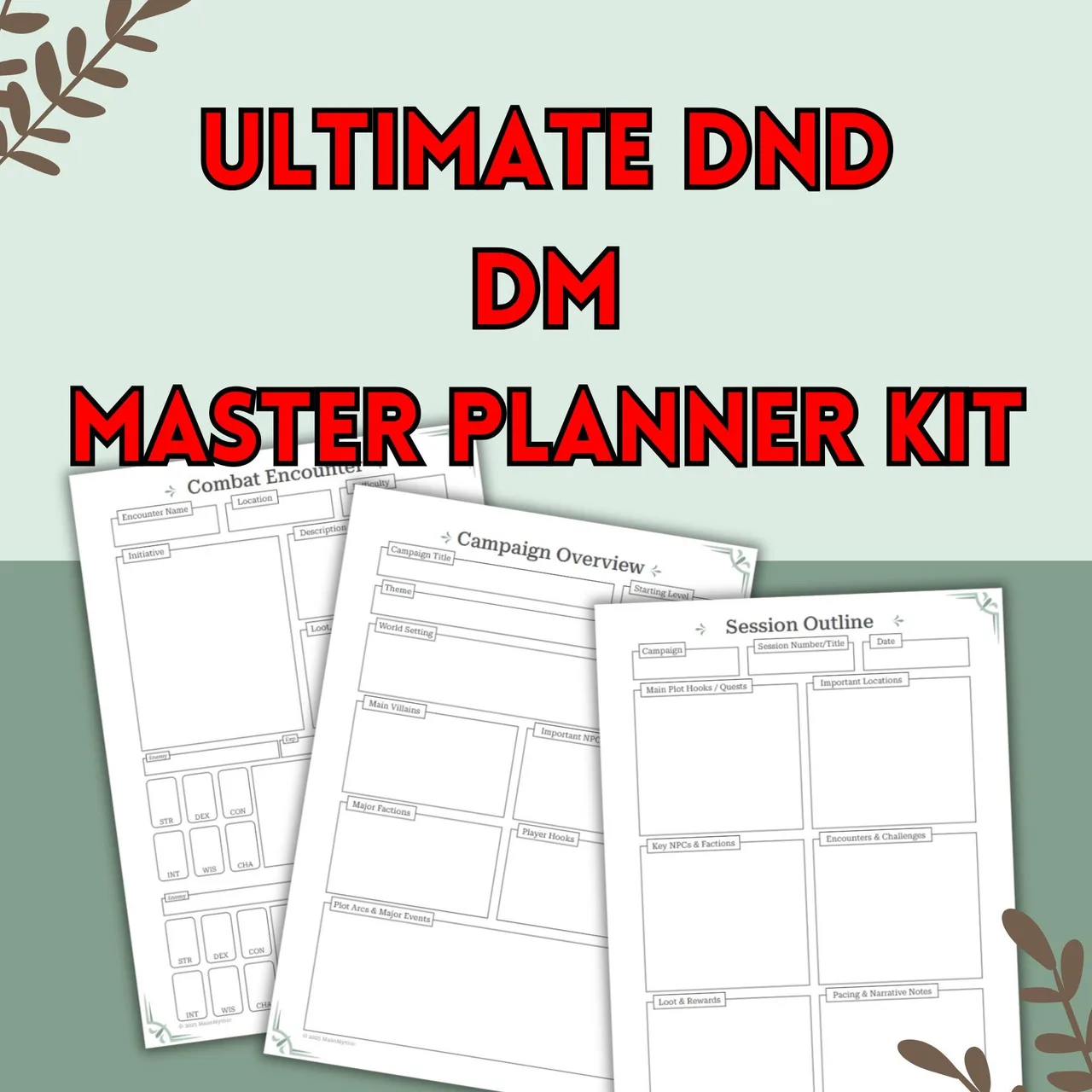
A spreadsheet or planner that keeps these categories and beats in one place saves you rebuilding the structure each week. If you’d rather not build the framework from scratch, the DnD DM Planning Kit gives you ready-made tabs for sessions, NPCs, quests, and campaign tracking — the same standing categories this system runs on, already laid out.
During the session: shorthand and delegation
The golden rule for in-session notes is to write the minimum. You are not transcribing the session — you are leaving yourself memory triggers. Names, numbers, keywords. A note like “Bren wants the deed back, lied re: brother” is enough to rebuild a whole scene the next day. A full paragraph written mid-combat is not, because you stopped running the game to write it.
Two techniques keep this fast.
Phonetic shorthand
Write names the way they sound, not the way they’re spelled, and fix the spelling later. When a player names their character on the spot or you improvise a tavern keeper, “Sorvane” might land on your page as “Sorvayn” — that’s fine. The goal in the moment is speed and recognition, not correctness. Drop vowels, abbreviate ruthlessly, use arrows and symbols. You’re the only person who needs to read it, and only for the next ten minutes. Clean it up when you write the recap.
This matters most for the things you invent on the fly. Improvised NPC names, prices you quoted, a rumour you made up to fill a pause — these have to stay canon, and they only survive if you catch them as they happen. Players remember the throwaway detail you forgot, so a fast phonetic note now saves a continuity slip three sessions later.
Delegate the recap to a player
You do not have to be the only person writing. Most tables have one player who genuinely enjoys keeping the chronicle — let them. Hand them a light structure (what happened, who you met, what you decided, what’s unresolved) and they produce a session recap you can lean on, while you keep your full attention on running the table. It also gives the group a shared record written from the players’ point of view, which is often more useful for “wait, what did we agree to do” moments than your own DM notes.
Keep your own shorthand running in parallel for the things only the DM tracks — secret motivations, the real state of a faction, what the villain is doing off-screen — but let the player-scribe carry the public narrative.
After the session: the 24-hour recap
This is the phase that makes the whole system work, and it’s the one most DMs skip. Within a day of the session — while the memory is fresh but the pressure of running it is gone — sit down for ten or fifteen minutes and turn your shorthand into a clean recap.
Work through it as bullet points, not prose:
- Key events — what actually happened, in order.
- NPCs met — anyone new or important, filed into your NPCs category with correct spelling.
- Decisions and promises — what the party committed to, because these are your hooks for next time.
- Loose threads — anything unresolved that you’ll want to pick back up.
As you write, distribute everything into the four standing categories. The new NPC goes to NPCs, the town to Locations, the job they took to Quests, the cult they angered to Factions. This is the step that prevents the slow rot — without it, details stay trapped in dated session scrawl and you lose them. With it, every fact has a permanent home you can find in seconds.
The recap also doubles as your prep compass for next session. Read it back before you build the next set of scene beats and the loose threads tell you exactly where the party’s attention is. You end up prepping the game they’re actually playing, not the one you imagined three sessions ago.
Make the notes earn their keep with on-site tools
A note system is only as good as how fast you can act on it at the table. A few free tools close the gap between “I wrote it down” and “I can run it now.” When you improvise an NPC and need a name that doesn’t break the moment, the NPC name generator gives you something usable instantly, so your phonetic shorthand starts from a real name. When the scene beat you prepped turns into a fight, the initiative tracker holds the turn order and conditions so your notes don’t have to. And when the party clears an encounter, the loot generator hands you a reward on the spot rather than a “TODO: figure out treasure” line you’ll forget.
For the bigger picture of how note-taking fits a DM’s whole prep workflow, see our round-up of the best free D&D DM tools. And if you’re starting a fresh campaign, the complete session 0 guide covers the agreements you’ll want recorded in your notes from day one.
The system in one line
Prep categories and beats before, write shorthand or delegate during, recap within 24 hours after — and file everything into NPCs, locations, quests, and factions. Run it for three sessions and it stops feeling like a chore. Your notes become the thing you reach for first, instead of the thing you apologise to your players for forgetting.
Frequently asked questions
- How should a DM take notes during a D&D session?
- Take the minimum during play — names, numbers, and keywords only, in fast shorthand. Trying to write full sentences pulls you out of running the game. Capture just enough to trigger your memory, then write the real recap within a day while the session is still fresh.
- What should a DM write down before each session?
- Set up four standing categories — NPCs, locations, quests, and factions — and slot prep into them. Add three to five scene beats you expect to hit, each with the names, stat references, and one or two lines of dialogue you'll need so you're not flipping pages mid-scene.
- Should I let a player take notes for me?
- Yes. Delegating the session recap to a player who enjoys it frees you to run the game and gives the table a shared record. Give them a light structure — what happened, who they met, what they decided — and you get a recap without splitting your attention during play.
- How do you write a good D&D session recap?
- Write it within 24 hours while memory is fresh. Turn your shorthand into clear bullet points: key events, NPCs met, decisions made, and loose threads. File new NPCs, locations, and quests into your standing categories so nothing gets lost between sessions.
- What is the best way to organise D&D campaign notes?
- Use four reusable categories — NPCs, locations, quests, and factions — and put every note into one of them. A consistent structure means you can find any detail in seconds, and player promises or improvised facts stay canon instead of vanishing between sessions.
Keep reading
From the shop
Battlemaps, spell cards, and magic item cards, ready to print.
Browse MakeMythic on Etsy →