How to keep a D&D character journal (and actually keep it up)
A practical guide to keeping a D&D character journal — what to record, how long it should take, and how in-character journalling makes you a better player.
Most players who try journalling stop by session six. The reason is almost never time. It is that they started writing a transcript, discovered that transcribing a four-hour session takes an hour, and quietly gave up.
The version that survives is much smaller and does much more work.
Notes and journals are different things
This distinction is the whole game.
Session notes are operational. Who the party talked to, what the innkeeper said about the road north, the name of the noble who owes them money, which door was locked. They exist so that in three weeks somebody can answer “wait, who was Halvard again?”
A journal is your character’s experience of those events. Not that the noble owes them money, but that your character does not trust him and has not said so. Not that the door was locked, but that your character is starting to think the party takes too many risks.
Notes are for the table. The journal is for you. It is entirely reasonable to keep both — many players run them on facing pages — but if you only keep one, the journal is the one that changes how you play.
The three-question entry
After each session, answer three questions. Short answers.
What happened? Two or three sentences. Not a recap — the headline. “We found the smugglers’ tunnel under the house. Bryn nearly drowned. We did not tell the town.”
What did my character think about it? This is the entry. This is the part that does the work. Did they approve? Were they frightened? Did they notice something nobody else did? Do they disagree with a decision the party made and say nothing?
What do they intend to do next? One line. Something they want to do, ask, or find out at the next session.
That is five to ten minutes. It is sustainable for a year, which a page of prose per session is not.
Why the second question matters most
Players who journal describe the same effect, and it is worth being specific about why it happens.
If you write down that your character resented being overruled about the tunnel, you have made a decision about who they are. Next session, when a similar thing happens, you already know how they react — because you decided a week ago, calmly, rather than in the middle of a scene while four people wait for you.
That is the entire mechanism. Journalling moves characterisation out of the moment and into reflection, which is where people are actually good at it. The result is a character who is consistent and who has opinions, which is what makes them interesting to play and to play alongside.
It also gives you something to bring. The third question — what do they intend — means you arrive at the session with an agenda rather than waiting to react. Players with agendas drive scenes. DMs notice them, and write for them.
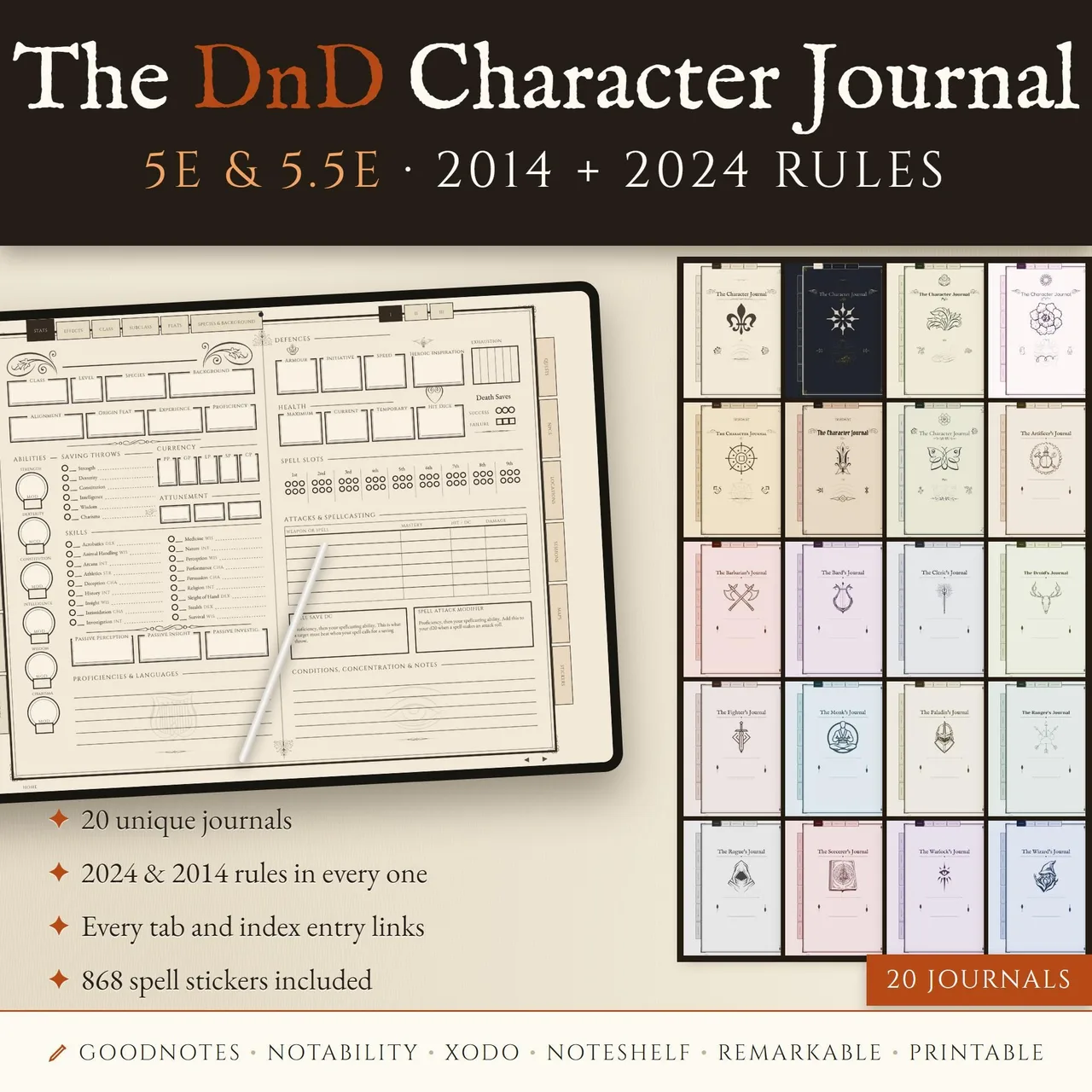
The thing that actually kills the habit is the blank page. A journal with prompts already on it, spell reference pages where you need them and tracker sheets for the mechanical bookkeeping means the five minutes goes on writing rather than deciding what to write. The MakeMythic set covers both printable and GoodNotes-ready digital versions, so it works on paper or on a tablet at the table.
Writing in character
If you can sustain it, write as your character. Not because it produces better prose, but because it forces a useful constraint: you can only record what they noticed.
Your character does not know the NPC was lying. They know he looked at the door twice. Writing from inside that limitation is where the interesting material is, and it stops the journal from becoming a summary of things you know as a player.
It also produces a genuinely valuable side effect. When your character is wrong about something in their journal, and the truth comes out six sessions later, you have a record of the misunderstanding. That is the kind of thing that makes a campaign feel like a story afterwards.
If in-character writing feels like too much, do not force it. An out-of-character journal that gets written beats an in-character one that does not.
Things worth recording that people forget
- Names of people you met once. You will need them. Your DM will be quietly delighted.
- What your character was wrong about. Especially useful later.
- Debts, promises and threats. Both directions. These are the things campaigns are made of and the things everyone forgets.
- Items you have not identified or used. The consumable in the bottom of the bag that nobody remembers.
- Questions you want answered. Feed these to your DM. They are a gift.
- What your character wants. Revisit it every few sessions — it should move.
Keeping it going
Write it immediately. Within an hour of the session ending, while you still remember how it felt. The next day is already too late and the following weekend never happens.
Allow bad entries. Some sessions are shopping and travel. “Nothing happened. Kest is bored and looking for a reason to start something.” That is a fine entry and it is characterisation.
Do not backfill. If you miss three sessions, do not try to catch up. Write the current one and move on. Trying to reconstruct the missed weeks is the most common point of abandonment.
Read it before the session. Thirty seconds, the last entry only. It puts you back in the character’s head before play starts, which is the second-biggest benefit after writing it.
If you are the DM
The DM version of this is a different job — you are tracking threads, NPCs and consequences rather than one person’s interior life. Our DM note-taking guide covers that, and the session recap habit covers the shared record the whole table relies on.
The overlap worth knowing: a DM whose players journal has a much easier job. Player journals are a free, detailed record of what the table believes is true, what they care about, and what they intend — which is most of what you need to prep for. Ask to read them.
Where journalling fits at the table
The mechanical bookkeeping is a separate problem and should not live in your journal. Keep spell slots, conditions and inventory on the tools built for them — the spell slot tracker and the condition reference handle the bits you need mid-session, and printable character sheets handle the rest.
The journal is for the parts that are not on the sheet. That is the point of it.
The short version
Three questions, ten minutes, immediately after the session. What happened, what did they think, what next. Write in character if you can and out of character if you cannot. Skip the sessions where nothing happened, never backfill, and read the last entry before you play. It is the cheapest thing a player can do to become someone the rest of the table wants to play with.
Frequently asked questions
- What should I write in a D&D character journal?
- Three things at minimum: what happened, what your character thought about it, and what they intend to do next. Everything else is optional. The middle one is what turns a log into a journal and is the part most people skip.
- How long should a D&D journal entry take?
- Five to ten minutes after a session. Anything longer becomes a chore and gets abandoned by session six. A short entry you actually write beats a detailed one you plan to write and never do.
- Should I write in character or out of character?
- In character, if you can sustain it — it forces you to decide what your character noticed and believed, which is where the value is. Out of character is a perfectly good fallback and far better than not journalling at all.
- Is a D&D journal the same as session notes?
- No. Session notes record facts the party needs — names, clues, rumours, quest details. A journal records your character's experience of those events. Many players keep both, often on facing pages.
- Do I need a special notebook for a D&D character journal?
- No, but a prepared journal with prompts, spell reference pages and tracker sheets removes the friction that kills the habit. The main reason journals get abandoned is a blank page, not a lack of time.
- How does journalling make you a better D&D player?
- It forces you to form opinions between sessions. A player who has written down what their character thinks about the party's decision arrives at the next session with something to say, rather than reacting to whatever happens first.
Keep reading
From the shop
Battlemaps, spell cards, and magic item cards, ready to print.
Browse MakeMythic on Etsy →