How to run Dragon of Icespire Peak: a new DM's guide
A practical guide to running Dragon of Icespire Peak — how the job board structure works, which quests to cut, how to fix the levelling, and how to link it to Phandelver.
Most published campaigns ask a first-time DM to hold a branching plot in their head while also learning the rules, doing voices, and adjudicating grapple. Dragon of Icespire Peak does not. It gives you a notice board in a tavern, a handful of short quests pinned to it, and a dragon circling somewhere above.
That structure is the whole reason to run it. It is also the thing most guides gloss over, so it is worth being precise about what the adventure is actually doing and where it needs help.
How the job board actually works
The party is in Phandalin. Townmaster Harbin Wester has posted jobs. The players pick one, go and do it, come back, and pick another. Three jobs are available at a time, and as characters gain levels the board refreshes with harder work.
Two consequences follow, and both are good for you.
You prepare one quest per session. Not one chapter, not one dungeon complex with four entrances — one location, one objective, usually one map. If the players pick the gnomish mine, the harpy nest and the old tower are simply not prepared yet, and that is fine.
Every session has a clean shape. Take a job, travel, resolve it, return, get paid. New players understand this immediately because it is how every video game quest they have ever played is structured. Nobody gets lost.
The cost is that the quests do not talk to each other. Finishing the manticore job does not change the orc job. That is the gap you have to fill, and it is not difficult.
The three fixes that matter
Give the job board an owner with opinions
Harbin Wester is written as a coward and a bureaucrat, which is fine but inert. Make him someone who wants specific jobs taken and specific jobs ignored — because a mine reopening threatens a deal he has made, or because the family at the orchard owes him money.
Now every visit to the board is a scene rather than a menu. Players start asking why this job is posted and that one is not. You have added a plot without writing one.
Let the quests leak into each other
When the party clears one location, put something there that points at another. A dead orc carrying a gnomish tool. A letter in the tower naming the family at the orchard. Nothing elaborate — just a thread, so the fifth session feels like a consequence of the second rather than a fresh start.
The adventure gives you Cryovain for exactly this purpose. The dragon should show up between quests: tracks in the snow, a burned-out farmstead, livestock gone. The players should be assembling a picture of it long before they see it.
Fix the levelling
Icespire Peak uses quest-based levelling, and it is uneven. Groups that hoover up every job arrive at the finale over-levelled; groups that beeline arrive under-levelled and get eaten.
The simplest fix is to ignore the printed triggers and level the party when the story wants them levelled — after the second job, the fourth, the sixth, and before the dragon. Milestone levelling is standard practice now and it removes the whole problem.
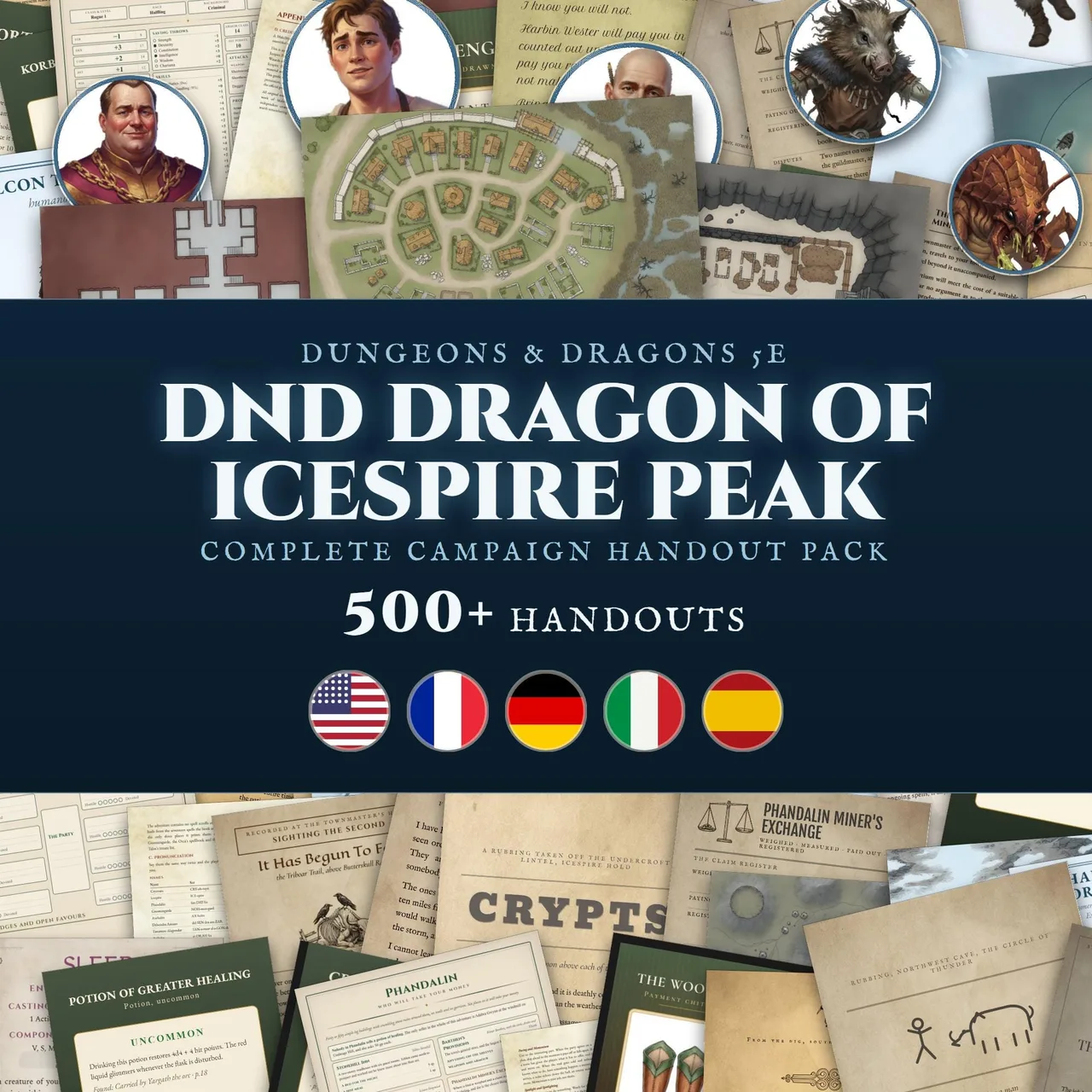
Because the job board is a physical object in the fiction, this is one of the few adventures where printed props do real mechanical work. Handing players actual quest posters to take off a board — rather than reading three options aloud — turns the central mechanic into something they touch. The MakeMythic bundle covers the quest posters, NPC cards, maps and the letters and ledgers the locations are full of.
Which quests to cut
Not all twelve jobs are worth the table time. If you want a tighter campaign, keep these:
- Dwarven Excavation — good introduction, low stakes, memorable NPCs
- Gnomengarde — the tonal outlier and the one players remember, because the mad gnome king is genuinely funny
- Butterskull Ranch — orcs, a burned homestead, and a clear moral question about what to do with the survivors
- Axeholm — the real dungeon of the adventure, with a proper map and a proper haunting
- Icespire Hold — the finale
And cut or compress Loggers’ Camp, Umbrage Hill and Falcon’s Hunting Lodge unless the party specifically bites. They are short, structurally identical to each other, and add travel time rather than variety.
That takes the campaign from twelve sessions to about seven, which is a much better length for a group that is trying D&D to see whether they like it.
Handling Cryovain
Cryovain is a young white dragon with 133 hit points, a breath weapon that will drop a level 4 character outright, and flight. A level 4 party that fights it in an open field loses.
Do not soften this. The adventure works because the dragon is a genuine threat the players learn to fear and then solve. What you owe them is information and options, not a weaker dragon.
Give them the tracks, the kills, the terrified farmers. Let an NPC mention that white dragons are vulnerable to fire. Let Axeholm’s narrow corridors suggest that fighting it indoors, where it cannot fly or use the breath weapon along a whole line, is the difference between a win and a wipe.
If the party charges it at level 4 anyway, let it be nearly fatal rather than actually fatal — Cryovain is a predator, not a duellist, and a predator that takes a solid hit from an unexpected direction leaves and comes back later. That is both realistic and a free second act.
Linking it to Phandelver
Both adventures use Phandalin, both are written for levels 1 to 5-ish, and both are constantly recommended as a new DM’s first campaign. Running them together gets you a much richer sandbox and a campaign that comfortably reaches level 8.
The cleanest method: use Icespire Peak’s job board as the frame, and post Lost Mine of Phandelver’s hooks on it. The Redbrands become a standing job nobody wants to take. Cragmaw Castle becomes available after the party proves itself. Wave Echo Cave becomes the deep-dungeon option sitting alongside Axeholm.
Cryovain then becomes the thing circling over the whole region rather than a plot that has to be finished before Phandelver starts. That is a better campaign than either book on its own.
What to prepare before session one
Keep it short. You need Phandalin, three jobs, and a reason the party is there.
- Read the Phandalin gazetteer and pick three NPCs you can do a voice for
- Prepare one quest location properly — whichever your players are most likely to pick
- Print the quest posters so the board is a real object
- Decide where Cryovain is right now, and what it has eaten this week
- Have a session zero about tone, because Gnomengarde is broad comedy and Butterskull Ranch is not
Everything else can wait. That is the point of the adventure.
Running it at the table
The tools that pay for themselves here are the ones that handle the things the book leaves to you. The NPC name generator covers the villagers Harbin sends you to, the encounter builder tells you whether a scaled-up orc raid will actually kill anyone, and the travel and weather generator gives the Sword Coast winter some texture between jobs.
For the maps, Axeholm and Icespire Hold are the two that benefit from being displayed properly rather than described — the grid overlay tool will get them onto a virtual tabletop or a TV at the right scale.
The short version
Icespire Peak is a scaffold, not a story. It hands you the single most useful structure a new DM can have — one quest, one session, one map — and asks you to supply the connective tissue. Give the job board an owner, let the quests reference each other, level on milestones, keep the dragon frightening, and cut the three quests that repeat. Do that and it is a better first campaign than the book it usually loses to.
Frequently asked questions
- Is Dragon of Icespire Peak good for a first-time DM?
- Yes, and arguably better than Lost Mine of Phandelver for a nervous DM. The job board structure means you only ever prepare one short quest at a time, and each quest resolves in a single session. You never have to hold a branching plot in your head.
- How long does Dragon of Icespire Peak take to run?
- Roughly eight to twelve sessions if you run every quest, or six if you cut the weaker side quests. Characters go from level 1 to level 6, which is a shorter arc than most published campaigns.
- Can I combine Dragon of Icespire Peak with Lost Mine of Phandelver?
- Yes — they share the town of Phandalin and the surrounding region, and many DMs run them together. The usual approach is to use Icespire Peak's job board as the connective tissue and drop Phandelver's Cragmaw and Redbrand plots in as two of the available jobs.
- How many players does Dragon of Icespire Peak support?
- It is written for five characters but scales well between four and six. The Essentials Kit was designed with smaller groups in mind, and several quests include explicit guidance for scaling the opposition.
- Is Cryovain the white dragon too strong for the party?
- Cryovain is a young white dragon and will kill a level 4 party that fights it head-on in the open. That is intentional. The adventure expects the players to avoid it, prepare for it, or fight it at level 6 with terrain on their side.
- Does Dragon of Icespire Peak work with the 2024 rules?
- Yes, with light conversion. The monsters have updated statblocks in the 2024 Monster Manual, and the character options changed, but the adventure's structure, maps and NPCs are ruleset-agnostic. Nothing in the plot depends on 2014-specific mechanics.
Keep reading
From the shop
Battlemaps, spell cards, and magic item cards, ready to print.
Browse MakeMythic on Etsy →