How to run Ghosts of Saltmarsh: making the anthology hang together
A DM's guide to Ghosts of Saltmarsh — how to link seven separate adventures into one campaign, run the three-faction town, and handle ship combat without it stalling.
Anthology books have a structural problem. Seven good adventures sitting next to each other do not add up to a campaign, and Ghosts of Saltmarsh is often run as exactly that — a sequence of unrelated jobs with a coastal theme.
The book does supply a solution, but it puts it in the gazetteer rather than the adventures, so it is easy to miss. The fix is the town, and specifically the three groups competing to decide what Saltmarsh becomes.
The faction engine
Saltmarsh has three power blocs:
The traditionalists want the town to stay a quiet fishing village. They are the old families, and their interest in smuggling is that it pays and asks no questions.
The loyalists want Crown money, a garrison, a proper harbour and an end to the smuggling that makes all of that impossible. They are new, ambitious, and correct about most things, which makes them harder to dislike than the book expects.
The Scarlet Brotherhood want the town destabilised and are prepared to work through either of the other two to get it.
Every adventure in the book pushes on this. Clearing the haunted house exposes a smuggling operation, which strengthens the loyalists. Making peace with the lizardfolk brings a trade partner, which strengthens the traditionalists who trade with them. Failing to deal with the sahuagin strengthens nobody and frightens everybody.
Track it visibly. Three named factions, a simple standing for each, updated at the end of each adventure where the players can see it. The moment players can see that a choice moved a number, the seven modules stop feeling separate.
Running the adventures in order
The printed order works, and there is little reason to deviate:
- The Sinister Secret of Saltmarsh — smuggling, a haunted house, and the town’s split introduced in one go
- Danger at Dunwater — the best adventure in the book, and the one that teaches players that fighting is optional
- The Final Enemy — a reconnaissance mission with a real ticking clock
- Tammeraut’s Fate — the horror one; a good tonal break
- The Styes — grimy, urban, and the one most tables skip
- Salvage Operation — a derelict ship, and the clearest use of the naval rules
- Isle of the Abbey — weakest of the seven, frequently cut
If you want a tighter campaign, run one, two, three, four and six. That is the smuggling plot, the lizardfolk alliance, the sahuagin threat, a horror interlude and a proper ship crawl — a coherent arc from level 1 to about level 9.
Danger at Dunwater deserves special attention. It is written so that a party which attacks the lizardfolk on sight will “win” and lose the campaign’s best ally. Signal hard beforehand that this is a diplomatic mission. Players trained on dungeon crawls will not assume it.
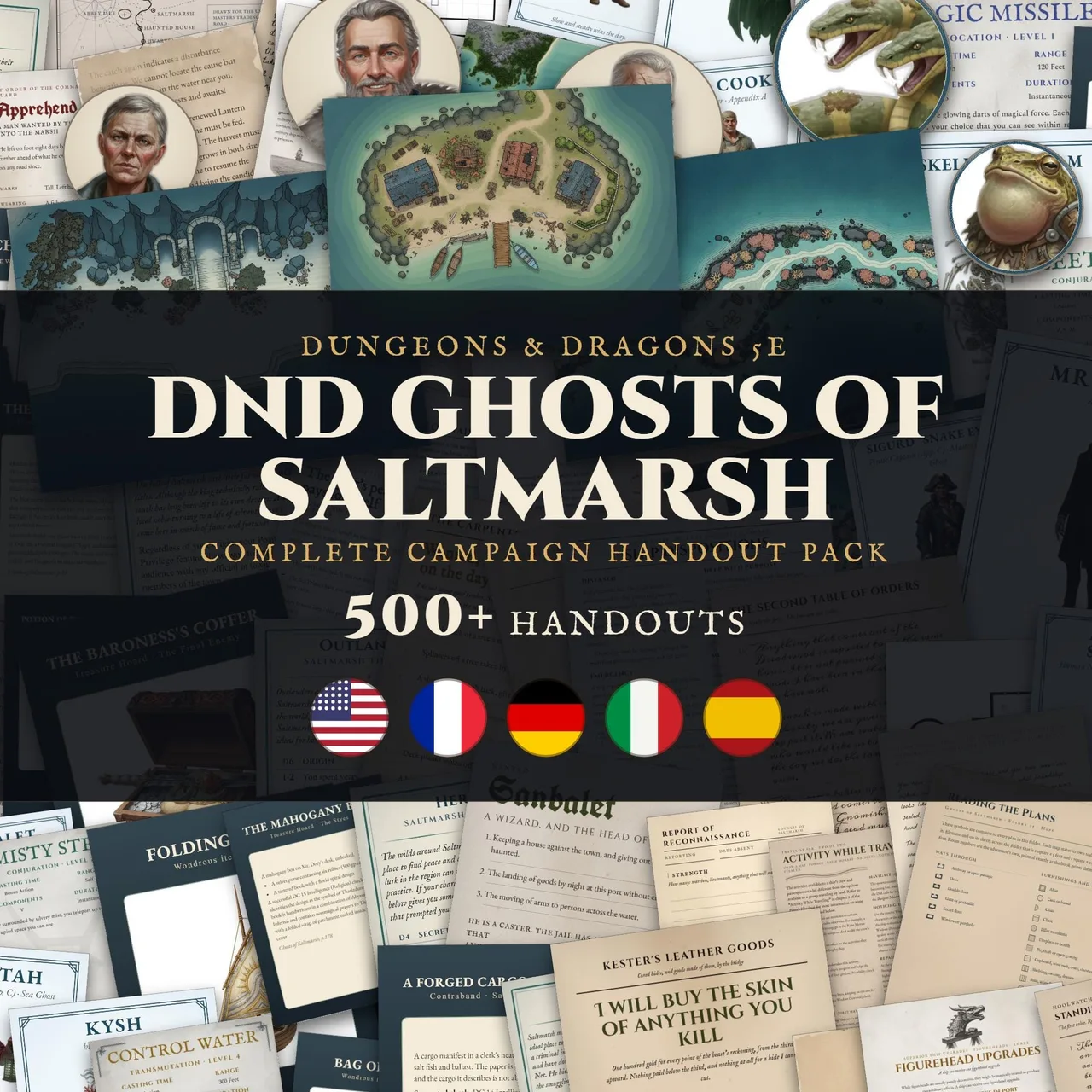
Saltmarsh is unusually document-heavy — smugglers’ manifests, ship’s papers, town notices, the letters that expose who is paying whom. These are the evidence the faction plot runs on, and a physical letter handed across the table does work that a read-aloud paragraph does not. The MakeMythic bundle covers the props, the ship and location battlemaps, and the NPC cards for a town with a large cast.
Naval combat without the stall
The ship rules in Appendix A are the best part of the book and the most likely to grind a session to a halt. Three things fix that.
Give every player a job. Ship combat fails when one person sails and everybody else waits. Assign roles before the first encounter — helm, weapons, repairs, lookout — and make each one a meaningful action on their turn. A character with nothing to do on a ship will make something to do, usually by jumping onto the other ship.
Use fewer, bigger hazards. Do not track every crew member’s hit points. Track the ship, the weather, and one complication — a fire below decks, a jammed rudder, boarders on the aft deck. One complication per round is plenty.
Zoom in when it matters. Ship-to-ship manoeuvring is abstract; boarding is a normal battle on an interesting map. Move between the two deliberately rather than trying to run both at once.
Our guide to naval combat and ship battlemaps goes deeper on the boarding-action geometry, and the initiative tracker is worth using here specifically because ship combat adds crew and hazard turns that are easy to lose track of.
Making the town a place
Saltmarsh only works as a hub if the players want to come back to it. The gazetteer gives you the buildings; you supply the reasons.
- Pick five NPCs and use them constantly. Not twenty. Five people the players know by name by session three.
- Let the town change. After the smugglers fall, the Empty Net has new customers. After the lizardfolk alliance, there are lizardfolk in the market and somebody objects.
- Give the players property. A ship, a warehouse, a stake in the mine. Saltmarsh is a campaign about what a town becomes, and players engage with that far harder when they own a piece of it.
The shop and tavern prices guide is useful here because a port town’s economy is a plot point rather than background — when the smuggling stops, prices move, and players notice.
Common problems
The party solves the haunted house in one session and the plot stalls. Have the smugglers respond. They are an organisation, not a location, and they now know who raided them.
Players do not care about the factions. They will once a faction does something to them. Have the loyalists commandeer their ship, or the traditionalists refuse them a berth. Abstract politics become personal quickly.
The Styes drags. It is the most atmospheric adventure and the least structured. Cut it, or run it as a two-session horror interlude with a hard exit.
Level 1 characters die to the smugglers. They can. Run the first adventure carefully, and consider starting at level 2.
Prep for session one
- Read the Saltmarsh gazetteer, pick your five NPCs
- Prepare Sinister Secret only — the haunted house map and the smuggler encounter
- Make your faction tracker visible at the table
- Print the town notices and the manifest, because they are the first real clues
- Decide why the party is in Saltmarsh together, ideally in a session zero
The short version
The book gives you seven adventures and a town, and most tables run the adventures. Run the town. Track which faction is winning, let the players see it move, put them on a ship early and give everybody a job when they get there. Saltmarsh becomes a campaign about what a place turns into — which is a better story than any of the seven modules tell on their own.
Frequently asked questions
- Is Ghosts of Saltmarsh a campaign or a collection of adventures?
- It is an anthology of seven converted adventures plus a town gazetteer and naval rules. It is not written as a continuous campaign, so the connective tissue between adventures is your job. The three-faction structure of Saltmarsh itself is what you use to supply it.
- What levels does Ghosts of Saltmarsh cover?
- Levels 1 to 12 if you run all seven adventures in the printed order. Most tables run five of them and land around level 10, which is a reasonable length for a campaign that started as separate modules.
- Do I need the naval combat rules to run Saltmarsh?
- No, but they are the reason to pick this book over another anthology. The ship statblocks, crew rules and hazards in the appendices are the best naval content published for 5e, and the adventures assume the party will spend real time on the water.
- Which Ghosts of Saltmarsh adventure should I start with?
- The Sinister Secret of Saltmarsh, as printed. It introduces the smuggling plot, the haunted house, and the town's political split in one adventure, and it ends with a hook straight into Danger at Dunwater.
- How do the three Saltmarsh factions work?
- The traditionalists want the town left alone, the loyalists want Crown investment and order, and the Scarlet Brotherhood work against both from the shadows. Every adventure outcome shifts the balance between them, which is what turns seven modules into one story.
- Can Ghosts of Saltmarsh be run with the 2024 rules?
- Yes. The adventures need no structural changes, and the updated 2024 monster statblocks drop straight in. The naval rules in the appendix are self-contained and unaffected by the ruleset change.
Keep reading
From the shop
Battlemaps, spell cards, and magic item cards, ready to print.
Browse MakeMythic on Etsy →