How to use monster stat cards to run faster D&D combat
How to use printable monster stat cards in D&D 5e: what belongs on a card, how to sort a deck, track HP without a book, and where to get free cards.
Combat slows down for one reason more than any other: the DM is looking something up. Not deciding, not narrating — searching. What is a bugbear’s AC, does a ghoul’s paralysis allow a save each turn, how much does the ogre actually hit for. Every one of those pauses costs the table thirty seconds and a little tension. Monster stat cards fix it by putting the numbers you need in your hand instead of somewhere in a 350-page book.
What belongs on the card
A stat card is a combat tool, not a bestiary entry. Include what you need mid-turn:
- AC, HP and speed — the three numbers you read every round
- Ability scores with modifiers — pre-calculated, so you are never doing arithmetic at the table
- Saving throws, resistances, immunities and vulnerabilities — the things players ask about the moment a spell lands
- Senses and languages — darkvision range and whether it can understand a Persuasion check
- The full action list — attacks with to-hit and damage written out, plus multiattack, recharge abilities, and legendary or lair actions
Leave off the ecology paragraph and the lore. It reads well and it is exactly what you do not need while four players wait for a damage roll. Keep that for prep.
Sort the deck before the session, not during
The cards only save time if the right ones are to hand. Fifteen minutes of prep does it:
Pull tonight’s encounters. Go through your notes and physically pull every creature the party could plausibly meet, including the ones from the wandering table you probably will not use.
Group them by encounter. Paperclip or elastic-band each encounter together. When the party kicks the door in, you pick up one bundle, not six loose cards.
Order each bundle by likely initiative. Rough is fine. It means that when you roll initiative you are re-ordering three cards, not sorting from scratch.
Note the count on the top card. “4x goblin, 1x bugbear” on a sticky note saves you counting.
That is the entire system. It sounds trivial written down, and it is the difference between combat that flows and combat that stalls.
Tracking HP
Three approaches, in order of how many DMs I have seen actually stick with them:
Sleeve and write. Put each card in a penny sleeve and write current HP on the sleeve with a fine dry-erase or wet-erase marker. The number sits directly next to the stat block you are already looking at. Wipe between sessions. This is the most common approach for a reason.
Separate tracker. Keep the cards clean and track HP on paper or in a tool. Better if you are running eight identical goblins and do not want eight sleeved cards. The free initiative tracker handles the order and the damage in one place.
Tokens on the card. Glass beads or dice sitting on the card, one per five HP. Tactile and fast for low-HP minions, unwieldy above about 40 HP.
For a group of identical creatures, do not sleeve five copies. Sleeve one card and track the five HP pools on your initiative list — the stat block is the same for all of them.
Printing and finishing
If you are printing your own, a few choices decide whether the deck survives a campaign.
Poker size, 63 x 88mm, is the safe default. It fits standard sleeves and deck boxes, which means you can protect the cards for pennies and store them somewhere they will not bend. Larger formats like 4x6 hold more text and suit high-CR monsters with long stat blocks, but nothing standard will store them.
Use 250-300gsm cardstock. Thinner and the cards curl and wear at the corners after a few sessions of shuffling.
Print double-sided with “flip on short edge”. Get this wrong and every back is upside down relative to its front. Print one test sheet before committing to thirty.
Sleeve everything you will write on. Dry-erase marker on bare cardstock smears and eventually stains. In a sleeve it wipes clean indefinitely.
Handle the long stat blocks
Poker size is generous for a goblin and tight for an adult dragon. Three ways round it:
Split across front and back. Core numbers and standard actions on the front, legendary actions, lair actions and spell lists on the back. Works for most creatures up to about CR 15.
Use two cards. A “stat” card and an “actions” card, paperclipped. Slightly clumsy, but a boss fight is one encounter and you can afford the desk space.
Abbreviate ruthlessly. You do not need the full text of a spell the monster casts once. “Fireball (3rd, 8d6 DEX 15)” is enough to run it if you know the spell, and if you do not, that is a prep problem rather than a card problem.
Cards for NPCs, not just monsters
The same trick works for recurring NPCs, and almost nobody does it. A card with the innkeeper’s name, a one-line voice note, what they want, and what they know is faster to find than a page of campaign notes, and it means a returning NPC stays consistent across months of play.
You do not need stats for most of them. Name, hook, secret, and a note of where the party met them covers the majority of social scenes. Add AC and HP only for the ones who might end up in a fight.
Cards versus a screen
This is the real comparison, because most DMs already have D&D Beyond or a laptop open.
Cards win on speed and presence. No loading, no tab switching, no laptop lid between you and the table. You can hand a card to a player who has cast Detect Thoughts and let them read it, which is a nice moment a screen cannot easily give you.
Screens win on breadth and search. When the party goes somewhere you did not prep, a search box beats a deck every time.
Most experienced DMs run both: cards for the encounters they planned, a tablet for the ones they did not. The cards handle ninety percent of the session; the screen covers the surprise.
Building your own versus buying a deck
You can absolutely make your own. Free generators like TableMancer and SpellCards.app will filter SRD creatures by type, size or CR and export a printable PDF, and the EN World community has shared blank templates sized for 4x6 index cards if you would rather fill them in by hand.
The trade-off is time and art. A generated card gets you accurate numbers in a plain layout. An illustrated deck gets you a card you can show a player, which does real work at the table — “this is what comes around the corner” lands harder with a picture.
Try a free deck first
Before committing to printing a full bestiary, run a session with a handful of cards and see whether the workflow suits you. Some DMs love it; some find a tablet faster and never look back.
MakeMythic gives away 20 illustrated monster cards free on Patreon — 2024 (5.5e) stat blocks, full art on the front, numbers on the back, CR 0 up to CR 23, in both full colour and an ink-saver version. There is a matching free token pack covering the same 20 creatures if you also run games online.
When you want the whole bestiary
The limit of a free sampler is the same as the limit of free paper minis: coverage. The creature you need is the one you did not print.
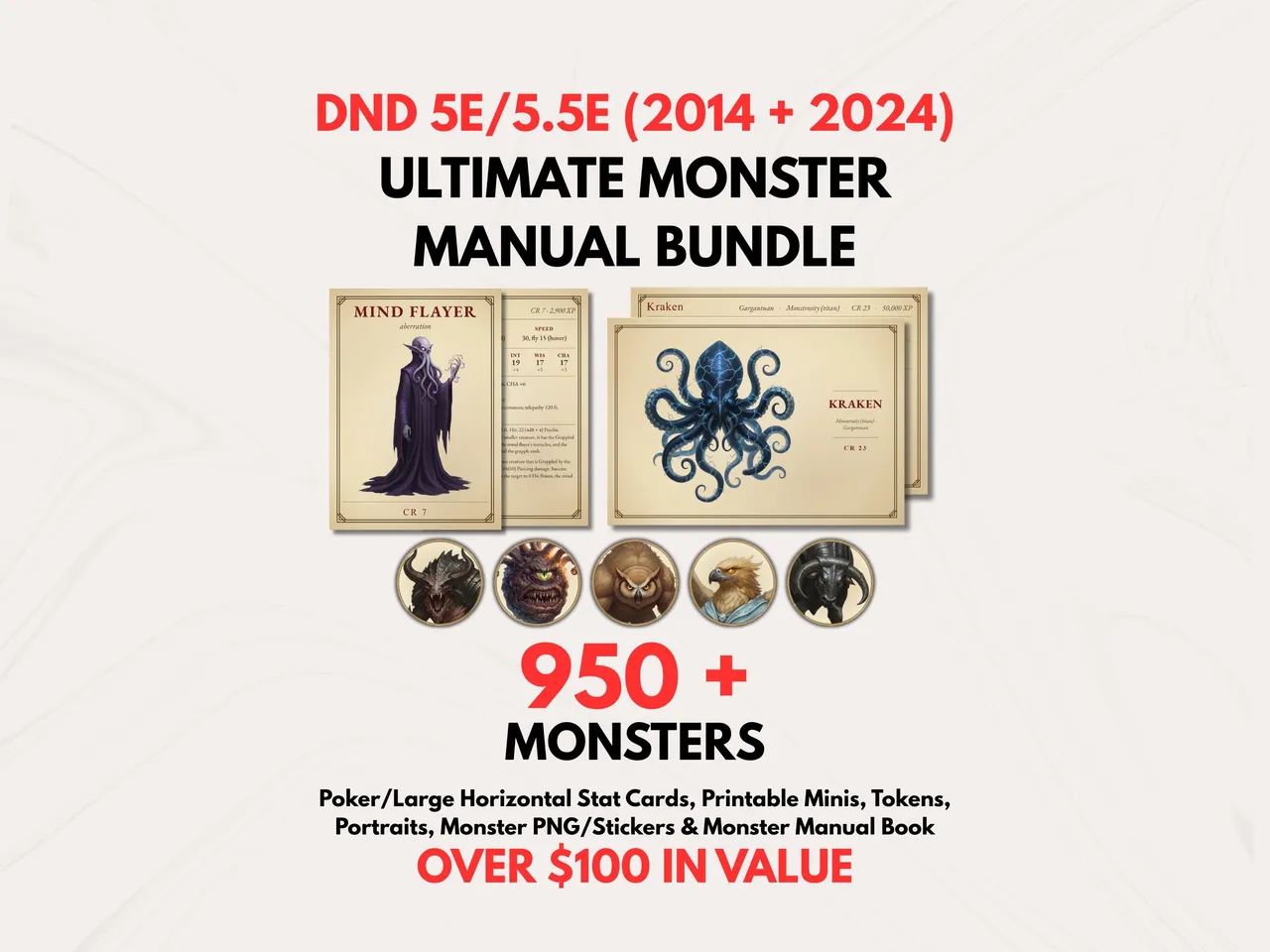
The Monster Cards Bundle ($88 $26.40) covers the SRD in both 2014 and 2024 stat blocks, with matching tokens, paper minis and printable booklets, so a creature you look up is a creature you can also put on the map.
Pair the cards with the rest of your prep
Cards solve the lookup problem. They do not tell you whether the fight is survivable — for that, run the numbers through the free encounter builder first, and read how to build balanced encounters if you are still calibrating.
If you are choosing what to throw at a new party, the best low-CR monsters for early encounters is a good starting deck. When the campaign reaches its climax, the deadliest monsters in the SRD covers running a boss whose stat block genuinely will not fit on one card — that is the moment sorted, sleeved prep pays for itself. You can browse every creature in the SRD bestiary while you plan.
Frequently asked questions
- What should be on a D&D monster stat card?
- AC, HP, speed, the six ability scores with modifiers, saves, resistances and immunities, senses, languages, and the full action list. Anything you would have to look up mid-turn belongs on the card. Lore and description do not — they slow you down at the exact moment you need numbers.
- How do you track monster HP without writing on the cards?
- Sleeve the card and write on the sleeve with a dry-erase marker, or keep HP on a separate initiative tracker and leave the cards clean. Sleeving is the more popular option because the number sits right next to the stat block you are already reading.
- Are monster cards better than a laptop or D&D Beyond?
- They are better for speed and worse for search. A card is instant and needs no screen between you and the players, but a digital tool wins when you need a creature you did not prep. Many DMs run cards for planned encounters and keep a tablet open for improvised ones.
- What size should printable monster cards be?
- Poker size, 63 x 88mm, is the standard because it fits every common sleeve and deck box. Larger index-card formats like 4x6 fit more text and suit high-CR monsters with long stat blocks, but they will not fit a normal card box.
- Where can I get free printable D&D monster cards?
- MakeMythic gives away 20 illustrated 5.5e monster cards free on Patreon, with art on the front and the stat block on the back. Free generators like TableMancer and SpellCards.app will also produce printable PDFs from SRD stat blocks if you want to build your own deck.
Keep reading
From the shop
Battlemaps, spell cards, and magic item cards, ready to print.
Browse MakeMythic on Etsy →