Official D&D Spellbook Cards vs printable: which should you buy?
Gale Force Nine's Spellbook Cards are the default answer, but they're split across decks, priced per class, and predate the 2024 rules. Here's the honest comparison.
Ask where to get D&D spell cards and the answer is usually “the official ones.” Gale Force Nine’s Spellbook Cards have been the default for years, they are properly printed, and they do the core job: get the rules text off the page and into the player’s hand.
They also have three structural problems that are easy to miss until you have bought two decks.
Problem one: you are buying a class, not a game
The official decks are split by spell list, and the sizes are wildly uneven:
| Deck | Approx. cards |
|---|---|
| Arcane | 253 |
| Druid | 110 |
| Cleric | 106 |
| Ranger | 46 |
| Paladin | 44 |
Listed prices sit roughly in the $18-$25 range per deck depending on size and where you buy.
So the cost is not “the price of spell cards.” It is the price of spell cards multiplied by how many casters are at your table. A wizard, a cleric and a druid is three separate purchases, comfortably over $60 at list. Add a warlock and a paladin later and you are buying again.
For a DM who wants cards for NPC casters, it is worse — you need broad coverage, which means the big decks, which are the expensive ones.
Problem two: the ruleset
The widely available decks were produced against the 2014 rules. The 2024 revision rewrote a number of spells and moved others between lists.
That does not make the decks useless — most spells are unchanged, and plenty of tables are still happily running 2014 anyway. But it does mean a card can quietly disagree with the book, and the whole point of a spell card is that you trust it mid-combat without checking. A card you have to verify is worse than no card.
Update, October 2026: Wizards of the Coast has now replaced the Spellbook Cards line with D&D Reference Cards, built on the 2024 rules. The spells come in three decks split by level rather than class — Spells 0-1, 2-3 and 4-5 — at $19.99 each. That fixes the ruleset problem and softens the per-class problem, but the decks stop at 5th-level spells, so anything from 6th to 9th level still needs another source. Our roundup of the best D&D spell cards compares every current option.
If you are weighing which ruleset to sit on generally, our 2024 vs 2014 comparison covers that decision.
Problem three: you get the whole list, and use a fraction of it
This is the one people underestimate.
A wizard at level 5 has maybe fifteen to twenty prepared spells. The Arcane deck has around 253 cards. Every time that player wants a card, they are searching a deck that is more than ten times larger than their actual spell list.
In practice most players solve this by pulling out their spells and rubber-banding them, which works — and is an admission that what they wanted was their spells, not the class list.
What a printable set changes
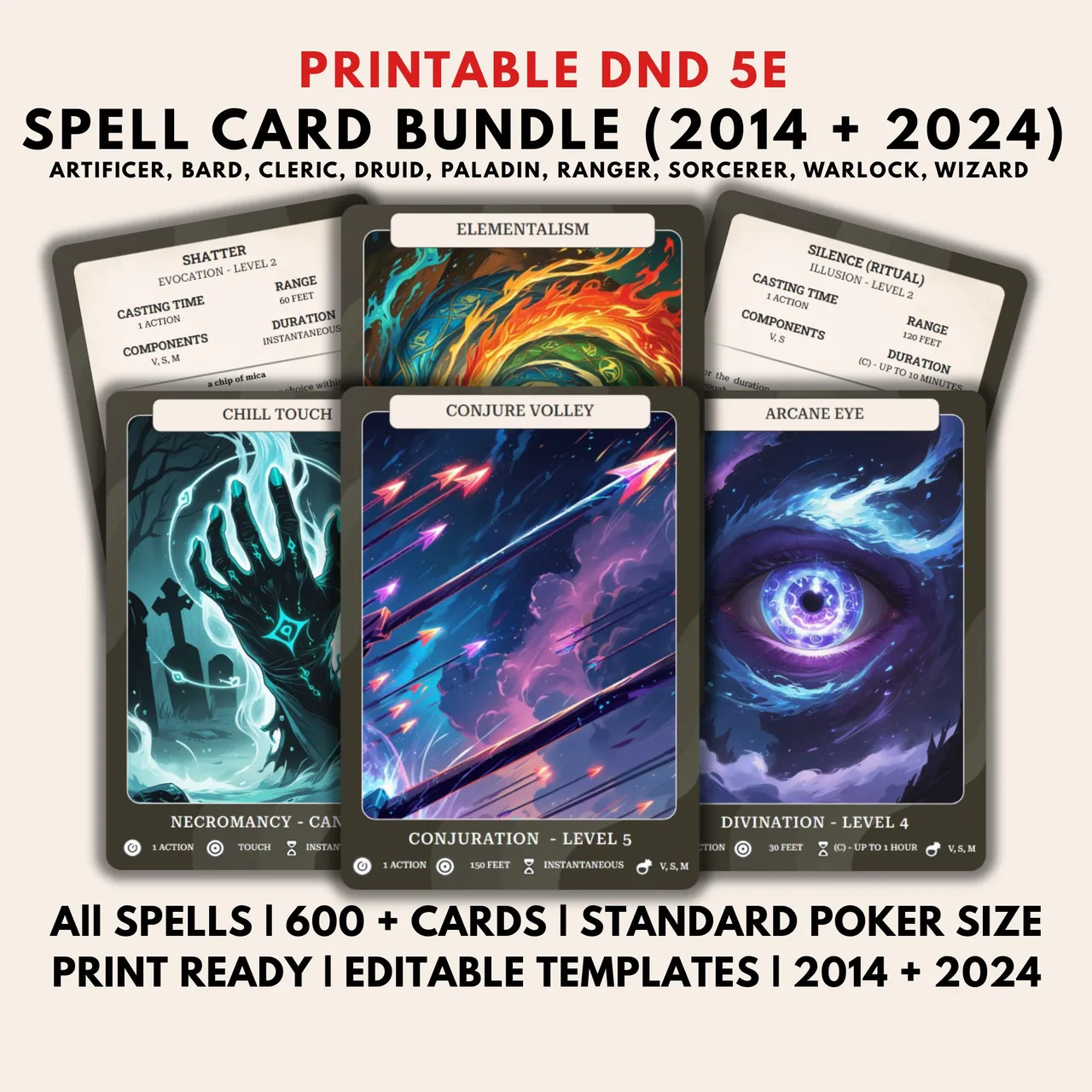
Three things, and they map directly onto the three problems above.
One purchase covers every class. Not one deck per caster. The wizard, the cleric, the druid and the warlock who joins at level 6 all come from the same files.
Both rulesets are in the download. 2014 and 2024. A table that switches edition prints the other set instead of rebuying, which is exactly the scenario that makes a physical deck obsolete.
Print per character, not per class. The wizard prints their eighteen prepared spells. When they level up and swap two, they print two more cards. The deck in their hand is their spellbook rather than a class encyclopaedia, and finding a card takes a second instead of thirty.
There is a fourth, less obvious one: you can print a spell twice. Two clerics at the table, both with healing word, both with a card. A physical deck has one.
Where the official decks genuinely win
Being fair about it:
Durability. A professionally printed, coated card survives a campaign of shuffling. Home-printed cardstock does not, unless you sleeve it — which you can, and should, and it costs a few pounds.
Zero effort. Buy, open, play. Printing 40 cards, duplexing them and cutting them is a real hour of your life. If you value that hour above the price difference, buy the deck.
They look uniform out of the box. Home printing has a learning curve — duplex alignment in particular — and your first sheet will probably be slightly off.
The practical answer
One caster at the table, playing 2014, and you hate printing? Buy that class’s official deck. It is a perfectly good product and the maths is fine at n=1.
More than one caster, or you are on the 2024 rules, or you want cards for NPC casters? Print. The cost curve on official decks is per class and it does not flatten, and the ruleset issue only gets worse as more 2024 material lands.
Either way, sleeve them. It is the cheapest thing you can do and it is the only real durability difference between the two routes.
Printing them well
If you go printable, the details that matter:
- 250-300gsm cardstock. Lighter stock feels wrong and shows through.
- Test duplex alignment on one sheet before running forty. Hold it to a light.
- Print per character and keep a DM set for NPC casters separately.
- A guillotine, not scissors. Nine-up sheets with cards butted edge to edge mean one cut serves two cards.
For the digital-only route, the free spell reference and spell slot tracker on this site cover lookup and slot bookkeeping at no cost, which is often enough for a player who does not want cards at all. More on the physical side in printable D&D spell cards.
Frequently asked questions
- What are the official D&D Spellbook Cards?
- They are physical spell card decks published by Gale Force Nine under licence. They are sold as separate decks by class or spell source — Arcane, Cleric, Druid, Paladin, Ranger and others — with each deck covering that list's spells on individual cards.
- How many cards are in the official D&D spell card decks?
- It varies a lot by deck. The Arcane deck is around 253 cards, Cleric around 106, Druid around 110, while Ranger is about 46 and Paladin about 44. Listed prices run roughly $18 to $25 per deck depending on size and retailer.
- Do the official Spellbook Cards cover the 2024 rules?
- The Gale Force Nine Spellbook Cards were produced for the 2014 rules. In August 2026 Wizards of the Coast replaced that line with D&D Reference Cards, built on the 2024 rules: three spell decks (Spells 0-1, 2-3 and 4-5) at $19.99 each, covering spells up to 5th level only.
- How much does it cost to cover a whole party with official spell cards?
- A party with a wizard, a cleric and a druid needs three separate decks, which lands in the region of $60 or more at list price. Cost scales with the number of casters at your table, because each class list is a different purchase.
- Are printable spell cards as good as the official decks?
- For durability, no — a professionally printed card beats home cardstock. For coverage and cost, printable wins clearly, because one purchase covers every class and both rulesets and you print only the spells your character actually knows.
- Can I print spell cards for only the spells my character knows?
- Yes, and it is the main practical advantage. A wizard with 18 prepared spells needs 18 cards, not a 253-card deck they shuffle through. Printing per character is far faster at the table than searching a full-class deck.
Keep reading
From the shop
Battlemaps, spell cards, and magic item cards, ready to print.
Browse MakeMythic on Etsy →