WizKids prepainted minis vs paper minis: the real cost per creature
Icons of the Realms booster bricks run $160-$250 for around 32 random miniatures. Here's what that works out to per creature, and what paper minis do instead.
Prepainted plastic miniatures are lovely. They have real presence on the table, they need no painting skill, and a well-populated battlefield of them looks like the hobby’s advertising.
They are also the most expensive way to solve the problem of “there needs to be something on that square,” and the maths is worth doing before you commit to it as your main approach.
The actual cost per creature
WizKids’ own store lists Icons of the Realms booster bricks in the region of $160 to $250 depending on the set. A brick holds eight to ten boosters, and each booster contains roughly four figures — typically one large or huge and three medium or small.
That puts a brick at around 32 miniatures, which works out at somewhere in the region of $5 to $8 per figure.
Now the part that matters more than the price: you do not choose them. Boosters are randomised. You are buying a distribution across a set, not a list of the creatures your campaign needs.
What random means in practice
Say your next four sessions need twelve goblins, four wolves, a bugbear chief and an owlbear.
With boosters you buy a brick, get 32 figures that are mostly not those, and end up with three of something you will never use and one goblin. You buy singles on the secondary market for the rest, where the creatures everyone needs are the ones that cost the most.
This is not a criticism of the product — it is a collectable model working as designed, and for people who enjoy collecting it is part of the appeal. But if the goal is “cover the creatures in my campaign,” a random distribution is a structurally poor fit.
The low-CR problem is the real one. Nobody struggles to find a dragon. Everyone struggles to have twelve identical goblins, six skeletons and four bandits — the creatures that appear constantly, in numbers, and that nobody wants to spend $6 each on.
What paper minis cost
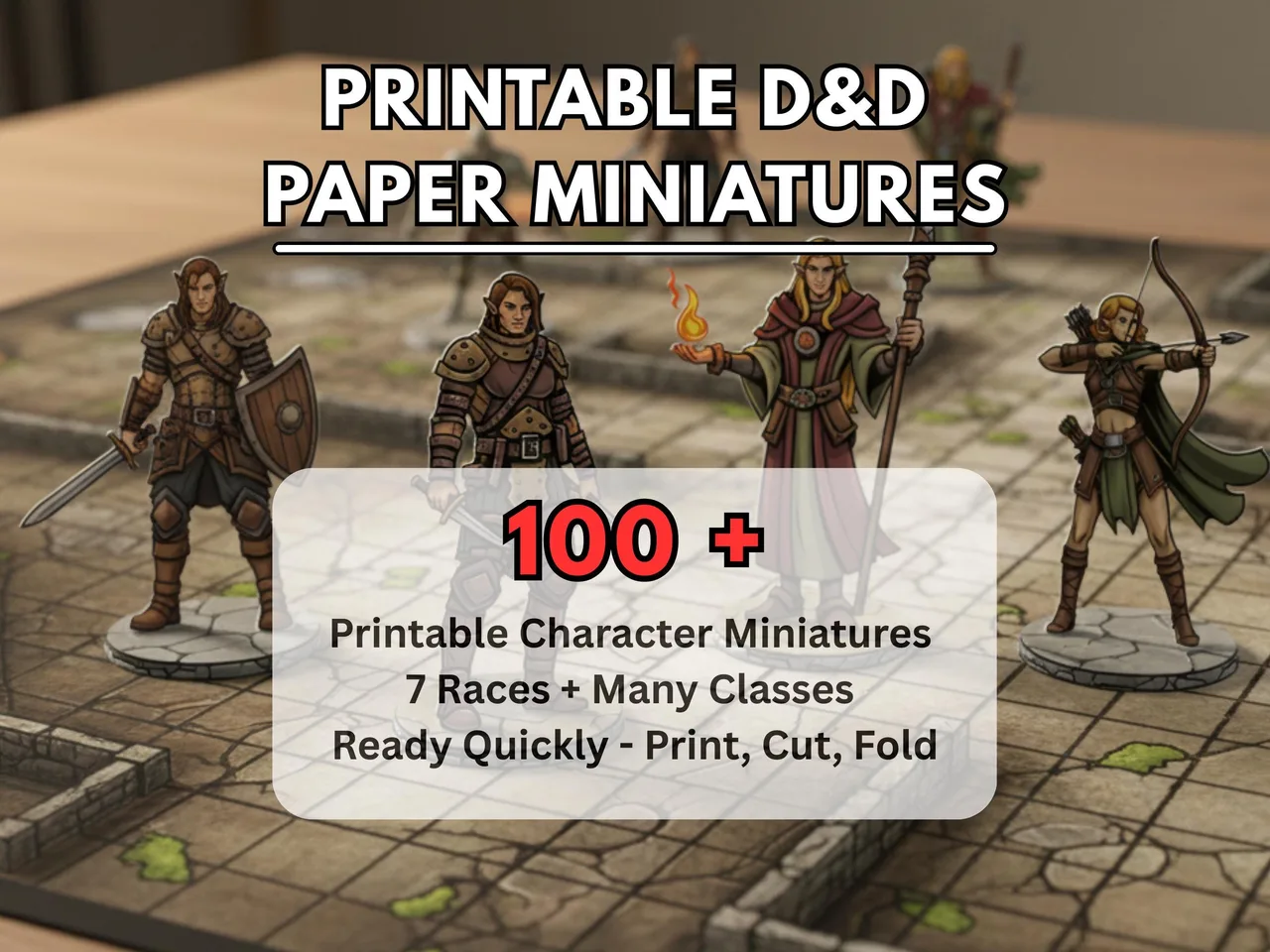
You pay once for the files. After that the cost is paper and ink, which puts a creature somewhere in the pennies.
More importantly, you print what you need. Twelve goblins means printing the goblin twelve times. The encounter with four wolves gets four wolves, not one wolf and a note that the others are imaginary.
And when the party fights something you did not expect, you print it before next session rather than substituting a red d6.
Our guide to making paper miniatures covers the build, and the printable miniatures tool lays them out at the right scale.
Where plastic genuinely wins
Being fair, because there is a real gap:
Presence. A painted figure looks better than folded paper. There is no argument here — it just does.
Durability. Plastic survives being knocked over, bagged and carried indefinitely. Paper creases.
They feel like objects. For a player’s own character, held and moved every session for two years, a physical figure means something a standee does not.
No prep. Open the box. No printing, cutting or folding.
The split most tables land on
After a year of play, most groups converge on the same arrangement without planning it:
- Plastic or painted figures for the player characters. Four to six models, used every session, personally meaningful. Absolutely worth the money.
- Plastic for recurring named NPCs and major villains. The handful of figures that carry story weight.
- Paper for everything else. The goblins, the skeletons, the guards, the wolves, the cultists — the volume creatures, printed by the dozen for the cost of a sheet.
That split gets you the presence where presence matters and the coverage where coverage matters, and it costs a fraction of trying to buy plastic for everything.
The third option: tokens
Worth mentioning because it is cheaper still and often better for large encounters.
Printed circular tokens take less time than standees, stack flat, and are unambiguous about which square a creature occupies. For a fight with twenty combatants, tokens beat standees on both cost and table clarity. The same art usually works for both — see where to get D&D monster tokens, and the free token maker if you want to make your own.
If you print, ink-saver versions matter — printing forty colour tokens is a genuinely different cost from printing forty on white.
If you want plastic, buy singles
One practical note. If you have decided you want physical figures, buying singles is almost always better value than boosters unless you specifically enjoy the randomness. You pay more per figure at face value but you get the creatures you actually need, with no duplicates and nothing wasted.
Boosters are good if you want a collection. Singles are good if you want a monster.
And for the twelve goblins? Print them.
Try paper before deciding. If you have never used a standee, the 50 free print-and-fold minis settle the question for the price of a sheet of card — 25 monsters, 10 NPCs and 15 player characters. The free downloads page has matching tokens if you would rather go flat.
Frequently asked questions
- How much do WizKids D&D miniatures cost?
- Icons of the Realms booster bricks are listed on WizKids' own store in the region of $160 to $250 depending on the set. A brick contains eight to ten boosters, and each booster holds roughly four figures, which works out at somewhere around $5 to $8 per miniature.
- Are D&D prepainted miniature boosters random?
- Yes. Boosters contain a mix of large and medium or small figures but you do not choose which creatures you get. That is the core tension with using them to cover a campaign — you are buying a distribution, not a shopping list.
- What is the cheapest way to get D&D miniatures?
- Printable paper miniatures, by a wide margin. You pay once for the files and then only for paper and ink, which puts the per-creature cost in pennies rather than dollars, and you can print exactly the creatures tonight's encounter needs.
- Do paper miniatures actually work at the table?
- Yes. Printed double-sided on 160-250gsm cardstock and folded into a base, they stand up fine, show correct facing front and back, and read clearly at table distance. They do not have the presence of a painted figure, but they occupy the square just as well.
- What scale should paper miniatures be?
- 28-32mm heroic scale, matching a one-inch grid square, so they sit correctly alongside plastic miniatures and on standard battlemaps. Print at 100% scale rather than fit-to-page or the scale drifts.
- Can you mix paper minis and plastic miniatures?
- Very commonly, and it works well. Most tables use painted figures for the player characters and named NPCs, and paper for the twelve goblins nobody wants to buy. Nothing about the two is incompatible at the same scale.
Keep reading
From the shop
Battlemaps, spell cards, and magic item cards, ready to print.
Browse MakeMythic on Etsy →