Cheap D&D Miniatures: Paper vs Plastic
An honest cost comparison of paper minis, standees, official plastic, 3D-printed, and tokens — plus a clear which-to-pick guide for a whole party on a budget.
If you want cheap D&D miniatures for a whole party plus the monsters they fight, paper minis win on raw cost. A printable paper pack covers your party and dozens of enemies for the price of a single plastic figure, at a few cents per mini once you own the file and some cardstock. Plastic prepainted minis look best on the table but cost the most. 3D printing is cheap per figure but expensive to start. Flat tokens are the rock-bottom option when you only need to mark who stands where. Below is the honest cost and quality breakdown, and a clear rule for which to pick.
The five ways to get minis on the table
There are really only five options, and each trades cost against quality and effort.
- Paper minis — printable PDFs you cut, fold, and stand in a base.
- Printed standees — a flat-art variant of paper minis, often a single card in a clip stand.
- Official plastic — prepainted figures from WizKids and similar, bought per pack.
- 3D-printed minis — resin or filament figures you print yourself from STL files.
- Tokens — flat discs or printed circles that mark a creature’s space on the grid.
The mistake most new DMs make is treating this as one decision. It isn’t. You are buying minis for two very different jobs: a handful of player characters you will use every week for years, and a large rotating cast of monsters you will use once and may never see again. The right answer is almost always a mix.
Cost per mini: the honest numbers
Here is what each option actually costs, using current public pricing rather than guesses.
Paper minis. Once you own a file pack, the only ongoing cost is paper and ink. A sheet of 160gsm cardstock prints several minis, so the per-figure cost lands in the single-cents range. The file itself is a one-time purchase, often the price of one plastic figure for an entire library.
Official plastic. WizKids prepainted figure packs with six minis typically run in the $40 to $50 range, and large boxed monsters can run from roughly $50 to over $120 each, with a Gargantuan boxed figure like the Black Dracolich listed near $120. That is more than a whole paper library costs for a single big monster you may use once.
3D printing. The material cost is genuinely tiny. A 28-32mm miniature uses only a few grams of filament or millilitres of resin, working out to roughly $0.06 per mini in PLA and around $0.21 to $0.30 in resin. The catch is the upfront cost: a printer, resin or filament, plus wash and cure gear for resin. It only beats buying once you print in real volume.
Tokens. A printed token sheet or a set of blank discs with stickers costs almost nothing and stores flat. Tokens skip the model entirely and just mark the square.
Printed standees sit between paper minis and tokens on cost. A standee is usually a single piece of card art held upright in a clip or slot base, so you print one image instead of folding a double-sided figure, but you still need a stand. They are slightly faster to assemble than fold-over paper minis and slightly less durable. On cost per figure they land in the same pennies-each range as paper.
So on pure cost per figure, the order is clear: tokens and paper minis are cheapest, printed standees are nearly as cheap, 3D printing is cheap per unit but expensive to start, and plastic is the most expensive way to fill a table.
Quality and table presence: where plastic earns its price
Cost is only half the decision. The other half is how the mini reads at the table.
Plastic prepainted figures and well-finished resin prints have real physical presence. A painted dragon mid-table changes how players feel about the fight in a way a flat illustration cannot. Resin prints in particular get very close to specialist-company detail. That presence is exactly what you want for the moments players will remember.
Paper minis trade some of that presence for flexibility. A folded, double-sided paper mini reads clearly from every seat and tells you which goblin is flanking the rogue just as well as a painted one. For an encounter with eight identical goblins, the table-presence gap barely matters — what matters is fast, clear identification, and paper delivers that for almost nothing.
Tokens sit at the bottom for presence and the top for speed. They are abstract by design. If your group is happy tracking positions on a grid without caring what the model looks like, tokens are the most efficient option on the table.
One quality factor that cuts across all of them is consistency. A set of minis drawn at the same scale and in the same style reads far better than a mix of sources where a goblin and a hill giant end up the same height. This is where ready-made bundles beat free art scavenged piecemeal: the scale and silhouette work has already been done, so every creature reads correctly next to every other one on the grid.
The budget setup that actually works
If you want a whole party and a monster roster on the table without spending plastic money, here is the setup most cost-conscious DMs land on.
Use paper minis for the bulk of your monsters and NPCs — goblins, bandits, cultists, guards, wolves, and the named NPCs you improvise mid-session. Build a print-on-demand library of 100 to 200 common creatures once, and you cover roughly 80% of the encounters in a typical campaign without printing anything new.
This is the natural point to grab a ready-made pack rather than sourcing art piece by piece. A structured bundle saves you the hours of hunting for consistent, properly scaled, double-sided art.
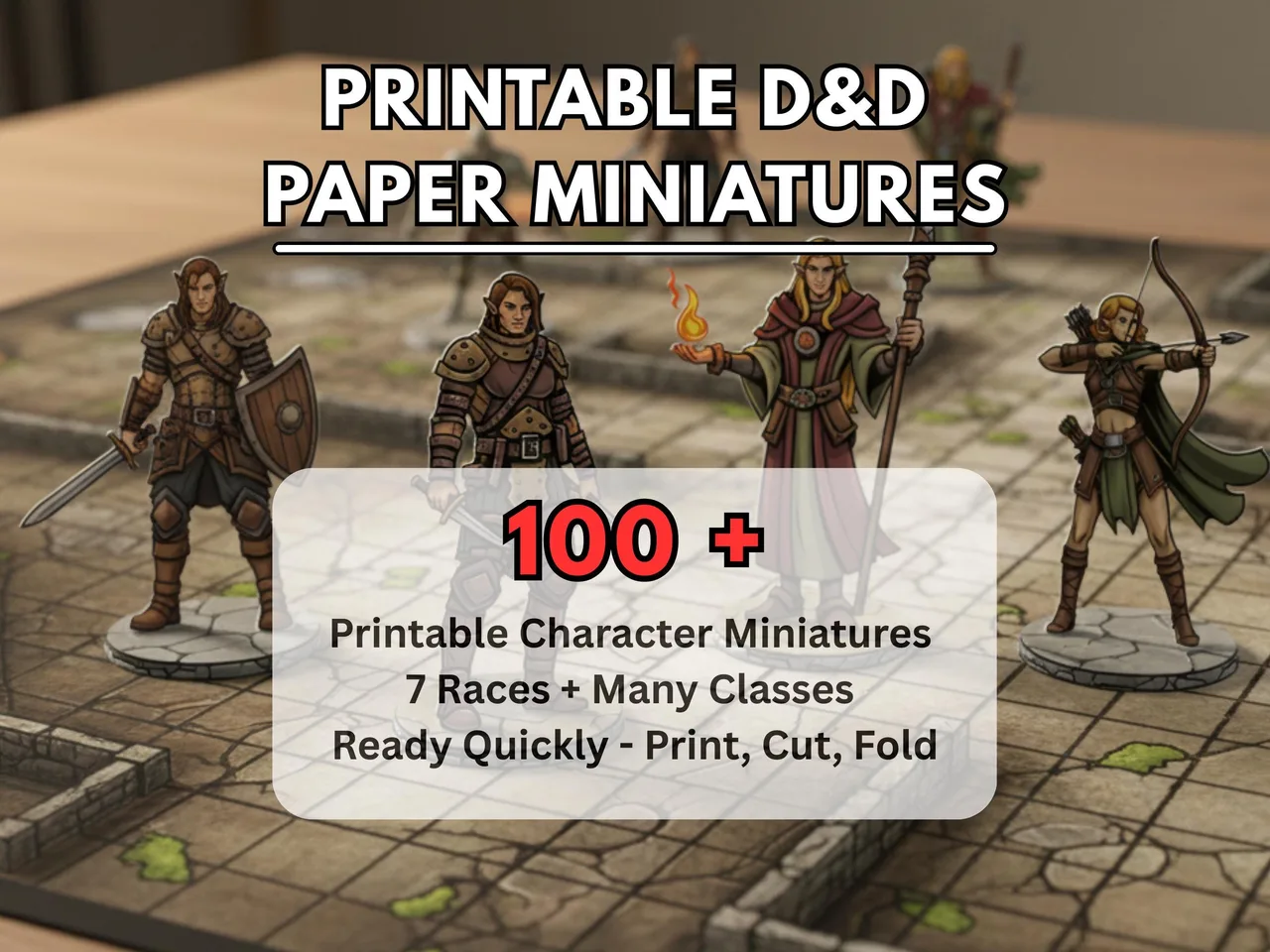
The RPG Paper Miniatures Bundle ($18 $5.40) is built as a library — humanoid enemies, beasts, monsters, undead, and NPCs in a consistent double-sided style. At a one-time cost lower than a single plastic figure pack, the per-mini price drops to pennies. If you want the full how-to on printing and assembling them, our printable paper miniatures guide covers cardstock weights, folding, and bases step by step.
Then spend selectively. Put your money where presence matters: a plastic or 3D-printed figure for each player character, since those get used for years, and a single nice figure for the campaign’s signature boss. That is one or two paid figures total, instead of buying out the monster manual in plastic.
Tokens: the cheapest tactical option of all
If even paper feels like too much cutting and folding, tokens are the floor for cost and effort. A token only needs to do one job: mark a creature’s space and identity on the grid so initiative order, flanking, and area spells stay clear.
You can make your own for free. Our token maker turns any character or monster art into a clean, bordered token in your browser, and our grid overlay tool drops a printable grid onto a map so your tokens line up to a 1-inch scale. For more on the whole token workflow, see how to make D&D tokens. For digital play, a token is all you need — there is no model to store or carry at all.
The trade-off is presence, same as before. Tokens are abstract. But for action economy and positioning — the only things minis strictly need to communicate during combat — a clear token does the job at zero cost.
Which to pick, in one rule
Match the mini to how often you will use it.
- Used once, in bulk (monsters, mooks): paper minis or tokens. Cheap, fast, replaceable.
- Used every week for years (player characters): one plastic or 3D-printed figure each. The cost amortises over hundreds of sessions.
- The signature boss: one good figure, plastic or resin, for the moment players will remember.
- Pure budget or digital play: tokens for everything, free from a token maker.
A whole-party-on-a-budget table almost never means buying everything in one material. It means paper or tokens for the rotating cast, and a small number of nicer figures for the characters and creatures that earn the spend. Do that and you field a full party plus a monster roster for less than the price of one boxed plastic dragon.
If you are still building out your free toolkit, the best free D&D DM tools roundup pairs these mini options with the grid, token, and display tools that make them sing on the table.
Settle it at your own table. The cheapest way to know whether paper minis work for your group is to try them: the 50 free print-and-fold minis cost a sheet of cardstock, and one session tells you more than any cost comparison.
Frequently asked questions
- What is the cheapest way to get D&D miniatures for a whole party?
- Printable paper minis are the cheapest, working out to a few cents per figure once you own a file pack and some cardstock. A printed PDF bundle can cover your party plus dozens of monsters for the price of a single plastic figure. Flat tokens are even cheaper if you only need to mark positions on a grid.
- Are paper miniatures worth it compared to plastic?
- Yes, for most tables. Paper minis cost a fraction of plastic, store in a box the size of a paperback, and are replaced in two minutes if one is lost or damaged. Plastic wins on table presence, so many DMs use paper for monsters and mooks and save plastic or 3D prints for boss creatures and player characters.
- How much do official WizKids D&D miniatures cost?
- WizKids prepainted figure packs with six minis typically sit in the $40 to $50 range, while large boxed monsters run from around $50 to $120 each. That makes a single dragon cost more than an entire paper or token library that covers a whole campaign.
- Is 3D printing miniatures cheaper than buying them?
- Per figure, yes — material cost for a 28-32mm mini is roughly $0.06 to $0.30 in filament or resin. But you pay upfront for a printer, resin or filament, and time spent printing, cleaning, and curing. It pays off only at high volume or if you already own a printer.
- Do I even need miniatures to play D&D?
- No. D&D runs fine with theatre of the mind or simple tokens. Miniatures help most during tactical combat with several creatures, where tracking positions, flanking, and area spells matters. If you only need to know who stands where, cheap tokens or paper minis do the job.
Keep reading
From the shop
Battlemaps, spell cards, and magic item cards, ready to print.
Browse MakeMythic on Etsy →