How to build a D&D town your players actually care about
A practical method for building D&D towns and villages — how many NPCs you need, what makes a settlement memorable, and how to prep a town in fifteen minutes.
Most DMs prepare towns backwards. They start with geography and economy, work outward to institutions, and arrive at the tavern keeper forty minutes later with no time left to think about what the players will actually do there.
Players do not experience a town as a settlement. They experience it as four or five people, one problem, and whatever they can buy. Prepare that.
The five-NPC rule
A town needs five people the players know by name. Not twenty. Five.
This is not a budget constraint, it is a memory constraint. Your players will meet these characters for ten minutes each, once, several weeks apart. Five is roughly the limit of what a group can hold onto between sessions — and a town where the players remember everybody is a town that feels real, while a town with twenty forgettable NPCs feels like a menu.
The five that work, almost universally:
- Someone who sells things. The party will interact with them every visit, guaranteed.
- Someone with authority. A reeve, a captain, a priest. Someone who can give permission or refuse it.
- Someone who knows things. The gossip. Where rumours come from.
- Someone with a problem. The adventure hook, standing in a doorway.
- Someone who dislikes the party. Friction. A town where everyone is helpful is scenery.
Give each one a name, one physical detail, one thing they want, and a voice you can actually do. That is the whole preparation. Our guide to NPC voices covers the last part, and the NPC name generator covers the first when you are put on the spot.
One thing that is wrong
Description does not make a place memorable. Anomaly does.
A village is not memorable because it has thatched roofs and a mill. It is memorable because it has thatched roofs, a mill, and nobody will walk past the mill after dark, and they will not say why.
Give every settlement exactly one specific wrongness:
- The village has no children in it
- Every house has the same symbol above the door, and nobody knows what it means
- The town is obviously richer than its land can explain
- The temple is new and the graveyard is much, much older
- The inn has fourteen rooms and one guest, who has been there nine years
None of these need an answer when you write them. They need an answer by the time the players ask, which is usually two sessions later and after they have invented three theories better than yours. Take theirs.
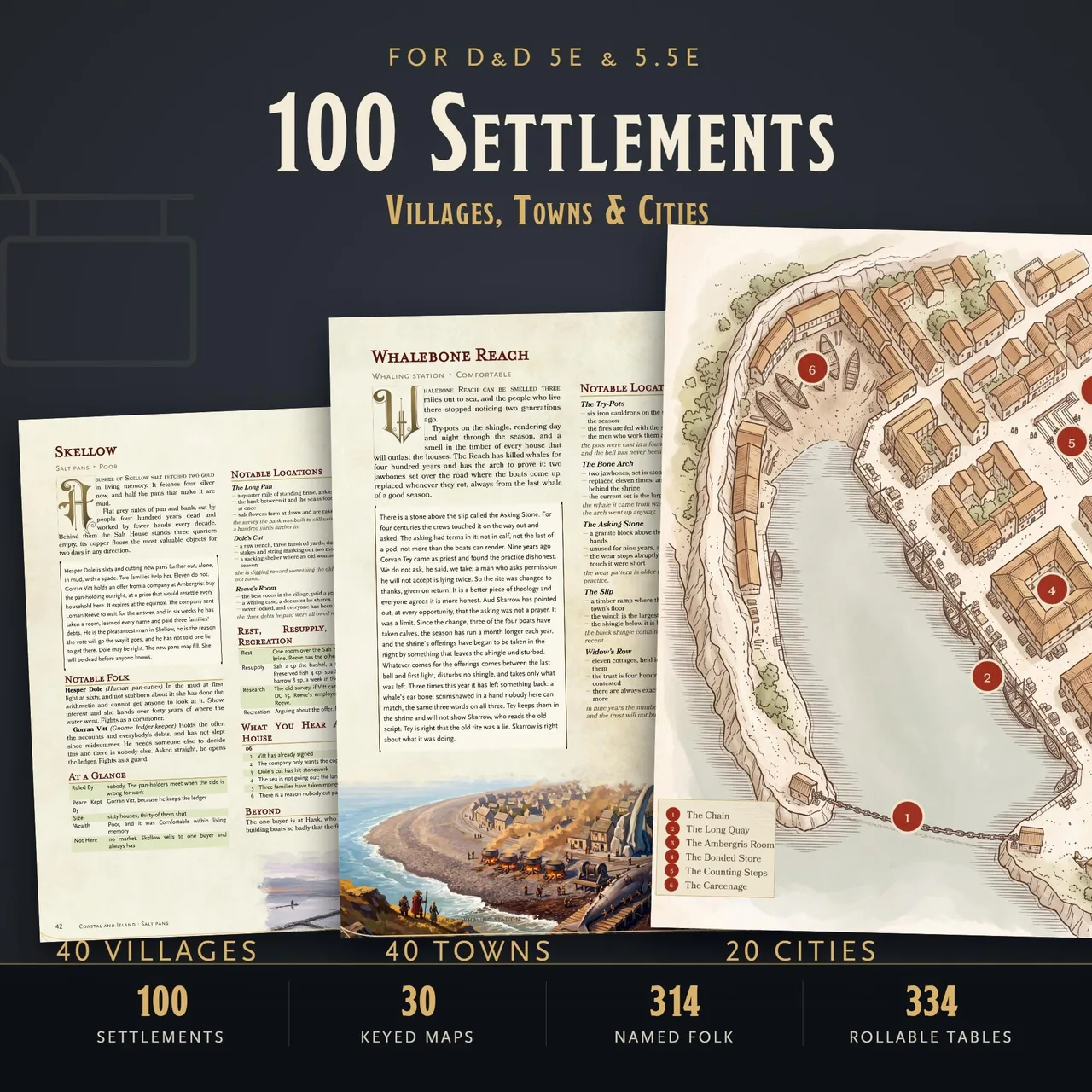
The alternative to building every settlement yourself is having a hundred of them ready to drop in — each with a map, a cast, its taverns and its local trouble already written. That is what the settlement compendium is for: the party goes somewhere you did not plan, and you have a town rather than an improvisation.
Three rumours
Every town gives the party three rumours. One is true, one is true but misleading, one is false.
This is an old technique and it survives because it does three jobs at once. It delivers plot hooks without an NPC standing up and announcing a quest. It teaches players that information in your world needs verifying, which makes them ask better questions. And it gives you a cheap way to seed things you have not written yet.
Write them as things people say, not as facts:
“The Vance boy went up to the old orchard and came back wrong.” “There’s Crown money coming. That’s why Harl’s been buying land.” “Nobody’s seen the miller’s wife since the spring.”
Three sentences. That is a session’s worth of hooks.
What to buy here
The practical function of a town is resupply, and this is where a lot of tables go vague. “You can buy anything on the equipment list” is a wasted opportunity — what a settlement stocks tells the players what kind of place it is.
A fishing village has rope, oil, salted rations and no armour. A garrison town has weapons, no luxuries and someone asking why you want them. A town near a mine has picks, lanterns and a black market in what comes out of the ground.
Our shop and tavern prices guide covers running this without it becoming a shopping session, and how to run a magic shop covers the harder case where the party has real money.
Maps: how much is enough
For most settlements, a rough sketch with five to eight labelled buildings is plenty. Players need to know where the inn is relative to the temple, not the street layout.
Draw a proper map when:
- The party will return repeatedly and you want the geography to become familiar
- A chase, a siege or a fire will happen in the streets
- The town’s shape is a clue — a wall on the wrong side, a district nobody built in
Otherwise, a list of locations beats a map. If you do want maps without drawing them, premade versus hand-drawn covers the trade-off, and the grid overlay tool will get a town map onto a virtual tabletop at the right scale when a street fight breaks out.
Making them come back
A town the party passes through is scenery. A town they return to is a character in the campaign. The difference is consequence.
Let it change without them. The thing they did in session four has visible results in session eleven. The NPC they helped has a better shop. The faction they crossed has hired someone.
Give them a stake. Property, a business share, a person they are responsible for. Ownership converts a location into a place they care about defending.
Leave something unresolved. Never tie off every thread. The miller’s wife is still missing. That is what brings them back.
This is the same engine that makes hub-based campaigns work — it is why Phandalin carries Lost Mine of Phandelver and why the town does more work than the adventures in Ghosts of Saltmarsh.
The fifteen-minute town
When the party goes somewhere you did not prepare:
- Name it. One word, and a reason for the name.
- Five NPCs. Shopkeeper, authority, gossip, problem, antagonist.
- One wrongness. Something specific that does not fit.
- Three rumours. True, misleading, false.
- What they sell. Three things you can buy here and one you cannot.
That is a settlement, and it will hold up for two sessions. If the party stays longer, you will have learned what they care about, and you can build the rest in the direction they are already looking — which is always better than the version you would have written in advance.
The short version
Towns are people, not places. Five NPCs with wants, one thing that is visibly wrong, three rumours and something the players own. Skip the population tables and the street plans. Prep the parts the players will touch, and let their theories build the rest — they are better at it than you are, and they will believe their own version.
Frequently asked questions
- How many NPCs does a D&D town need?
- Five. Players cannot hold more than that in their heads, and a town with five characters they know by name feels far more alive than one with twenty they do not. Add more only when the players ask about someone you have not invented yet.
- How do I make a D&D village memorable?
- Give it one thing that is wrong. A prosperous village where nobody will go near the mill, a fishing town whose boats all come back at the same hour, a farming village with no children. One specific anomaly does more work than five paragraphs of description.
- How long should I spend prepping a town?
- Fifteen minutes for a stop-over, an hour for a hub the party will return to. Anything more is usually detail the players will never touch. Prep the five NPCs, the one anomaly, and three rumours, then improvise the rest.
- What is the difference between a village, a town and a city in D&D?
- Functionally, it is what services are available and how much anonymity the party has. A village has one inn and no secrets; a town has specialists and factions; a city has everything and nobody notices you. Pick based on what the story needs, not on population figures.
- Should I draw a map of every town?
- No. A rough sketch with five to eight labelled buildings is enough for almost every settlement. Detailed town maps only pay off for hub settlements the party returns to repeatedly, or when a chase or a siege will happen in the streets.
- How do I make players return to a town?
- Give them something there that changes while they are away — a business they part-own, an NPC with an unresolved problem, or a faction whose fortunes shift based on what they did. Players return to places where their absence has consequences.
Keep reading
From the shop
Battlemaps, spell cards, and magic item cards, ready to print.
Browse MakeMythic on Etsy →