Nord Games Ultimate Bestiary and NPCs: worth it, or print cards?
Nord Games' Ultimate books are $50 hardcovers packed with monsters and NPCs. Here's what a book gives you that cards can't, and where cards win at the table.
Nord Games have built a solid reputation on the principle that the core bestiary is thin in a specific way: it gives you one goblin. Their Ultimate Bestiary series expands familiar creature types into whole ecologies — Revenge of the Horde on gnolls, goblins, kobolds, orcs and trolls; The Dreaded Accursed, 268 pages of undead and cursed things; Secrets of the Fey. Listed around $50 each in hardcover, often discounted heavily.
The Ultimate NPCs line does the same for people, with Skulduggery listed at $50.
They are genuinely useful books. The question is what problem you are trying to solve, because “I need better monsters” and “I need to run this fight without losing my place” are different complaints with different answers.
What a sourcebook does that cards cannot
Variety within a type. This is the whole pitch and it is a good one. Twelve distinct goblins with different roles, tactics and stat blocks turns a goblin ambush from a repeated encounter into a varied one. No card deck gives you that depth of a single creature family.
Lore and context. Why these creatures organise the way they do, what they want, how they fight together. That is what turns a stat block into an encounter, and it needs pages.
Design guidance. How to build encounters with the material, what pairs well, what breaks. Sourcebooks teach; cards do not.
Reference density. 268 pages holds far more than a deck.
If your problem is that your monsters feel interchangeable, a book is the correct purchase and cards will not fix it.
What cards do that a book cannot
Lie flat, several at once. This is the entire practical argument, and it is stronger than it sounds. A fight with a goblin boss, four goblins, two worgs and a shaman is four stat blocks. A book opens to one page. Cards sit in front of you side by side, in initiative order, all visible.
Survive the table. A card gets picked up, moved, put down next to the initiative tracker. A book has to stay open at a page while you also need the page about something else.
Get handed to players. Some DMs run with monster cards face-down and flip them as creatures are identified. You cannot do that with a hardcover.
Print in quantity. Six identical goblins, six identical cards, each tracking its own damage.
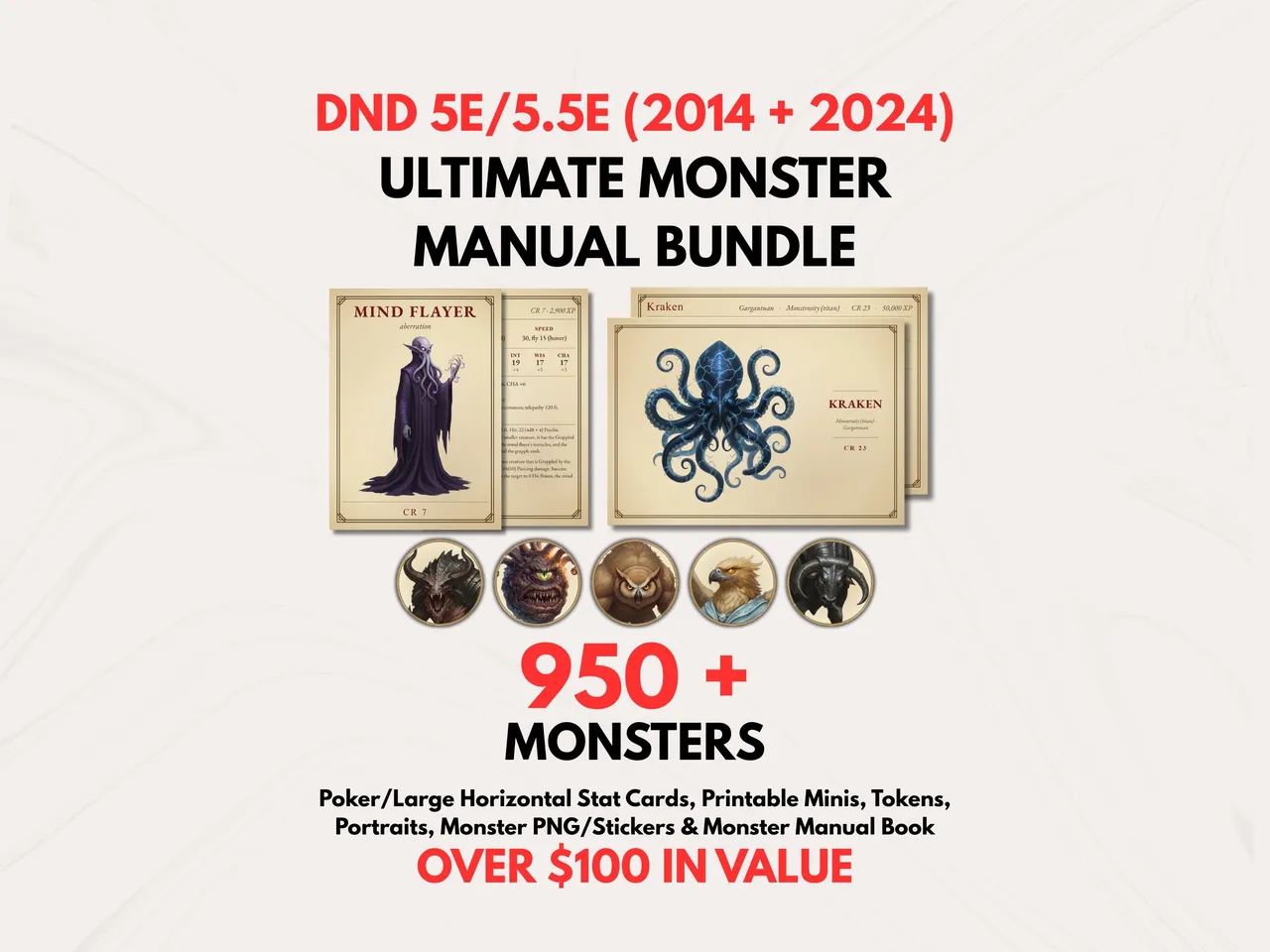
The edition point matters here. Many creatures were revised between the 2014 and 2024 rules, so a card set covering both is the difference between a reference you trust mid-combat and one you have to check. More on running them in how to use monster stat cards.
The NPC side
The same split applies, but the balance shifts.
An NPC sourcebook gives you fully realised characters with histories, motivations and hooks. That is a lot of words per NPC, and you will use maybe a dozen of them across a campaign.
What you actually need at the table, constantly, is a face and a stat block for someone the party just decided to talk to. That is a card, or a name generator, not a 300-page book you have to search under time pressure.

For the improvisation side, the free NPC name generator covers the name, and how to do NPC voices covers making them distinct without exhausting yourself.
Start free, then decide which problem you have
Before spending on either, work out which complaint is actually yours. The free monster reference covers the SRD bestiary and costs nothing, and there are 20 free illustrated monster cards on Patreon with matching tokens if you want to test whether the card format helps you before buying a set.
Run three sessions and note what went wrong:
- “The fights are samey and my monsters feel generic.” → Sourcebook. Buy the Ultimate Bestiary volume covering the creatures you use.
- “I keep losing my place and combat drags.” → Cards. Our guide to speeding up combat covers the rest of that problem.
- “Both.” → Cards first, because they are cheaper and fix a problem you have every single session. The book fixes one you have every few months.
The combination that works
Most experienced DMs end up with a book for depth and cards for the table, and use them at different times: the book during prep, when you have time to read and pick; the cards during play, when you have none.
Buying the book and then reading from it mid-combat is the failure mode. That is what the flipping and the “hang on, let me find it” comes from — a reference designed for reading being used as a reference for reacting.
Frequently asked questions
- What is Nord Games' Ultimate Bestiary?
- It is a series of 5e monster sourcebooks that expand familiar creature types with far more depth and variety. Titles include Revenge of the Horde, covering gnolls, goblins, kobolds, orcs and trolls, The Dreaded Accursed at 268 pages covering undead and cursed creatures, and Secrets of the Fey. Listed at around $50 each, frequently discounted.
- What are Ultimate NPCs books?
- A companion series of fully fleshed-out non-player characters ready to drop into a campaign. Ultimate NPCs: Skulduggery is listed at $50 in hardcover, with PDF versions of the series available for less.
- Are monster sourcebooks better than monster cards?
- They do different jobs. A sourcebook gives you depth — lore, variants, tactics and design context you cannot fit on a card. A card gives you a stat block you can lay on the table and read at a glance mid-combat. Most DMs eventually want both, in that order of purchase.
- How do you run a fight with several monster types without flipping pages?
- Lay the stat blocks out side by side. Cards do this natively — one card per creature type in front of you, in initiative order. A book cannot be open at four pages at once, which is the single practical argument for cards.
- Do monster cards include the 2024 stat blocks?
- It depends on the set. Look for one covering both 2014 and 2024 stat blocks, since many creatures were revised, and a card that disagrees with your rulebook is worse than no card at all.
- What is the cheapest way to expand your monster roster?
- The SRD covers a large number of creatures for free, and free monster references online index them. Paid expansion is worth it when you want variety within a creature type — twelve distinct goblins rather than one goblin stat block used twelve times.
Keep reading
From the shop
Battlemaps, spell cards, and magic item cards, ready to print.
Browse MakeMythic on Etsy →