Book of Battle Mats vs digital battlemaps: which is better value?
Loke's wipe-clean battle mat books are brilliant and cover about 60 maps for £22-£24. Digital libraries cover thousands. Here's when each one is the right buy.
Loke’s battle mat books are a genuinely good product and it is worth saying so up front. Spiral-bound, wipe-clean, they lie flat, they take miniatures, you draw on them with a wet-erase pen, and pages combine into bigger layouts. The Big Book range runs around 58-62 maps at an RRP of roughly £22-£24.
For a group that plays in person and wants zero setup, that is close to an ideal object.
But “which is better value” depends almost entirely on how you play, and the two options fail in completely different places.
What a map book is unbeatable at
Zero setup. Open the book, find a page, play. No printer, no screen, no cables, no scaling. That is worth more than it sounds when your session starts at eight and someone is still parking.
Drawing on it. This is the underrated feature. Wet-erase means you add the door, the furniture, the burning wagon, the spell effect — and wipe it afterwards. A printed map is fixed; a digital map on a screen needs software to annotate. A map book is the only one of the three you can just draw on.
Physical durability. It works at a pub table, a friend’s kitchen, a convention. No battery, no failure mode.
Minis sit on it properly. Flat, rigid, gridded at the right scale.
Where a map book runs out
Coverage. Sixty maps sounds like a lot until you run weekly. That is roughly a year at one new map a session, and in practice you will reuse the good pages and skip the ones that never fit. Buying more books gets expensive fast, and each new book is another ~£22 for another ~60.
Specificity. Books are generic by design — a tavern, a forest clearing, a dungeon corridor. When the campaign calls for a skydock, an infernal foundry or a specific ship deck, a generic book cannot deliver it. You improvise, which is fine, but it is not the map you wanted.
It does not go online. A physical book cannot be a Foundry scene. If any of your sessions are remote, this is a hard limit.
Fixed scale. The page is the size the page is. You cannot print it bigger for a set-piece fight.
What a digital library changes
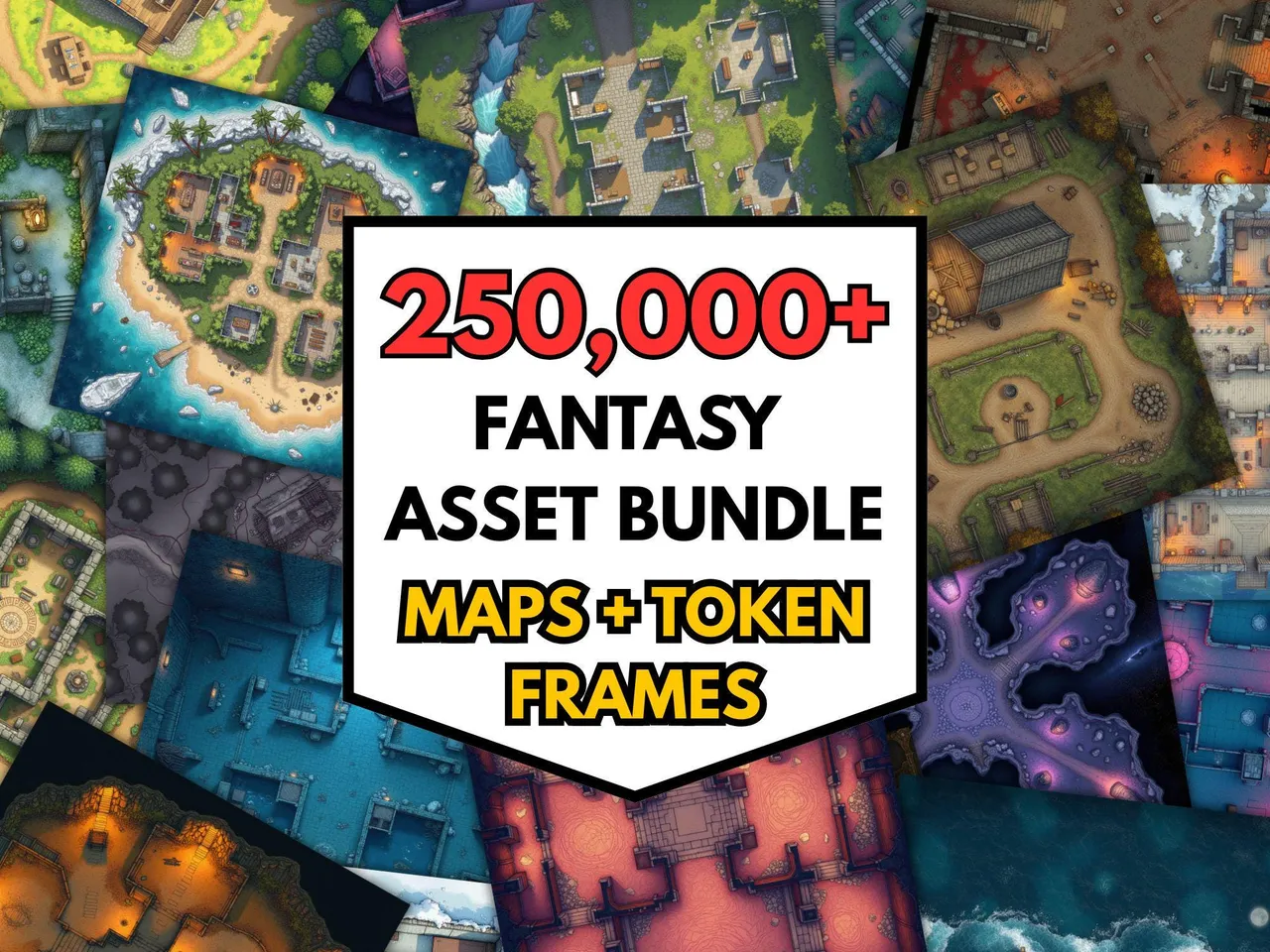
Coverage stops being a constraint. The difference between sixty maps and a library measured in thousands is not incremental — it changes what you prep. You stop asking “which of my maps is closest to this scene?” and start asking “what does this scene look like?”
Specificity. Themed coverage means the cyberpunk skydock, the arctic tundra, the infernal hellscape and the tavern interior all exist as actual maps rather than approximations.
It works everywhere. The same file is a Foundry scene, a Roll20 upload, a TV display, or a printed sheet. One purchase, every table configuration — which matters given how many groups now run hybrid.
Any size you want. Print a corridor on one sheet or a boss arena across nine. The map splitter tiles it for you and the grid overlay puts a correctly scaled grid on anything.
The trade is honest: you need either a printer or a screen, and there is setup.
The setup question, answered cheaply
The objection to digital is always “but I play in person.” The standard answer is a cheap TV laid flat under a sheet of perspex, and it is a smaller job than most people expect — a second-hand screen, a piece of acrylic, and the map scaled so one grid square is one inch.
Once that exists, digital maps stop having a downside at a physical table, and you keep the ability to draw on them via the perspex with a dry-erase pen. Our guide to battlemaps on a TV or projector covers the build, and the tabletop display tool handles the scaling.
If a screen is not happening, printing is the fallback — see how big should a D&D battlemap be for getting the scale right.
The actual recommendation
Play in person, casually, no printer, no screen? Buy the book. It is the right product and this comparison does not apply to you.
Play weekly, or online at all, or want specific locations? Digital. Sixty generic maps will not carry a campaign, and the per-map cost of buying more books is not competitive.
Play weekly in person and enjoy drawing on maps? Both, honestly. The book handles the improvised “they went somewhere I didn’t prep” scene, and the digital library handles everything you planned. That combination costs less than three map books and covers every situation.
What to do first
If you are starting from nothing, the order that gets you playing fastest:
- Grab a free map or two and run a session — the maps page has samples and the free tools cover the rest.
- Use the grid overlay to size anything you already own correctly.
- Decide whether you are a screen table or a print table. That answer determines everything else.
- Buy coverage once you know which.
More on building the library in building a D&D battlemap library.
Frequently asked questions
- What are Loke's Books of Battle Mats?
- They are spiral-bound books of wipe-clean, gridded battle maps that lie flat on a table, published by Loke Battle Mats. Pages combine into larger maps, and you draw on them with wet-erase pens. The Big Book range typically carries around 58-62 maps at an RRP of roughly £22-£24.
- How many maps do you get in a Book of Battle Mats?
- It varies by title, but the Big Book range is generally in the 58 to 62 map region. Modular sets are designed so that facing pages join into larger playing areas, which effectively increases the number of usable layouts beyond the raw page count.
- Are digital battlemaps better than printed map books?
- Neither is better outright. Map books need no printer, no screen and no setup, and are unbeatable for a pick-up game. Digital libraries offer vastly more coverage, work on a VTT, and can be printed or displayed at any size — but they require a display or a printer to use.
- Can you use digital battlemaps at an in-person table?
- Yes, in two ways. Print them across multiple sheets and tape them together, or display them on a TV laid flat under the table or a projector overhead. A cheap TV under glass is the most common setup and it is a significant upgrade.
- What size should a printed battlemap be?
- One inch per grid square is the standard so miniatures and tokens fit correctly. A 20 by 30 square map at that scale is 20 by 30 inches, which needs tiling across several sheets of A4 or Letter — a map splitter tool handles the tiling for you.
- Do map books work with miniatures?
- Yes, and it is one of their strengths. The pages are flat and rigid enough to stand minis on, and the wipe-clean surface means you can draw doors, furniture and effects directly onto the map and erase them afterwards.
Keep reading
From the shop
Battlemaps, spell cards, and magic item cards, ready to print.
Browse MakeMythic on Etsy →