How Big Should a D&D Battlemap Be? Grid and Sizing
How big a D&D battlemap should be: grid square scale, common map dimensions, resolution for print and VTT, and how to size maps for a TV or tabletop.
“How big should a battlemap be?” is really two questions: how big is a square, and how big is the whole map. The first has a firm answer that everything else hangs off; the second depends on the scene and how you display it. Get the square right and the rest follows. Here’s the full sizing logic for print, TV, and virtual tabletops.
The square is the fixed point
One grid square equals five feet in D&D, and the physical standard is one inch per square, because that’s the scale miniatures are built for. A 25–28mm figure stands naturally on a one-inch square. This single number drives everything:
- A character with 30 feet of speed moves six squares.
- A Medium creature occupies one square; a Large creature a 2×2 block.
- A 15-foot-radius spell covers a 3-square radius.
If the square is sized wrong, every one of those breaks — minis crowd or float, and movement stops matching the rules. So whatever else you decide, lock the square to one inch (physical) or to the VTT’s five-foot grid (digital). Our grid overlay tool lets you set this precisely on any image.
How big should the whole map be?
For the overall map, there’s a practical sweet spot rather than a rule. Most encounter maps run 20×20 to 30×30 squares — that’s 100 to 150 feet across. That gives room for movement, ranged attacks, and positioning without the map sprawling past the edge of your table or screen.
Why not bigger? Two reasons. In person, a very large map won’t fit on a TV or a table, so you end up panning, which kills the at-a-glance clarity that’s the whole point. On a VTT, oversized maps get slow to navigate and players lose track of the action. Save the genuinely large maps for set-pieces that need the space — a siege, a sprawling cavern — and keep everyday encounters in the 20–30 square range.
Shape is free: square maps suit rooms and arenas, rectangular maps suit roads, corridors, and shorelines. Match the shape to the scene’s location rather than forcing a ratio.
Resolution: keeping it sharp
Size in squares is one thing; size in pixels or dots is what keeps a map from looking blurry.
Virtual tabletops: the common baseline is 70 pixels per grid square. A 30×30 map at 70 ppi is about 2100×2100 pixels. Some packs ship at 140 ppi for crisper zoom. Crucially, never upscale a small image to hit these numbers — it looks fine zoomed out and falls apart when players zoom in. More detail on this in battlemaps for Roll20 and Foundry.
Printing: target at least 150 dpi at final print size. A map printed at 24 inches wide wants to be around 3600 pixels across at the source. If you’re tiling a big map across several sheets, the map splitter handles the page breaks.
Sizing for a TV or projector
A flat TV is the most popular modern in-person setup, and it has a hard constraint: the screen’s physical size. A 55-inch TV laid flat shows roughly a 24×13 inch play area — so about 24×13 one-inch squares visible at once. That comfortably fits a 20×20-ish encounter; a 30×30 map will need slight scaling or panning.
The setup step is simple: display the map and scale it until one square measures one inch against a ruler on the glass. Then standard minis sit correctly. We cover the full TV and projector workflow in battlemaps on a TV or projector, and our tabletop display tool is built for exactly this second-screen setup.
Let your maps come pre-sized
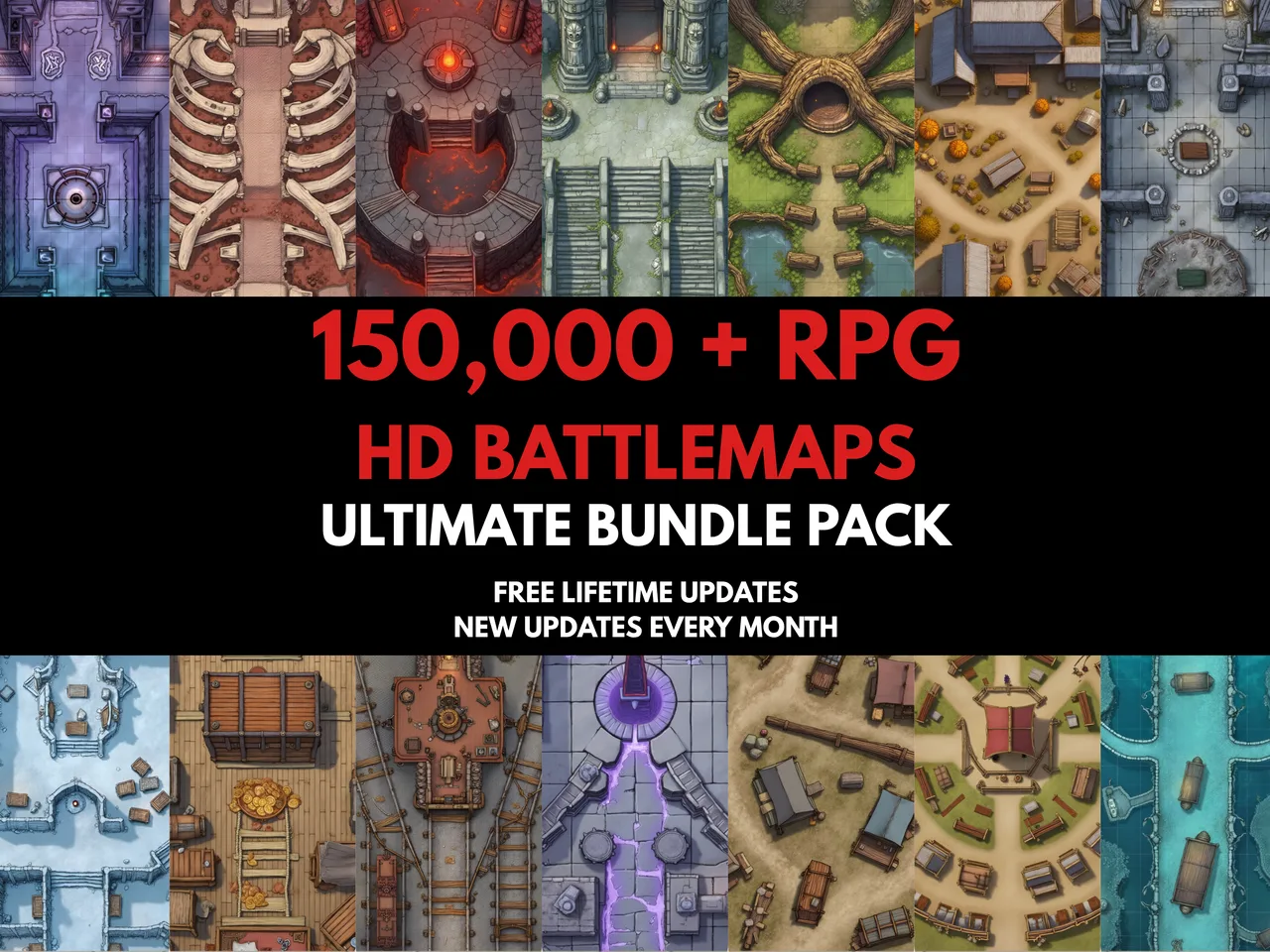
Getting all of this right yourself — square scale, sensible dimensions, print and VTT resolution — is real work per map. Pre-made battlemap packs that are already built to the standard (one-inch grid, VTT-ready resolution, sensible encounter dimensions) skip the sizing problem entirely: you drop the map in and it’s correct.
The short answer
One-inch squares, 20×30 squares for most encounters, 70+ ppi for VTTs and 150+ dpi for print, scaled to a literal inch on whatever you display on. Nail the square and everything else is just fitting the scene to your screen. Next, read how to use a battlemap as a new DM to run it smoothly once it’s sized.
Frequently asked questions
- How big should a D&D battlemap grid square be?
- One inch per square is the standard, matching the 5-foot square D&D uses and standard 25–28mm miniatures. On a printed map or a flat TV, the square should physically measure one inch; on a virtual tabletop, you align the map to the VTT grid so each square represents five feet.
- What is a good size for a D&D battlemap?
- Most encounter maps fall between 20x20 and 30x30 squares, which is 100 to 150 feet across — enough room for movement and positioning without sprawling off the table. Larger set-pieces can go bigger, but very large maps get hard to display in person and slow to navigate.
- What resolution should a battlemap be?
- For virtual tabletops, 70 pixels per grid square is the common baseline, so a 30x30 map is around 2100x2100 pixels, with 140 ppi packs giving sharper zoom. For printing, aim for at least 150 dpi at final print size so the map stays crisp on paper.
- How do I size a battlemap on a TV?
- Display the map and scale it until one grid square measures one inch with a ruler on the screen, so standard miniatures fit. A 55-inch TV laid flat shows roughly a 24x13 inch play area, so very large maps may need to be panned or scaled down to fit the visible region.
- Should battlemaps be square or rectangular?
- Either works. Square maps suit contained rooms and arenas, while rectangular maps suit roads, corridors, and shorelines. Match the shape to the scene rather than forcing a fixed ratio, and make sure the playable area fits your display or print area.
- Why does battlemap size matter for miniatures?
- Miniatures are built to a scale where a 25–28mm figure stands on a one-inch square representing five feet. If the grid is sized wrong, figures either crowd together or float in oversized squares, and movement distances stop matching the rules. Correct sizing keeps minis and the grid in sync.
From the shop
Battlemaps, spell cards, and magic item cards, ready to print.
Browse MakeMythic on Etsy →