Which D&D campaign should I run? A DM's comparison
An honest comparison of the major published D&D 5e campaigns — difficulty to run, prep load, tone, length and who each one actually suits. Pick the right one first time.
The question behind “which campaign should I run” is almost never about quality. All the major 5e campaigns are competently made. The question is which one matches how much prep you can do each week, how long your group will realistically keep meeting, and what your players want out of a game.
Here is what each one actually asks of you.
The short answer
| Campaign | Levels | Prep load | Best for |
|---|---|---|---|
| Dragon of Icespire Peak | 1–6 | Low | First-time DMs, groups testing D&D |
| Lost Mine of Phandelver | 1–5 | Low | First-time DMs who want a proper story |
| Curse of Strahd | 1–10 | Medium | Tables who want a real antagonist |
| The Wild Beyond the Witchlight | 1–8 | Medium | Groups who dislike combat |
| Ghosts of Saltmarsh | 1–12 | Medium | Nautical campaigns, episodic play |
| Icewind Dale | 1–12 | Medium–high | Survival, horror, strong first act |
| Waterdeep: Dragon Heist | 1–5 | High | Experienced DMs who like improvising |
| Tomb of Annihilation | 1–11 | High | Tables who want genuine lethality |
The easy ones
Dragon of Icespire Peak is a job board. Three quests are available, the party picks one, you prepare that one. You never hold more than a single location in your head, and each session has a clean beginning and end. It is the lowest-stress campaign in print and it finishes in eight to twelve sessions, which matters more than people admit — a group that finishes something is far more likely to start another. Our full guide to running it covers which quests to cut.
Lost Mine of Phandelver is the better story and slightly more work. It has a proper three-act shape, a memorable villain in the Black Spider, and Phandalin, which is the best small town published for 5e. The Redbrand hideout is a genuinely good first dungeon. The DM guide covers the pacing problems in the middle.
Run either of these first. Then run the other one, combined, in the same region — they share Phandalin and slot together neatly.
The great one
Curse of Strahd is still the high-water mark. Barovia is small, bounded and fully described, so the sandbox never sprawls. Strahd is the only 5e villain who is present throughout rather than waiting at the end. The Tarokka reading randomises three major elements, so no two runs are the same and the DM cannot be spoiled by a player who has read the book.
What it asks of you: tonal control. Barovia is gothic horror and it collapses instantly into comedy if you let it. It also expects you to play Strahd as an intelligent recurring presence, which means improvising him in scenes rather than reading a statblock. Our guide to running it covers the Tarokka reading and the pacing of Strahd’s appearances.
Not for a first campaign, but a very good second one.
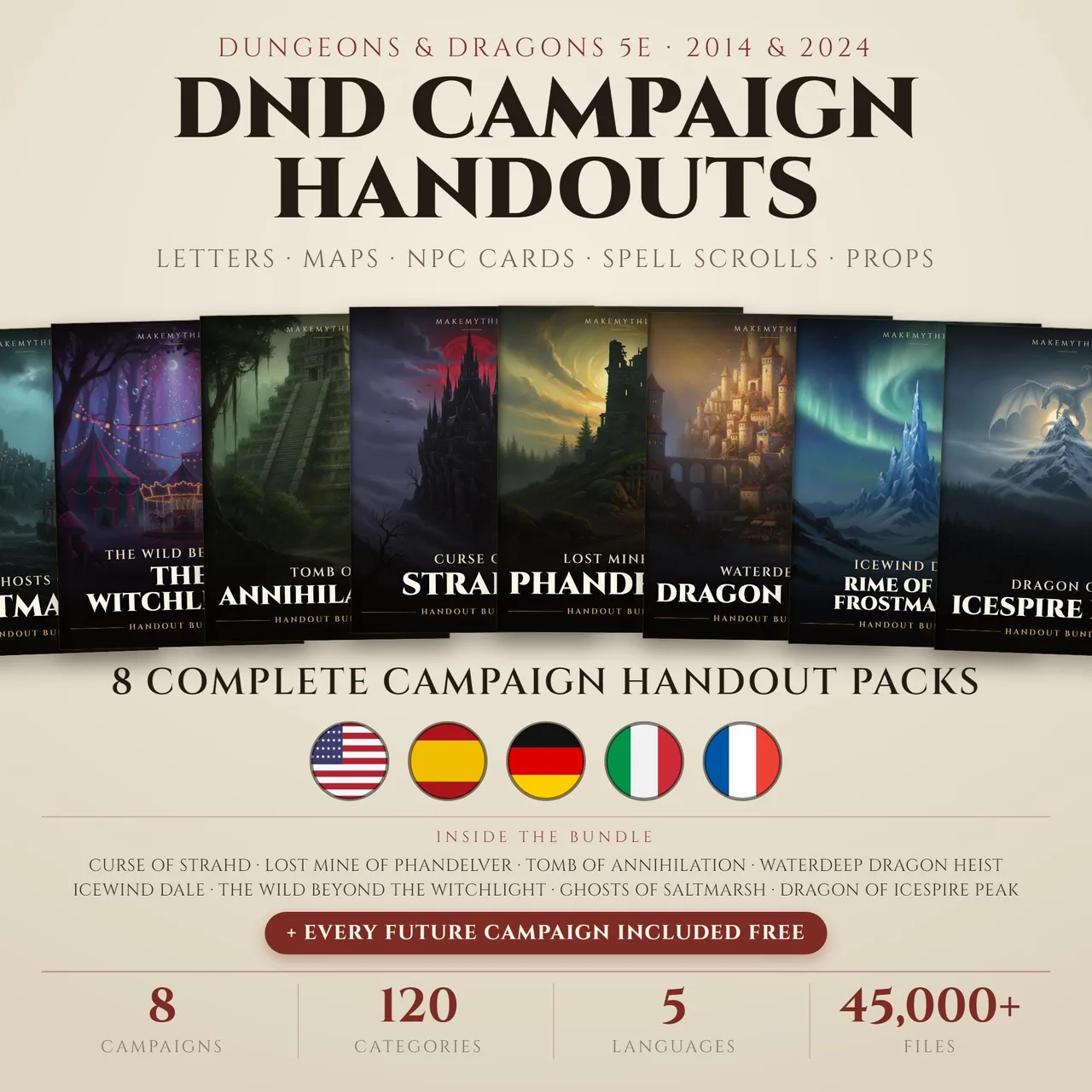
If you expect to run more than one of these — and most DMs do, over a few years — the per-campaign handout bundles add up fast. The combined bundle covers all eight campaigns on this page: props, letters, maps, NPC cards, tokens and paper minis for Strahd, Saltmarsh, Icespire Peak, Phandelver, Tomb of Annihilation, Dragon Heist, Icewind Dale and Witchlight in one download.
The specialist ones
The Wild Beyond the Witchlight is the campaign you can run for people who do not enjoy combat. It is explicitly written so that the entire adventure can be completed without a single fight, and the Feywild setting gives you licence for logic that would be nonsense anywhere else. Excellent for younger players, mixed groups, and tables burnt out on encounter balance. Weak if your players want a tactical game — the running guide covers where to add teeth.
Ghosts of Saltmarsh is an anthology, not a campaign, which is either a feature or a problem depending on your group. If people miss sessions, episodic adventures are far kinder than a continuous plot. It also has the best naval rules in 5e. The work is connecting the seven adventures, which the Saltmarsh guide handles through the town’s three factions.
Icewind Dale: Rime of the Frostmaiden has the strongest opening act of any 5e campaign — ten isolated towns in permanent darkness, each with a secret, and genuine survival pressure. It also has a notorious second half that changes genre abruptly. Run the first act, and be ready to make choices about the rest. See running Rime of the Frostmaiden and the cold weather survival rules.
The demanding ones
Waterdeep: Dragon Heist is short, brilliant at the edges, and hollow in the middle. The first chapter is excellent, the finale is excellent, and between them is a city, a faction war, and a great deal of blank space that you fill. Experienced DMs love it because it is a framework for the campaign they wanted to run anyway. New DMs frequently stall in chapter two. The running guide covers how to structure the middle.
Tomb of Annihilation is the lethal one. A death curse on a timer, hex-crawl jungle travel with supply and disease tracking, and a final megadungeon that kills characters with traps rather than monsters. Tables that want danger love it. It demands the most bookkeeping of any campaign here — see the running guide and the hex coordinates tool for the travel half.
How to actually choose
Three questions, in this order.
How much prep can you do in a week? Be honest, and assume the honest answer is less than you hope. If it is under an hour, run Icespire Peak or Phandelver. Everything else will start well and stall around session eight.
How long will this group keep meeting? Most groups do not last a year. A campaign that takes 50 sessions will probably not finish. That is fine if everyone knows it, and demoralising if they expected an ending. Short campaigns finish, and finishing feels good.
What do your players want? Ask them in a session zero rather than guessing. A table that wants tactical combat will be bored by Witchlight. A table that wants roleplay and intrigue will resent Tomb of Annihilation. This is the single most common reason a campaign fails, and it is the easiest to avoid.
Before you commit
Read the whole book first — not the first chapter. Every campaign here has a structural problem somewhere in the second half, and knowing about it in advance is the difference between adjusting for it and being ambushed by it in month four.
Then do the cheap prep that pays off across any campaign: decide how you will prep sessions fast, get your battlemap workflow sorted before session one rather than during session three, and set up a recap habit so the plot survives the gaps between sessions.
The short version
Pick for prep load first, length second, tone third. Icespire Peak and Phandelver to learn. Curse of Strahd when you are ready for something great. Witchlight for a table that does not want to fight. Dragon Heist and Tomb of Annihilation only when you are confident improvising. The best campaign is the one you will still be running in month six.
Frequently asked questions
- What is the best D&D campaign for a first-time DM?
- Dragon of Icespire Peak or Lost Mine of Phandelver. Both are short, low-level, and structured so you only prepare a small amount at a time. Icespire Peak has the lighter prep load; Phandelver has the better story.
- What is the hardest published D&D campaign to run?
- Waterdeep: Dragon Heist and Tomb of Annihilation, for opposite reasons. Dragon Heist is a sandbox city adventure with a famously thin middle that the DM has to fill; Tomb of Annihilation demands constant bookkeeping for the death curse, hex travel and a lethal megadungeon.
- Which D&D campaign is the most popular?
- Curse of Strahd, consistently, and it has been since 2016. It has the strongest antagonist in 5e, a tightly bounded setting, and a structure that rewards player choice without becoming a sandbox.
- How long does a published D&D campaign take to finish?
- Most run 30 to 60 sessions at levels 1 to 10 or higher, which is a year or more of weekly play. Short campaigns like Dragon of Icespire Peak finish in eight to twelve. Most tables never finish a long campaign, which is worth knowing before you start one.
- Should I run a published campaign or write my own?
- Run a published one first. You learn pacing, encounter balance and how much prep a session actually takes using someone else's structure, which is far cheaper than learning it on material you are emotionally invested in.
- Do published campaigns work with the 2024 rules?
- Yes. The adventures themselves are ruleset-agnostic — maps, NPCs, plots and locations do not change. You update monster statblocks to the 2024 Monster Manual versions and adjust for the slightly stronger player characters, which usually means adding a monster rather than rewriting anything.
Keep reading
From the shop
Battlemaps, spell cards, and magic item cards, ready to print.
Browse MakeMythic on Etsy →